Verified Solution • 2025–26 Session moderate

QJEEM25Phf402: JEE Main 2025 Physics - Class 11 JEEM25Phf402 Solution: A poly-atomic molecule , where is gas constant) goes from phase …
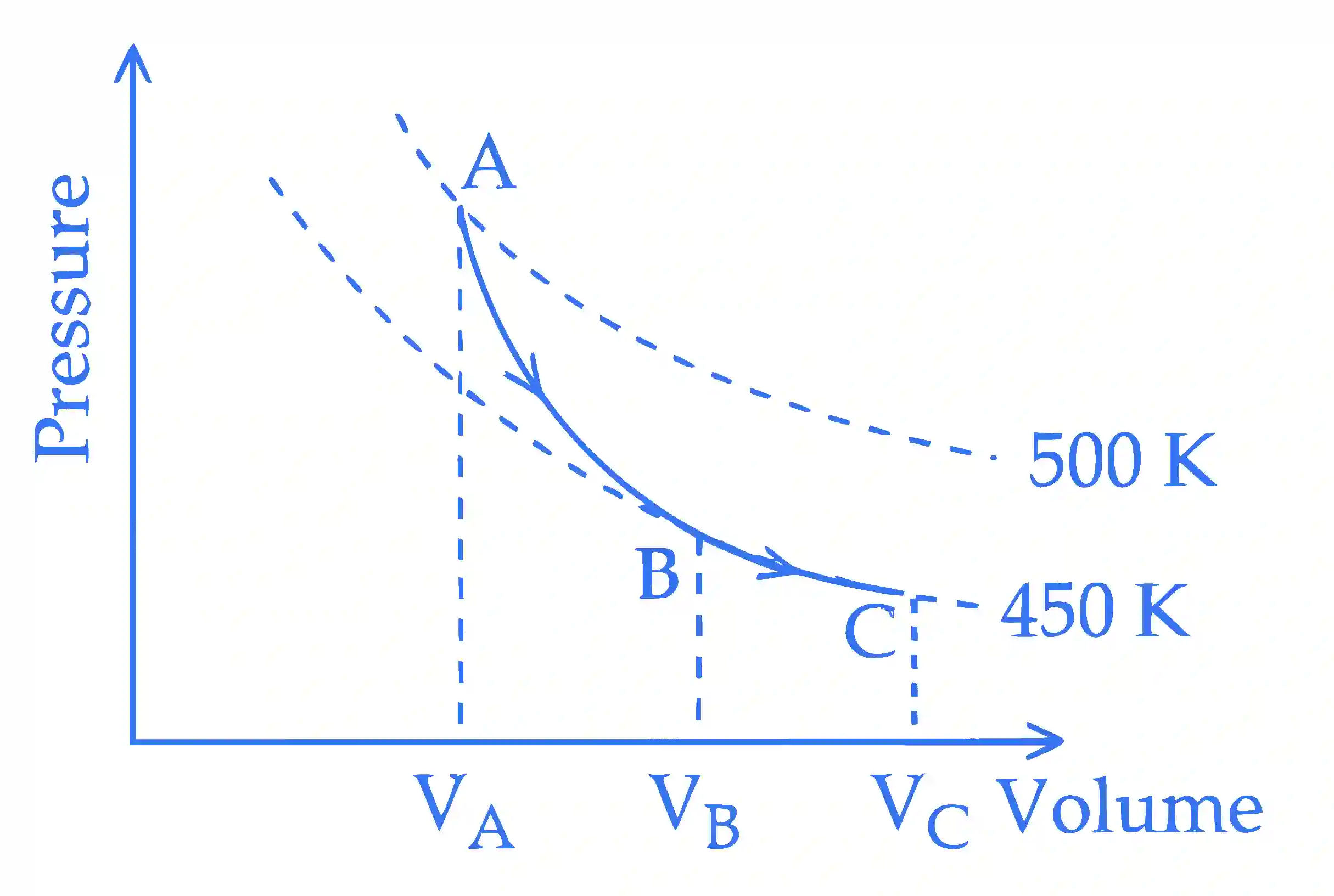
JEE Main 2025 (Online) 29th January Evening Shift Physics - Heat and Thermodynamics Question 23 English

A poly-atomic molecule (CV=3R,CP=4R\left(C_V=3 R, C_P=4 R\right. , where RR is gas constant) goes from phase space point A(PA=105 Pa, VA=4×10⁻⁶ m3)\mathrm{A}\left(\mathrm{P}_{\mathrm{A}}=10^5 \mathrm{~Pa}, \mathrm{~V}_{\mathrm{A}}=4 \times 10^{-6} \mathrm{~m}^3\right) to point B(PB=5×10⁴ Pa, VB=6×10⁻⁶ m3)\mathrm{B}\left(\mathrm{P}_{\mathrm{B}}=5 \times 10^4 \mathrm{~Pa}, \mathrm{~V}_{\mathrm{B}}=6 \times 10^{-6} \mathrm{~m}^3\right) to point C(PC=104\mathrm{C}\left(\mathrm{P}_{\mathrm{C}}=10^4\right. Pa,VC=8×10⁻⁶ m3\mathrm{Pa}, \mathrm{V}_C=8 \times 10^{-6} \mathrm{~m}^3 ). A to BB is an adiabatic path and BB to CC is an isothermal path.

The net heat absorbed per unit mole by the system is :

Multiple Choice Options

  • A 500R(ln⁡3+ln⁡4)500 \mathrm{R}(\ln 3+\ln 4)
  • B 450R(ln⁡4−ln⁡3)450 \mathrm{R}(\ln 4-\ln 3)
  • C 500Rln⁡2500 \mathrm{R} \ln 2
  • D 400Rln⁡4400 \mathrm{R} \ln 4

Step-by-Step Verified Solution

As A to B is can adiabatic path,

So, ΔQA→B=o\Delta {Q_{A \to B}} = o .... (1)

So, now we need to find the heat absorbed for the isothermal path (B to C)

We know, change in internal energy

Δu=mcvΔT\Delta u = m{c_v}\Delta T

⇒Δu=o\Rightarrow \Delta u = o (for isothermal as ΔT=o\Delta T = o )

Now, using Ist law of thermodynamics

ΔQ=Δu+w\Delta Q = \Delta u + w

⇒ΔQ=o+w⇒ΔQ=w\Rightarrow \Delta Q = o + w \Rightarrow \Delta Q = w

So, ΔQB→C=WB→C\Delta {Q_{B \to C}} = {W_{B \to C}}

=nRTln⁡(vCvB)= nRT\ln \left( {{{{v_C}} \over {{v_B}}}} \right)

⇒ΔQB→C=nR(450)ln⁡(43)\Rightarrow \Delta {Q_{B \to C}} = nR(450)\ln \left( {{4 \over 3}} \right)

⇒ΔQB→C=450nRln⁡(43)\Rightarrow \Delta {Q_{B \to C}} = 450nR\ln \left( {{4 \over 3}} \right) .... (2)

So net heat absorbed,

Q=ΔQA→B+ΔQB→CQ = \Delta {Q_{A \to B}} + \Delta {Q_{B \to C}}

⇒Q=450nRln⁡(43)\Rightarrow Q = 450nR\ln \left( {{4 \over 3}} \right) ... (from 1 and 2)

Net heat absorbed per mole,

⇒Qn=450R(ln⁡4−ln⁡3)\Rightarrow {Q \over n} = 450R(\ln 4 - \ln 3) .

Option 2 is correct.

Related Learning Resources & Exam Preparation