Verified Solution • 2025–26 Session moderate

QJEEM25Ph5552: JEE Main 2025 Physics - Class 12 JEEM25Ph5552 Solution: A point particle of charge is located at along the axis of an…

A point particle of charge QQ is located at PP along the axis of an electric dipole 1 at a distance rr as shown in the figure. The point P is also on the equatorial plane of a second electric dipole 2 at a distance r. The dipoles are made of opposite charge q separated by a distance 2a2 a . For the charge particle at P not to experience any net force, which of the following correctly describes the situation?
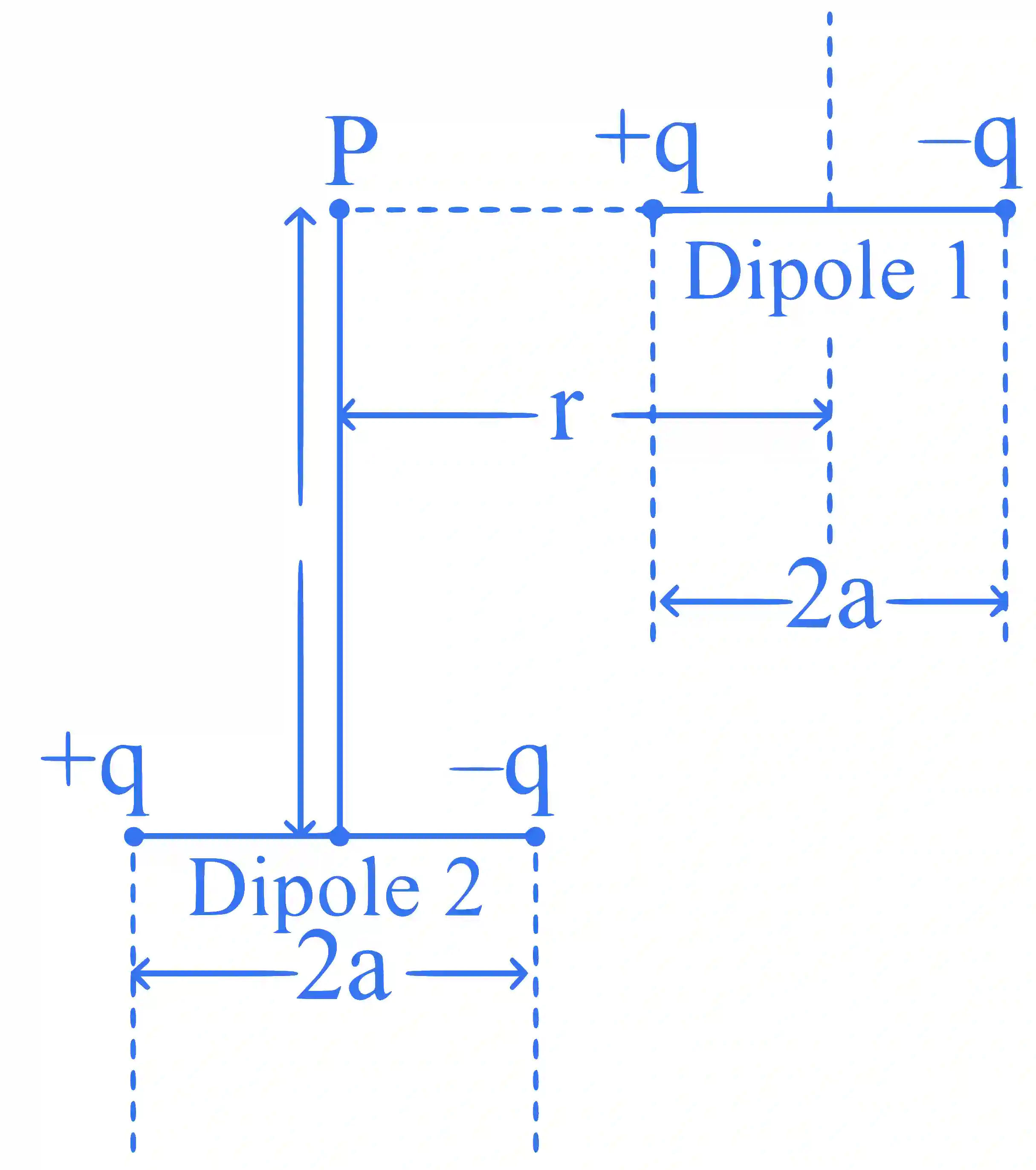
JEE Main 2025 (Online) 23rd January Morning Shift Physics - Electrostatics Question 9 English

Multiple Choice Options

  • A ar∼0.5\frac{a}{r} \sim 0.5
  • B ar∼3\frac{a}{r} \sim 3
  • C ar∼10\frac{a}{r} \sim 10
  • D ar∼20\frac{a}{r} \sim 20

Step-by-Step Verified Solution

JEE Main 2025 (Online) 23rd January Morning Shift Physics - Electrostatics Question 9 English Explanation

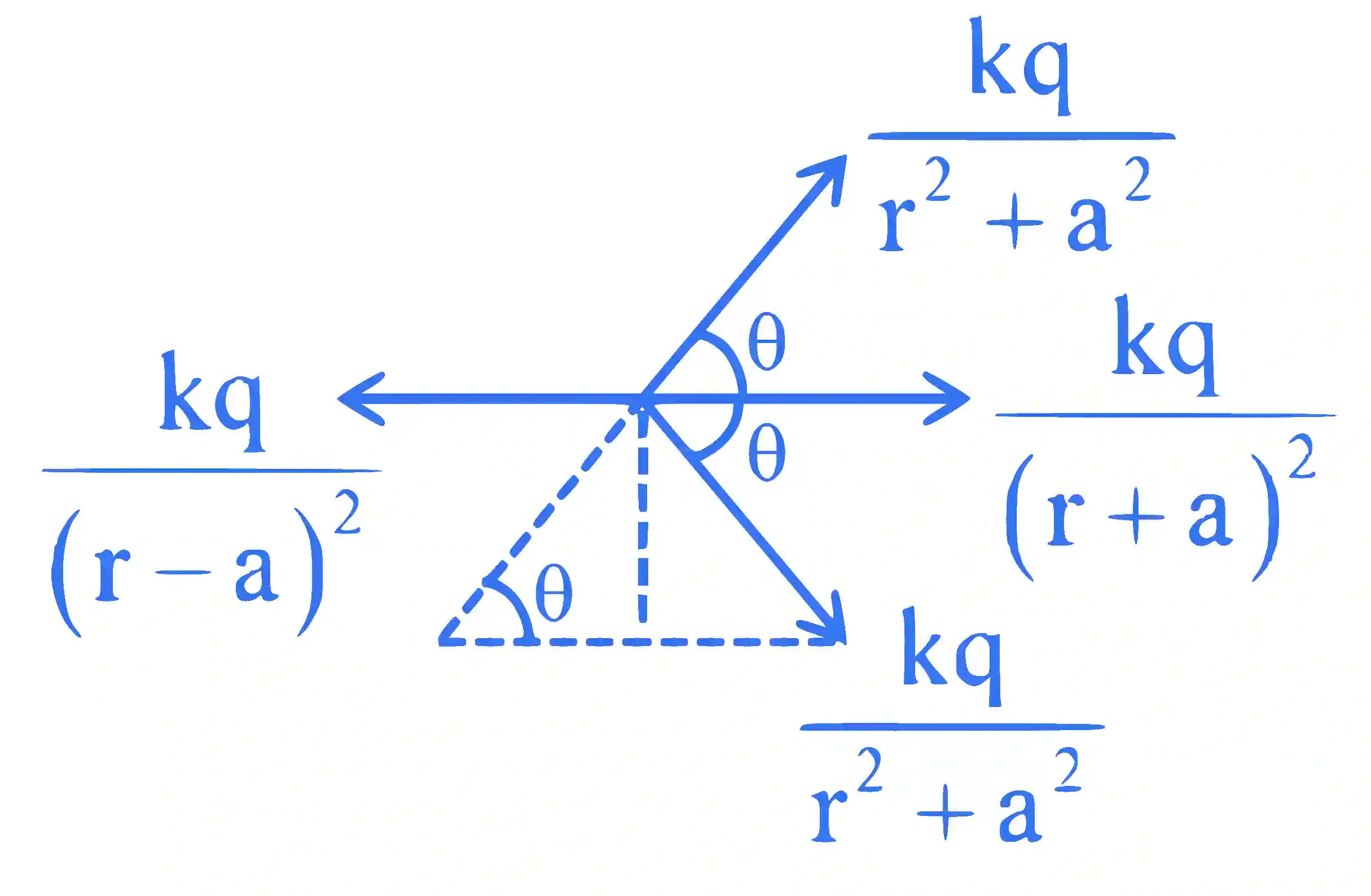
amp;kq(r−a)2=kq(r+a)2+2kq(r2+a2)cos⁡θamp;1(r−a)2=1(r+a)2+2a(r2+a2)32amp;1(r−a)2−1(r+a)2=2a(r2+a2)32amp;4ra(r2−a2)2=2a(r2+a2)32\begin{aligned} & \frac{\mathrm{kq}}{(\mathrm{r}-\mathrm{a})^2}=\frac{\mathrm{kq}}{(\mathrm{r}+\mathrm{a})^2}+\frac{2 \mathrm{kq}}{\left(\mathrm{r}^2+\mathrm{a}^2\right)} \cos \theta \\ & \frac{1}{(\mathrm{r}-\mathrm{a})^2}=\frac{1}{(\mathrm{r}+\mathrm{a})^2}+\frac{2 \mathrm{a}}{\left(\mathrm{r}^2+\mathrm{a}^2\right)^{\frac{3}{2}}} \\ & \frac{1}{(\mathrm{r}-\mathrm{a})^2}-\frac{1}{(\mathrm{r}+\mathrm{a})^2}=\frac{2 \mathrm{a}}{\left(\mathrm{r}^2+\mathrm{a}^2\right)^{\frac{3}{2}}} \\ & \frac{4 \mathrm{ra}}{\left(\mathrm{r}^2-\mathrm{a}^2\right)^2}=\frac{2 \mathrm{a}}{\left(\mathrm{r}^2+\mathrm{a}^2\right)^{\frac{3}{2}}}\end{aligned}

amp;⇒2r(r2−a2)2=1(r2+a2)32amp;4r2(r2−a2)4=1(r2+a2)3amp;⇒4r2(r2+a2)3=(r2−a2)4amp;4r8(1+a2r2)3=r8(1−a2r2)4amp;4(1+a2r2)3=(1−a2r2)4\begin{aligned} & \Rightarrow \frac{2 r}{\left(r^2-a^2\right)^2}=\frac{1}{\left(r^2+a^2\right)^{\frac{3}{2}}} \\ & \frac{4 r^2}{\left(r^2-a^2\right)^4}=\frac{1}{\left(r^2+a^2\right)^3} \\ & \Rightarrow 4 r^2\left(r^2+a^2\right)^3=\left(r^2-a^2\right)^4 \\ & 4 r^8\left(1+\frac{a^2}{r^2}\right)^3=r^8\left(1-\frac{a^2}{r^2}\right)^4 \\ & 4\left(1+\frac{a^2}{r^2}\right)^3=\left(1-\frac{a^2}{r^2}\right)^4\end{aligned}

Exact value cannot be solved in exam for this equation to be true

\left|\frac{\mathrm{a}}{\mathrm{r}}\right|>1 \Rightarrow \mathrm{a}>\mathrm{r}

But point charge QQ lies between charges of dipole

1 hence electric field cannot be zero.

There for it should be bonus.

But by solving from mathematical software we are getting a/r≈3\mathrm{a} / \mathrm{r} \approx 3 .

Related Learning Resources & Exam Preparation