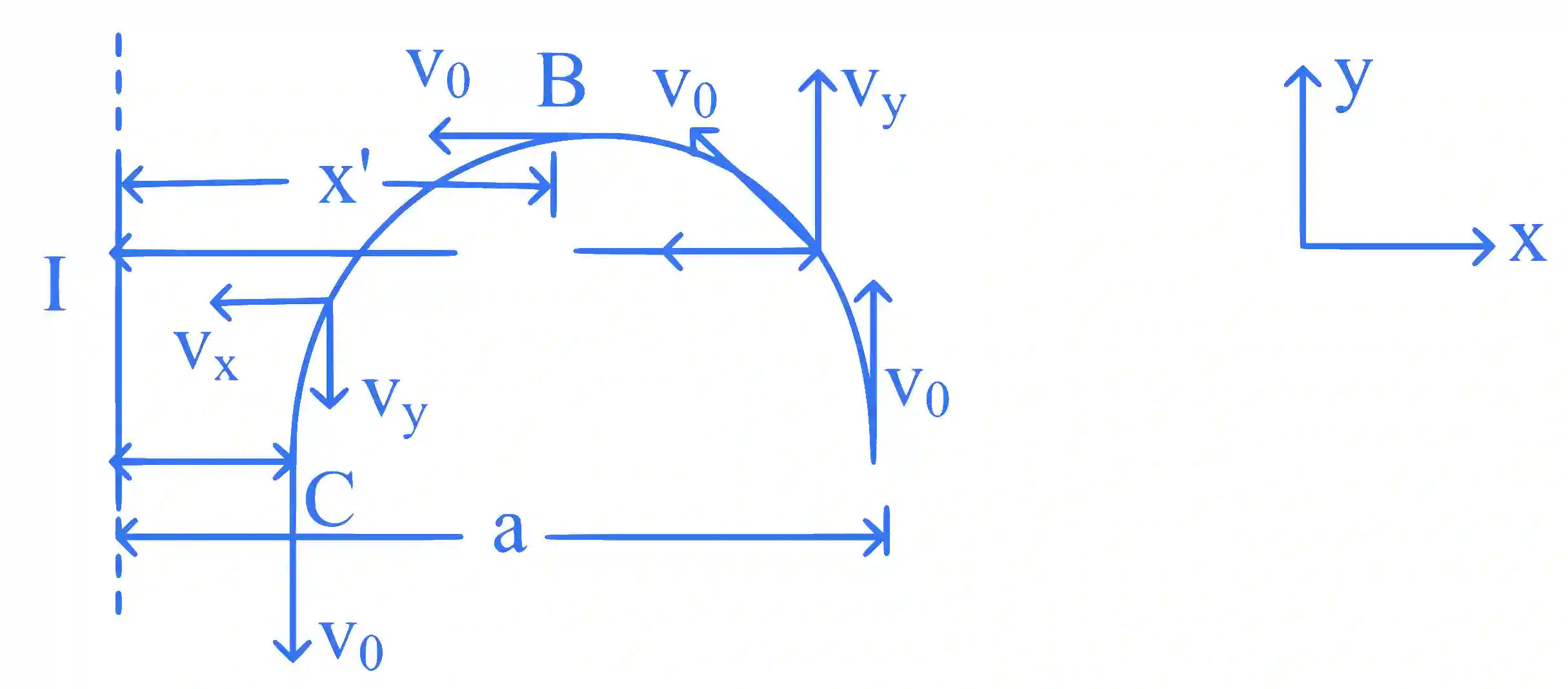
For A → B A \to B A → B
V → = − v x i ^ + v y j ^ \overrightarrow V = - {v_x}\widehat i + {v_y}\widehat j V = − v x i + v y j
B → = μ 0 I 2 π r ( − k ^ ) \overrightarrow B = {{{\mu _0}I} \over {2\pi r}}\left( { - \widehat k} \right) B = 2 π r μ 0 I ( − k )
∵ \because ∵ F → = q ( v → × B → ) \overrightarrow F = q\left( {\overrightarrow v \times \overrightarrow B } \right) F = q ( v × B )
So, F → = q μ 0 I 2 π r [ [ ( − v x ) i ^ + v y j ^ ] × ( − k ^ ) ] \overrightarrow F = {{q{\mu _0}I} \over {2\pi r}}\left[ {\left[ {\left( { - {v_x}} \right)\widehat i + {v_y}\widehat j} \right] \times \left( { - \widehat k} \right)} \right] F = 2 π r q μ 0 I [ [ ( − v x ) i + v y j ] × ( − k ) ]
= q μ 0 I 2 π r [ v x ( i ^ × k ^ ) − v y ( j ^ × k ^ ) ] = {{q{\mu _0}I} \over {2\pi r}}\left[ {{v_x}\left( {\widehat i \times \widehat k} \right) - {v_y}\left( {\widehat j \times \widehat k} \right)} \right] = 2 π r q μ 0 I [ v x ( i × k ) − v y ( j × k ) ]
F → = q μ 0 I 2 π r [ − v x j ^ − v y i ^ ] \overrightarrow F = {{q{\mu _0}I} \over {2\pi r}}\left[ { - {v_x}\widehat j - {v_y}\widehat i} \right] F = 2 π r q μ 0 I [ − v x j − v y i ]
⇒ F x = − μ 0 I q 2 π r v y \Rightarrow {F_x} = {{ - {\mu _0}Iq} \over {2\pi r}}{v_y} ⇒ F x = 2 π r − μ 0 I q v y
⇒ m a x = − μ 0 I q 2 π r v y \Rightarrow m{a_x} = {{ - {\mu _0}Iq} \over {2\pi r}}{v_y} ⇒ m a x = 2 π r − μ 0 I q v y
⇒ v x d v x d r = − μ 0 I q 2 π m v y r \Rightarrow {v_x}{{d{v_x}} \over {dr}} = {{ - {\mu _0}Iq} \over {2\pi m}}{{{v_y}} \over r} ⇒ v x d r d v x = 2 πm − μ 0 I q r v y
⇒ v x d v x v y = − μ 0 I q 2 π m d r r \Rightarrow {{{v_x}d{v_x}} \over {{v_y}}} = {{ - {\mu _0}Iq} \over {2\pi m}}{{dr} \over r} ⇒ v y v x d v x = 2 πm − μ 0 I q r d r
Since, v x 2 + v y 2 = v 0 2 v_x^2 + v_y^2 = v_0^2 v x 2 + v y 2 = v 0 2
⇒ v y = v 0 2 − v x 2 \Rightarrow {v_y} = \sqrt {v_0^2 - v_x^2} ⇒ v y = v 0 2 − v x 2
⇒ ∫ 0 v 0 v x d v x v 0 2 − v x 2 = − μ 0 I q 2 π m ∫ a x ′ d r r \Rightarrow \int_0^{{v_0}} {{{{v_x}d{v_x}} \over {\sqrt {v_0^2 - v_x^2} }} = {{ - {\mu _0}Iq} \over {2\pi m}}\int_a^{x'} {{{dr} \over r}} } ⇒ ∫ 0 v 0 v 0 2 − v x 2 v x d v x = 2 πm − μ 0 I q ∫ a x ′ r d r
Let v 0 2 − v x 2 = z 2 v_0^2 - v_x^2 = {z^2} v 0 2 − v x 2 = z 2
⇒ − 2 v x d v x = 2 z d z \Rightarrow - 2{v_x}d{v_x} = 2zdz ⇒ − 2 v x d v x = 2 z d z
when v x = 0 , z = v 0 {v_x} = 0,\,z = {v_0} v x = 0 , z = v 0
v x = v 0 , z = 0 {v_x} = {v_0},\,z = 0 v x = v 0 , z = 0
⇒ ∫ v 0 0 z d z z = − μ 0 I q 2 π m ∫ a x ′ d r r \Rightarrow \int_{{v_0}}^0 {{{zdz} \over z} = - {{{\mu _0}Iq} \over {2\pi m}}\int_a^{x'} {{{dr} \over r}} } ⇒ ∫ v 0 0 z z d z = − 2 πm μ 0 I q ∫ a x ′ r d r
⇒ − v 0 = μ 0 I q 2 π m ln ( x ′ a ) \Rightarrow - {v_0} = {{{\mu _0}Iq} \over {2\pi m}}\ln \left( {{{x'} \over a}} \right) ⇒ − v 0 = 2 πm μ 0 I q ln ( a x ′ )
⇒ ln ( x ′ a ) = − 2 π m v 0 μ 0 I q \Rightarrow \ln \left( {{{x'} \over a}} \right) = - {{2\pi m{v_0}} \over {{\mu _0}Iq}} ⇒ ln ( a x ′ ) = − μ 0 I q 2 πm v 0
⇒ x ′ = a c − 2 π m v 0 μ 0 I q \Rightarrow x' = ac{{ - 2\pi m{v_0}} \over {{\mu _0}Iq}} ⇒ x ′ = a c μ 0 I q − 2 πm v 0 .... (1)
Now, for B → C B \to C B → C
v → = − v x i ^ − v y j ^ \overrightarrow v = - {v_x}\widehat i - {v_y}\widehat j v = − v x i − v y j
B → = μ 0 I 2 π r ( − k ^ ) \overrightarrow B = {{{\mu _0}I} \over {2\pi r}}\left( { - \widehat k} \right) B = 2 π r μ 0 I ( − k )
F → = q ( v → × B → ) = q μ 0 I 2 π r [ v x ( i ^ × k ^ ) + v y ( j ^ × k ^ ) ] \overrightarrow F = q\left( {\overrightarrow v \times \overrightarrow B } \right) = {{q{\mu _0}I} \over {2\pi r}}\left[ {{v_x}\left( {\widehat i \times \widehat k} \right) + {v_y}\left( {\widehat j \times \widehat k} \right)} \right] F = q ( v × B ) = 2 π r q μ 0 I [ v x ( i × k ) + v y ( j × k ) ]
⇒ F → = μ 0 I q 2 π r [ − v x j ^ + v y i ^ ] \Rightarrow \overrightarrow F = {{{\mu _0}Iq} \over {2\pi r}}\left[ { - {v_x}\widehat j + {v_y}\widehat i} \right] ⇒ F = 2 π r μ 0 I q [ − v x j + v y i ]
⇒ F x = μ 0 I q 2 π r v y \Rightarrow {F_x} = {{{\mu _0}Iq} \over {2\pi r}}{v_y} ⇒ F x = 2 π r μ 0 I q v y
⇒ v x d v x d r = μ 0 I q 2 π m v y r \Rightarrow {v_x}{{d{v_x}} \over {dr}} = {{{\mu _0}Iq} \over {2\pi m}}{{{v_y}} \over r} ⇒ v x d r d v x = 2 πm μ 0 I q r v y
∫ v 0 0 v x d v x v 0 2 − v x 2 = μ 0 I q 2 π m ∫ x ′ x d r r \int_{{v_0}}^0 {{{{v_x}d{v_x}} \over {\sqrt {v_0^2 - v_x^2} }} = {{{\mu _0}Iq} \over {2\pi m}}\int_{x'}^x {{{dr} \over r}} } ∫ v 0 0 v 0 2 − v x 2 v x d v x = 2 πm μ 0 I q ∫ x ′ x r d r
Let v 0 2 − v x 2 = z 2 v_0^2 - v_x^2 = {z^2} v 0 2 − v x 2 = z 2
− 2 v x d v x = 2 z d z - 2{v_x}d{v_x} = 2zdz − 2 v x d v x = 2 z d z
v x = v 0 ⇒ z = 0 {v_x} = {v_0} \Rightarrow z = 0 v x = v 0 ⇒ z = 0
v x = 0 ⇒ z = v 0 {v_x} = 0 \Rightarrow z = {v_0} v x = 0 ⇒ z = v 0
⇒ − ∫ 0 v 0 z d z z = μ 0 I q 2 π m [ ln r ] x ′ x \Rightarrow - \int_0^{{v_0}} {{{zdz} \over z} = {{{\mu _0}Iq} \over {2\pi m}}\left[ {\ln r} \right]_{x'}^x} ⇒ − ∫ 0 v 0 z z d z = 2 πm μ 0 I q [ ln r ] x ′ x
⇒ − v 0 = μ 0 I q 2 π m ln ( x x ′ ) \Rightarrow - {v_0} = {{{\mu _0}Iq} \over {2\pi m}}\ln \left( {{x \over {x'}}} \right) ⇒ − v 0 = 2 πm μ 0 I q ln ( x ′ x )
⇒ x = x ′ e − 2 π m v 0 μ 0 I q \Rightarrow x = x'{e^{ - {{2\pi m{v_0}} \over {{\mu _0}Iq}}}} ⇒ x = x ′ e − μ 0 I q 2 πm v 0 .... (2)
From (1) & (2), x = a e − 4 π m v 0 μ 0 I q x = a{e^{ - {{4\pi m{v_0}} \over {{\mu _0}Iq}}}} x = a e − μ 0 I q 4 πm v 0