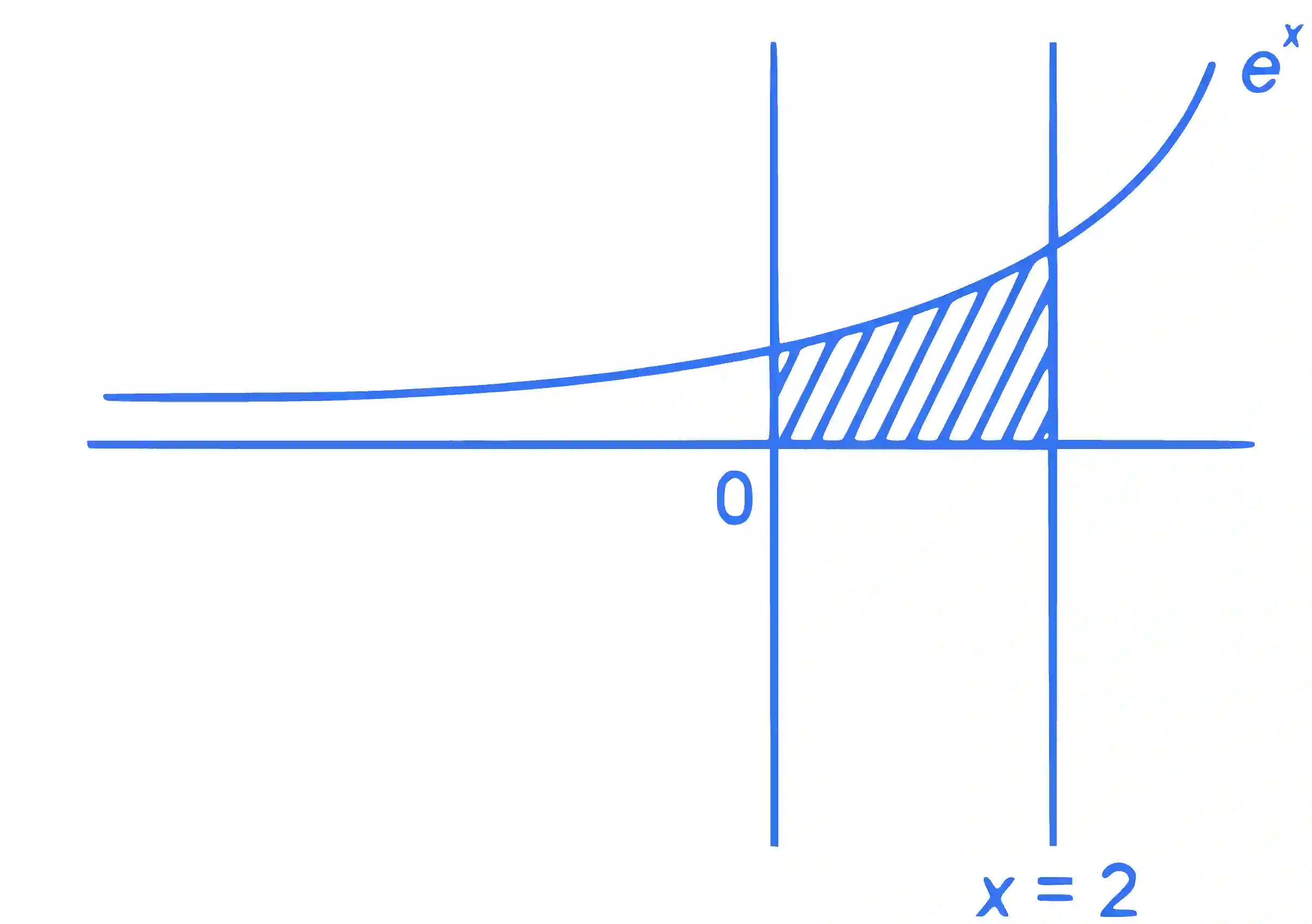
Let f:R→R be a twice differentiable function such that f(x+y)=f(x)f(y) for all x,y∈R . If f′(0)=4a and f satisfies f^{\prime \prime}(x)-3 \mathrm{a} f^{\prime}(x)-f(x)=0, \mathrm{a}>0 , then the area of the region R={(x,y)∣0≤y≤f(ax),0≤x≤2} is :
Step-by-Step Verified Solution
amp;f(x+y)=f(x)f(y)amp;⇒f(x)=eλxf′(0)=4aamp;⇒f′(x)=λeλx⇒λ=4a
So, f(x)=e4ax
amp;f′′(x)−3af′(x)−f(x)=0amp;⇒λ2−3aλ−1=0amp;⇒16a2−12a2−1=0⇒4a2=1⇒a=21
 amp;F(x)=e2xamp; Area =∫02exdx=e2−1