Verified Solution • 2025–26 Session moderate

QJEEM24Phc862: JEE Main 2024 Physics - Class 11 JEEM24Phc862 Solution: One end of a metal wire is fixed to a ceiling and a load of…

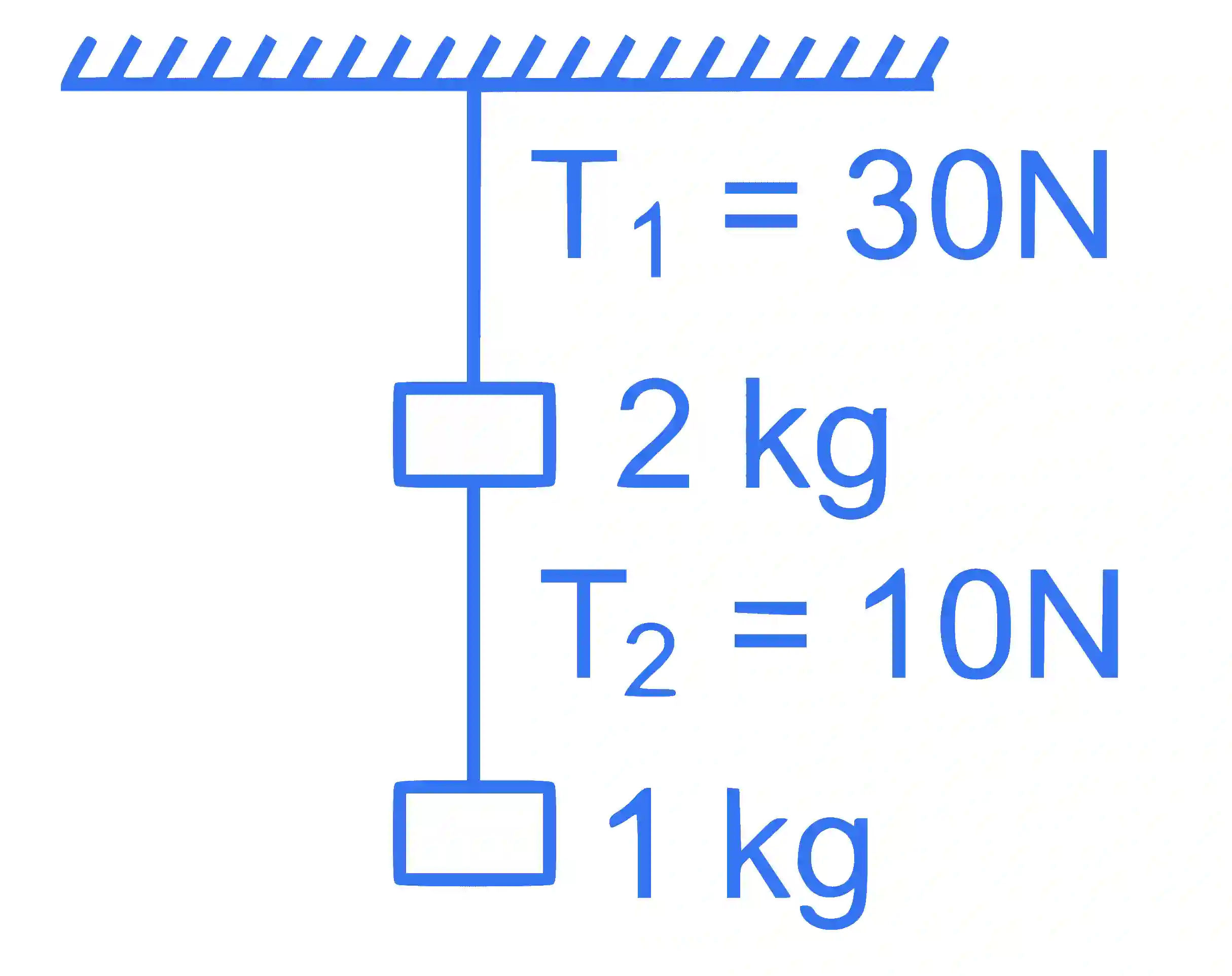
One end of a metal wire is fixed to a ceiling and a load of 2 kg2 \mathrm{~kg} hangs from the other end. A similar wire is attached to the bottom of the load and another load of 1 kg1 \mathrm{~kg} hangs from this lower wire. Then the ratio of longitudinal strain of upper wire to that of the lower wire will be ________.

[Area of cross section of wire =0.005 cm2,Y=2×10¹¹Nm−2=0.005 \mathrm{~cm}^2, \mathrm{Y}=2 \times 10^{11} \mathrm{Nm}^{-2} and g=10 ms−2\mathrm{g}=10 \mathrm{~ms}^{-2} ]

Step-by-Step Verified Solution

JEE Main 2024 (Online) 1st February Evening Shift Physics - Properties of Matter Question 57 English Explanation

To solve this problem, we use the fact that the longitudinal strain in a wire is given by the formula:

Strain=ΔLL=FAY\text{Strain} = \frac{\Delta L}{L} = \frac{F}{AY}

where ΔL\Delta L is the change in length, LL is the original length, FF is the force applied, AA is the area of cross-section of the wire, and YY is the Young's modulus of the material of the wire.

The force applied by each load due to gravity is calculated using F=mgF = mg , where mm is the mass of the load and gg is the acceleration due to gravity ( 10 m/s210 \text{ m/s}^2 in this case).

For the upper wire, the total force applied is the weight of both masses (2 kg and 1 kg):

F1=(2 kg+1 kg)×10 m/s2=30 NF_1 = (2 \text{ kg} + 1 \text{ kg}) \times 10 \text{ m/s}^2 = 30 \text{ N}

For the lower wire, the force applied is just the weight of the 1 kg mass:

F2=1 kg×10 m/s2=10 NF_2 = 1 \text{ kg} \times 10 \text{ m/s}^2 = 10 \text{ N}

Since the area AA and Young's modulus YY are the same for both wires, these values cancel out when we calculate the ratio of the strains. Therefore, the ratio of the strains is directly proportional to the ratio of the forces:

Strain of upper wireStrain of lower wire=F1F2=30 N10 N=3\frac{\text{Strain of upper wire}}{\text{Strain of lower wire}} = \frac{F_1}{F_2} = \frac{30 \text{ N}}{10 \text{ N}} = 3

Hence, the ratio of longitudinal strain of the upper wire to that of the lower wire is 3.

Related Learning Resources & Exam Preparation