QJEEM24Ph96d1: JEE Main 2024 Physics - Class 11 JEEM24Ph96d1 Solution: A heavy iron bar of weight is having its one end on the ground…
A heavy iron bar of weight is having its one end on the ground and the other on the shoulder of a man. The rod makes an angle with the horizontal, the weight experienced by the man is :
Multiple Choice Options
- A
- B
- C
- D
Step-by-Step Verified Solution
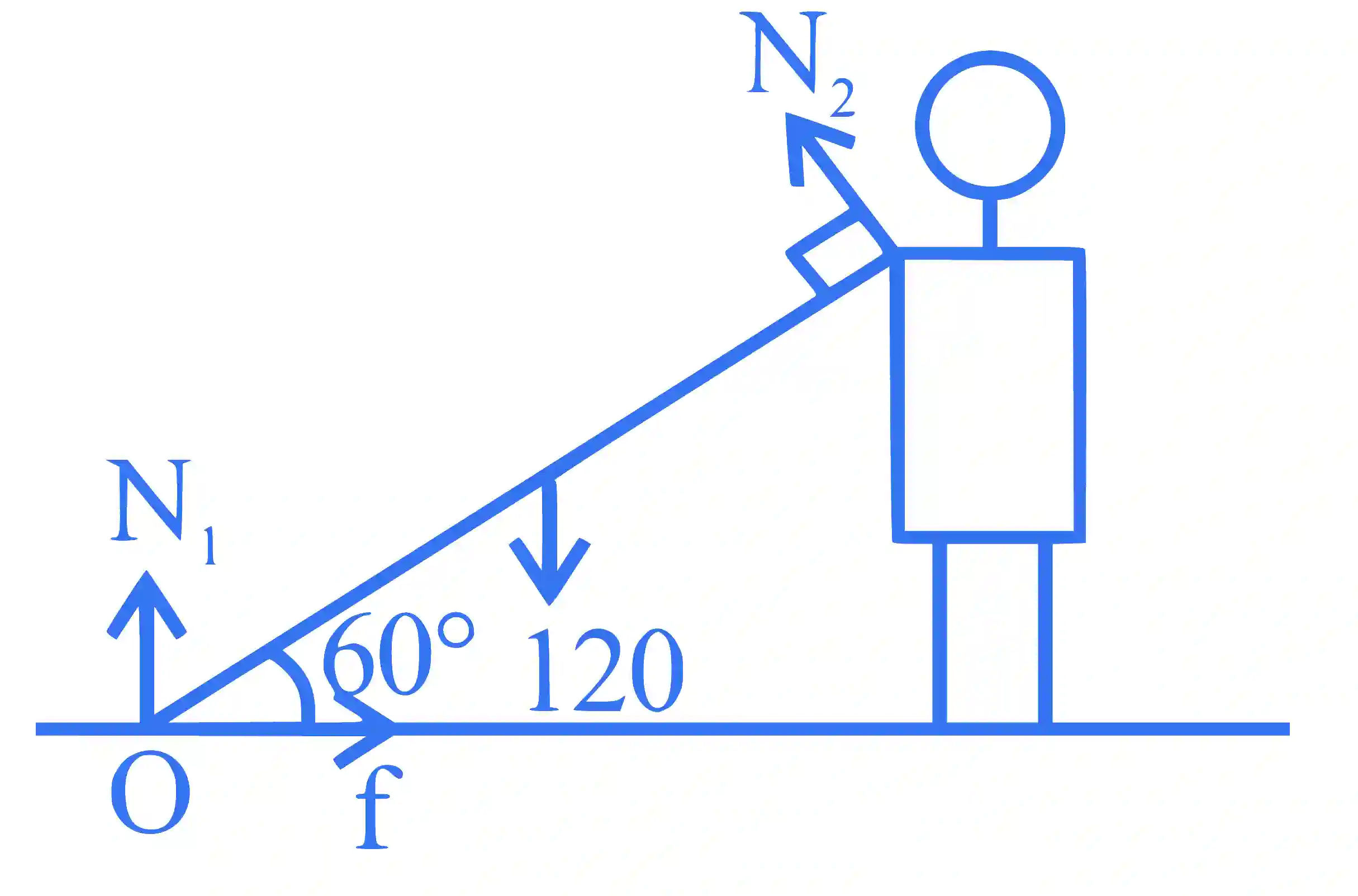
First, let us restate the problem in our own words:
We have a uniform iron bar of weight (meaning its mass is , so its weight is in SI units).
One end of the bar is on the ground (assume a frictionless contact), and the other end is on a man’s shoulder (also assume frictionless contact).
The bar makes an angle of with the horizontal.
We want to find how much load (“effective weight”) the man feels on his shoulder.
Under these (common) assumptions of frictionless contacts at both ends, each contact force is perpendicular to the bar. We can solve the problem by taking torques about the ground contact point.
1. Labeling and geometry
Let the length of the bar be .
The bar is inclined at from the horizontal.
Because the bar is uniform, its center of gravity (C.O.G.) lies at its midpoint, i.e., at a distance from either end.
Let the weight of the bar be .
Let the reaction force from the man’s shoulder be . (Magnitude unknown.)
Let the reaction force at the ground be . (We do not actually need its exact value to answer the question.)
We will place our origin (for torque calculation) at the ground contact point.
2. Torques about the ground contact
Torque due to the bar’s weight
The weight acts downward at the midpoint of the bar.
The position vector from the pivot (ground) to the bar’s midpoint is long and makes with the horizontal.
The weight is vertical downward, i.e., from the horizontal.
The angle between the position vector ( from horizontal) and the weight ( from horizontal) is
Hence, the torque magnitude from the weight is
Torque due to the man’s reaction force
The man’s shoulder is at the other end of the bar, i.e., from the pivot.
For frictionless contact, is perpendicular to the bar. Since the bar is at from horizontal, a line perpendicular to the bar is away from the bar’s direction, so the angle between the bar’s position vector ( ) and is .
Thus, the torque from about the ground contact is
Because the bar is in static equilibrium, the net torque about the ground contact must be zero. Taking the clockwise direction (by weight) as positive, we have
Solving for ,
Hence, the force on the man’s shoulder has magnitude in newtons.
3. Converting to “kg weight”
Often, such problems phrase the answer in “kg of weight” rather than newtons. Since for a mass in Earth’s gravity, a force of corresponds to a “weight” of .
So the man effectively feels 3 kg of load on his shoulder.