Verified Solution • 2025–26 Session moderate

QJEEM24Ph6636: JEE Main 2024 Physics - Class 11 JEEM24Ph6636 Solution: A disc of radius and mass is rolling horizontally without…
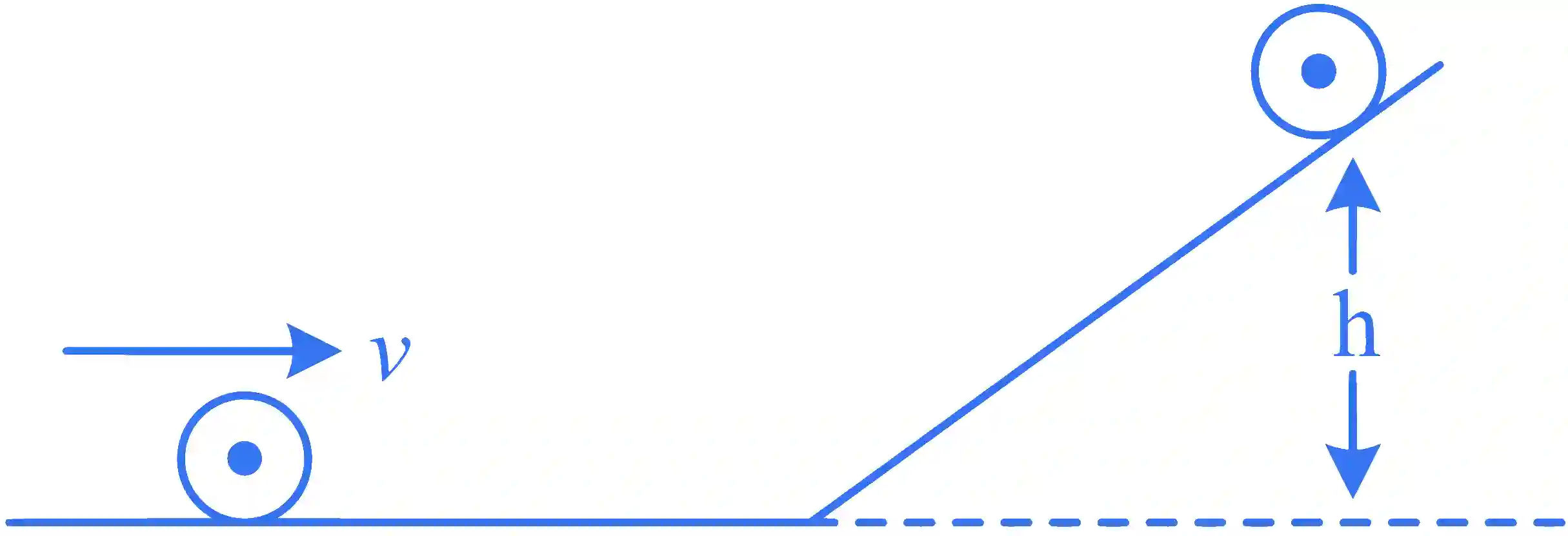
A disc of radius R\mathrm{R} and mass M\mathrm{M} is rolling horizontally without slipping with speed vv . It then moves up an inclined smooth surface as shown in figure. The maximum height that the disc can go up the incline is :

JEE Main 2024 (Online) 1st February Evening Shift Physics - Rotational Motion Question 32 English

Multiple Choice Options

  • A v2g\frac{v^2}{g}
  • B 23v2 g\frac{2}{3} \frac{v^2}{\mathrm{~g}}
  • C 34v2 g\frac{3}{4} \frac{v^2}{\mathrm{~g}}
  • D 12v2 g\frac{1}{2} \frac{v^2}{\mathrm{~g}}

Step-by-Step Verified Solution

1. Initial Energy (At the bottom, h=0)

The disc is rolling without slipping on the horizontal surface. Its total initial energy ( EiE_i ) is the sum of its translational kinetic energy ( KtransK_{\text{trans}} ) and its rotational kinetic energy ( KrotK_{\text{rot}} ). We set the initial potential energy UiU_i to zero.

Ei=Ktrans+Krot+UiE_i = K_{\text{trans}} + K_{\text{rot}} + U_i

The translational kinetic energy is:

Ktrans=12Mv2K_{\text{trans}} = \frac{1}{2} M v^2

The rotational kinetic energy is:

Krot=12Iω2K_{\text{rot}} = \frac{1}{2} I \omega^2

For a solid disc, the moment of inertia is I=12MR2I = \frac{1}{2} M R^2 . Since it's rolling without slipping, ω=vR\omega = \frac{v}{R} .

Krot=12(12MR2)(vR)2=14Mv2K_{\text{rot}} = \frac{1}{2} \left( \frac{1}{2} M R^2 \right) \left( \frac{v}{R} \right)^2 = \frac{1}{4} M v^2

So, the total initial energy is:

Ei=12Mv2+14Mv2=34Mv2E_i = \frac{1}{2} M v^2 + \frac{1}{4} M v^2 = \frac{3}{4} M v^2


2. Final Energy (At maximum height hh )

The disc moves up a smooth incline. "Smooth" means there is no friction.

Because there is no friction, there is no external torque to change the disc's rotation. Therefore, its angular velocity ω\omega remains constant as it moves up the incline.

At the maximum height hh , the disc's translational motion stops, so its final translational speed vfv_f is 0. However, it is still spinning with its original angular velocity ω\omega .

The final energy ( EfE_f ) is the sum of its final potential energy ( UfU_f ), final translational kinetic energy ( Ktrans, fK_{\text{trans, f}} ), and final rotational kinetic energy ( Krot, fK_{\text{rot, f}} ).

Ef=Ktrans, f+Krot, f+UfE_f = K_{\text{trans, f}} + K_{\text{rot, f}} + U_f

Uf=MghU_f = M g h

Ktrans, f=12M(vf)2=0K_{\text{trans, f}} = \frac{1}{2} M (v_f)^2 = 0

Krot, f=12Iω2=14Mv2(This value is unchanged from the start)K_{\text{rot, f}} = \frac{1}{2} I \omega^2 = \frac{1}{4} M v^2 \quad \text{(This value is unchanged from the start)}

So, the total final energy is:

Ef=0+14Mv2+MghE_f = 0 + \frac{1}{4} M v^2 + M g h


3. Conservation of Energy

We set the total initial energy equal to the total final energy:

Ei=EfE_i = E_f

34Mv2=14Mv2+Mgh\frac{3}{4} M v^2 = \frac{1}{4} M v^2 + M g h

Subtract 14Mv2\frac{1}{4} M v^2 from both sides:

34Mv2−14Mv2=Mgh\frac{3}{4} M v^2 - \frac{1}{4} M v^2 = M g h

24Mv2=Mgh\frac{2}{4} M v^2 = M g h

12Mv2=Mgh\frac{1}{2} M v^2 = M g h

Cancel MM from both sides:

12v2=gh\frac{1}{2} v^2 = g h

Solving for the maximum height hh :

h=v22gh = \frac{v^2}{2g}


Final Answer:

The maximum height that the disc can go up the incline is:

h=v22g\boxed{h = \frac{v^2}{2g}}

Related Learning Resources & Exam Preparation