Verified Solution • 2025–26 Session moderate

QJEEM24Ph5eac: JEE Main 2024 Physics - Class 11 JEEM24Ph5eac Solution: A body falling under gravity covers two points and separated by …

A body falling under gravity covers two points AA and BB separated by 80 m80 \mathrm{~m} in 2 s2 \mathrm{~s} . The distance of upper point A from the starting point is _________ m\mathrm{m} (use g=10 ms−2\mathrm{g}=10 \mathrm{~ms}^{-2} ).

Step-by-Step Verified Solution

To find the distance of the upper point A from the starting point, we need to first understand the motion of a freely falling body under the influence of gravity. The body falling under gravity is an example of uniformly accelerated motion with the acceleration equal to the acceleration due to gravity, which is given as g=10m/s2g = 10 \textrm{m/s}^2 .

We will consider point A where the body was at time t1t_1 and point B where the body was at time t2=t1+2st_2 = t_1 + 2 \textrm{s} . The displacement in these 2 seconds is given to be 80 meters.

For an object under constant acceleration, the displacement ss can be found using the equation:

s=ut+12at2s = ut + \frac{1}{2}at^2

where

uu is the initial velocity,

tt is the time,

aa is the acceleration,

ss is the displacement.

Since the body falls under gravity, its initial velocity at the starting point is 0 ( u=0u = 0 ), thus the equation simplifies to:

s=12gt2s = \frac{1}{2}gt^2

Let's denote the distance of point A from the starting point as sAs_A and the distance of point B as sBs_B . We know the body covers 8080 meters in 22 seconds from A to B, so we can write:

sB−sA=80ms_B - s_A = 80 \textrm{m}

We can calculate the distance covered till point B (in time t2=t1+2t_2 = t_1 + 2 ) as:

sB=12g(t1+2)2s_B = \frac{1}{2}g(t_1 + 2)^2

And the distance covered till point A (in time t1t_1 ) as:

sA=12gt12s_A = \frac{1}{2}gt_1^2

Now, substituting sBs_B and sAs_A in our difference equation:

12g(t1+2)2−12gt12=80\frac{1}{2}g(t_1 + 2)^2 - \frac{1}{2}gt_1^2 = 80

g(12(t1+2)2−12t12)=80g \left( \frac{1}{2}(t_1 + 2)^2 - \frac{1}{2}t_1^2 \right) = 80

5((t1+2)2−t12)=805((t_1 + 2)^2 - t_1^2) = 80

(t1+2)2−t12=16(t_1 + 2)^2 - t_1^2 = 16

t12+4t1+4−t12=16t_1^2 + 4t_1 + 4 - t_1^2 = 16

4t1+4=164t_1 + 4 = 16

4t1=16−44t_1 = 16 - 4

4t1=124t_1 = 12

t1=3st_1 = 3 \textrm{s}

Therefore, time t1t_1 at point A is 33 seconds. To find sAs_A , we can use the above simplified motion equation:

sA=12gt12s_A = \frac{1}{2}gt_1^2

sA=12×10×32s_A = \frac{1}{2} \times 10 \times 3^2

sA=5×9s_A = 5 \times 9

sA=45ms_A = 45 \textrm{m}

So, the distance of the upper point A from the starting point is 45m\mathbf{45 \textrm{m}} .

Alternate Method :


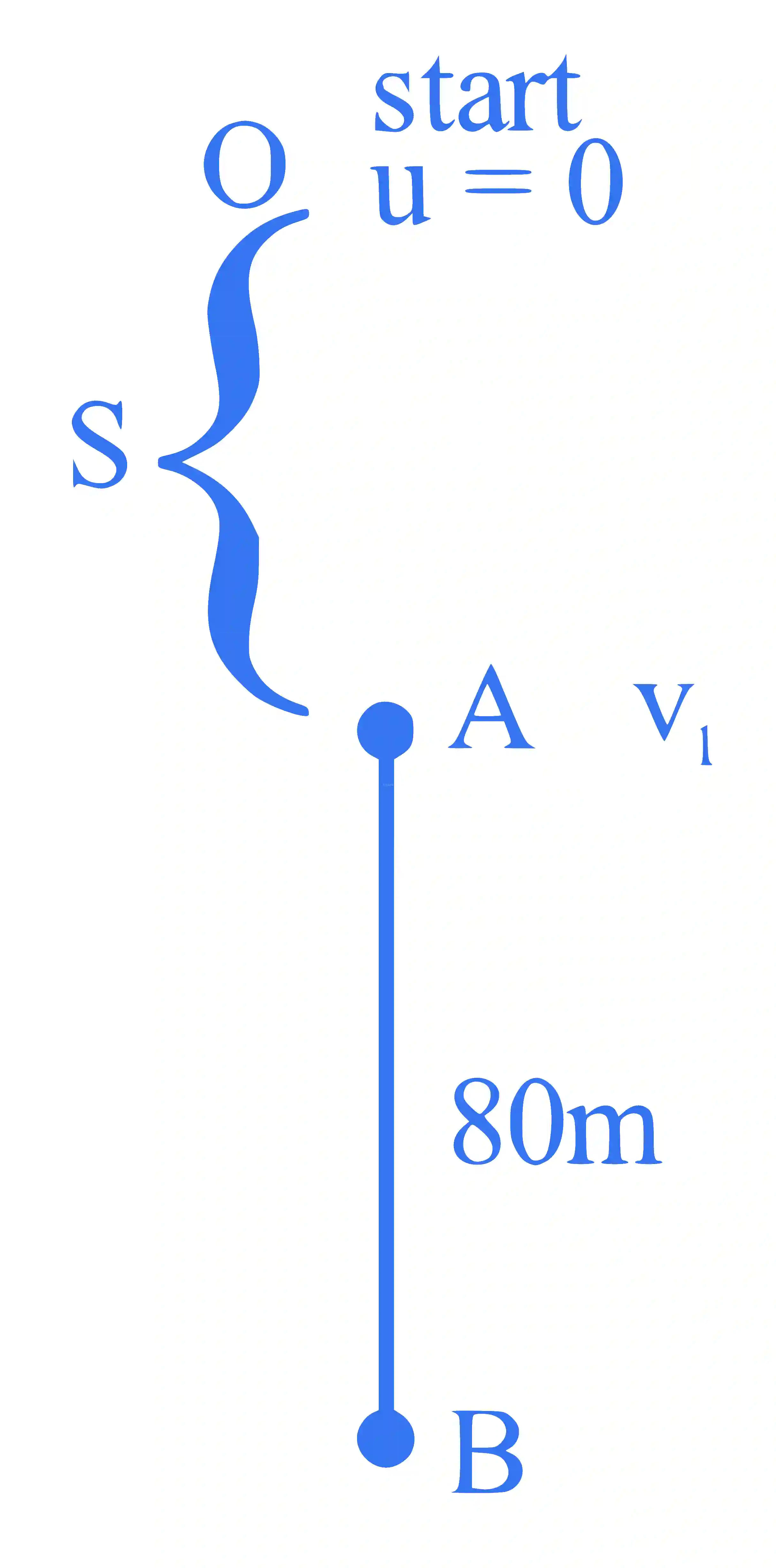
JEE Main 2024 (Online) 27th January Evening Shift Physics - Motion in a Straight Line Question 16 English Explanation
From A→B\mathrm{A} \rightarrow \mathrm{B}

amp;−80=−v1t−12×10t2amp;−80=−2v1−12×10×22amp;−80=−2v1−20amp;−60=−2v1amp;v1=30 m/s\begin{aligned}& -80=-\mathrm{v}_1 \mathrm{t}-\frac{1}{2} \times 10 \mathrm{t}^2 \\\\& -80=-2 \mathrm{v}_1-\frac{1}{2} \times 10 \times 2^2 \\\\& -80=-2 \mathrm{v}_1-20 \\\\& -60=-2 \mathrm{v}_1 \\\\& \mathrm{v}_1=30 \mathrm{~m} / \mathrm{s}\end{aligned}

From O\mathrm{O} to A\mathrm{A}

v2=u2+2gS\mathrm{v}^2=\mathrm{u}^2+2 \mathrm{gS}

⇒\Rightarrow 302=0+2×(−10)(−S)30^2=0+2 \times(-10)(-\mathrm{S})

⇒\Rightarrow 900=20 S900=20 \mathrm{~S}

⇒\Rightarrow S=45 m\mathrm{S}=45 \mathrm{~m}

Related Learning Resources & Exam Preparation