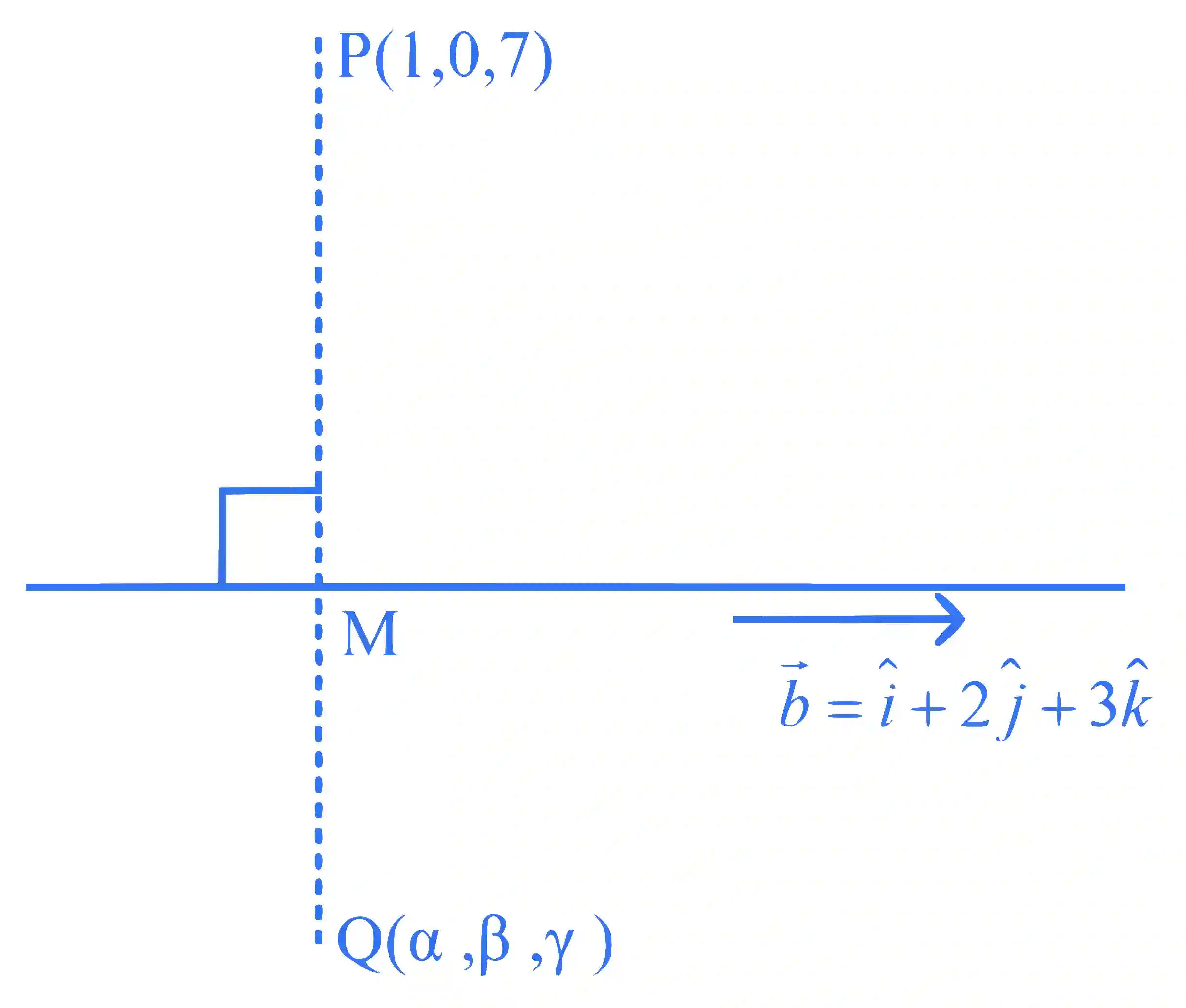
L 1 = x 1 = y − 1 2 = z − 2 3 = λ \mathrm{L}_1=\frac{\mathrm{x}}{1}=\frac{\mathrm{y}-1}{2}=\frac{\mathrm{z}-2}{3}=\lambda L 1 = 1 x = 2 y − 1 = 3 z − 2 = λ
a m p ; M ( λ , 1 + 2 λ , 2 + 3 λ ) a m p ; P M → = ( λ − 1 ) i ^ + ( 1 + 2 λ ) j ^ + ( 3 λ − 5 ) k ^ \begin{aligned}& \mathrm{M}(\lambda, 1+2 \lambda, 2+3 \lambda) \\& \overrightarrow{\mathrm{PM}}=(\lambda-1) \hat{\mathrm{i}}+(1+2 \lambda) \hat{\mathrm{j}}+(3 \lambda-5) \hat{\mathrm{k}}\end{aligned} am p ; M ( λ , 1 + 2 λ , 2 + 3 λ ) am p ; PM = ( λ − 1 ) i ^ + ( 1 + 2 λ ) j ^ + ( 3 λ − 5 ) k ^
P M → \overrightarrow{\mathrm{PM}} PM is perpendicular to line L 1 \mathrm{L}_1 L 1
a m p ; P M → b → = 0 ( b → = i ^ + 2 j ^ + 3 k ^ ) a m p ; ⇒ λ − 1 + 4 λ + 2 + 9 λ − 15 = 0 a m p ; 14 λ = 14 ⇒ λ = 1 a m p ; ∴ M = ( 1 , 3 , 5 ) a m p ; Q → = 2 M → − P → [ M is midpoint of P → & a m p ; Q → ] \begin{aligned}& \overrightarrow{\mathrm{PM}} \overrightarrow{\mathrm{b}}=0 \quad(\overrightarrow{\mathrm{b}}=\hat{\mathrm{i}}+2 \hat{\mathrm{j}}+3 \hat{\mathrm{k}}) \\& \Rightarrow \lambda-1+4 \lambda+2+9 \lambda-15=0 \\& 14 \lambda=14 \Rightarrow \lambda=1 \\& \therefore \mathrm{M}=(1,3,5) \\& \overrightarrow{\mathrm{Q}}=2 \overrightarrow{\mathrm{M}}-\overrightarrow{\mathrm{P}}[\mathrm{M} \text { is midpoint of } \overrightarrow{\mathrm{P}} \& \overrightarrow{\mathrm{Q}}]\end{aligned} am p ; PM b = 0 ( b = i ^ + 2 j ^ + 3 k ^ ) am p ; ⇒ λ − 1 + 4 λ + 2 + 9 λ − 15 = 0 am p ; 14 λ = 14 ⇒ λ = 1 am p ; ∴ M = ( 1 , 3 , 5 ) am p ; Q = 2 M − P [ M is midpoint of P & am p ; Q ]
a m p ; Q → = 2 i ^ + 6 j ^ + 10 k ^ − i ^ − 7 k ^ a m p ; Q → = i ^ + 6 j ^ + 3 k ^ a m p ; ∴ ( α , β , γ ) = ( 1 , 6 , 3 ) \begin{aligned}& \overrightarrow{\mathrm{Q}}=2 \hat{\mathrm{i}}+6 \hat{\mathrm{j}}+10 \hat{\mathrm{k}}-\hat{\mathrm{i}}-7 \hat{\mathrm{k}} \\& \overrightarrow{\mathrm{Q}}=\hat{\mathrm{i}}+6 \hat{\mathrm{j}}+3 \hat{\mathrm{k}} \\& \therefore(\alpha, \beta, \gamma)=(1,6,3)\end{aligned} am p ; Q = 2 i ^ + 6 j ^ + 10 k ^ − i ^ − 7 k ^ am p ; Q = i ^ + 6 j ^ + 3 k ^ am p ; ∴ ( α , β , γ ) = ( 1 , 6 , 3 )
Required line having direction cosine ( l , m , n ) (l, \mathrm{~m}, \mathrm{n}) ( l , m , n )
a m p ; l 2 + m 2 + n 2 = 1 a m p ; ⇒ l 2 + ( − 1 2 ) 2 + ( − 1 2 ) 2 = 1 \begin{aligned}& l^2+m^2+n^2=1 \\& \Rightarrow l^2+\left(-\frac{1}{2}\right)^2+\left(-\frac{1}{\sqrt{2}}\right)^2=1\end{aligned} am p ; l 2 + m 2 + n 2 = 1 am p ; ⇒ l 2 + ( − 2 1 ) 2 + ( − 2 1 ) 2 = 1
l 2 = 1 4 l^2=\frac{1}{4} l 2 = 4 1
∴ l = 1 2 \therefore l=\frac{1}{2} ∴ l = 2 1 [Line make acute angle with x \mathrm{x} x -axis]
Equation of line passing through ( 1 , 6 , 3 ) (1,6,3) ( 1 , 6 , 3 ) will be
r → = ( i ^ + 6 j ^ + 3 k ^ ) + μ ( 1 2 i ^ − 1 2 j ^ − 1 2 k ^ ) \overrightarrow{\mathrm{r}}=(\hat{\mathrm{i}}+6 \hat{\mathrm{j}}+3 \hat{\mathrm{k}})+\mu\left(\frac{1}{2} \hat{\mathrm{i}}-\frac{1}{2} \hat{\mathrm{j}}-\frac{1}{\sqrt{2}} \hat{\mathrm{k}}\right) r = ( i ^ + 6 j ^ + 3 k ^ ) + μ ( 2 1 i ^ − 2 1 j ^ − 2 1 k ^ )
Option (3) satisfying for μ = 4 \mu=4 μ = 4