Verified Solution • 2025–26 Session moderate

QJEEM24Maf801: JEE Main 2024 Mathematics - Class 12 JEEM24Maf801 Solution: The area enclosed by the curves and is equal to :

The area enclosed by the curves xy+4y=16x y+4 y=16 and x+y=6x+y=6 is equal to :

Multiple Choice Options

  • A 28−30log⁡e228-30 \log _{\mathrm{e}} 2
  • B 30−28log⁡e230-28 \log _{\mathrm{e}} 2
  • C 30−32log⁡e230-32 \log _{\mathrm{e}} 2
  • D 32−30log⁡e232-30 \log _{\mathrm{e}} 2

Step-by-Step Verified Solution

To find the enclosed area between the two curves xy+4y=16x y+4 y=16 and x+y=6x+y=6 , we need to determine the region of intersection and integrate the difference of the functions over the interval where they intersect.

First, let's solve the equations simultaneously to find the points of intersection.

The second curve x+y=6x+y=6 can be rewritten as y=6−xy=6-x .

Substitute y=6−xy=6-x into the first equation:

x(6−x)+4(6−x)=16x(6-x) + 4(6-x) = 16

6x−x2+24−4x=166x - x^2 + 24 - 4x = 16

−x2+2x+8=0-x^2 + 2x + 8 = 0

This can be simplified to:

x2−2x−8=0x^2 - 2x - 8 = 0

Using the quadratic formula, we can find the roots of this equation:

x=−(−2)±(−2)2−4(1)(−8)2(1)x = \frac{-(-2) \pm \sqrt{(-2)^2 - 4(1)(-8)}}{2(1)}

x=2±4+322x = \frac{2 \pm \sqrt{4 + 32}}{2}

x=2±362x = \frac{2 \pm \sqrt{36}}{2}

x=2±62x = \frac{2 \pm 6}{2}

So we have two solutions:

x1=2+62=4x_1 = \frac{2 + 6}{2} = 4

x2=2−62=−2x_2 = \frac{2 - 6}{2} = -2

For x1=4x_1 = 4 , substitute this back into the line equation x+y=6x+y=6 :

4+y=64+y=6

y=2y=2

For x2=−2x_2 = -2 , do the same:

−2+y=6-2+y=6

y=8y=8

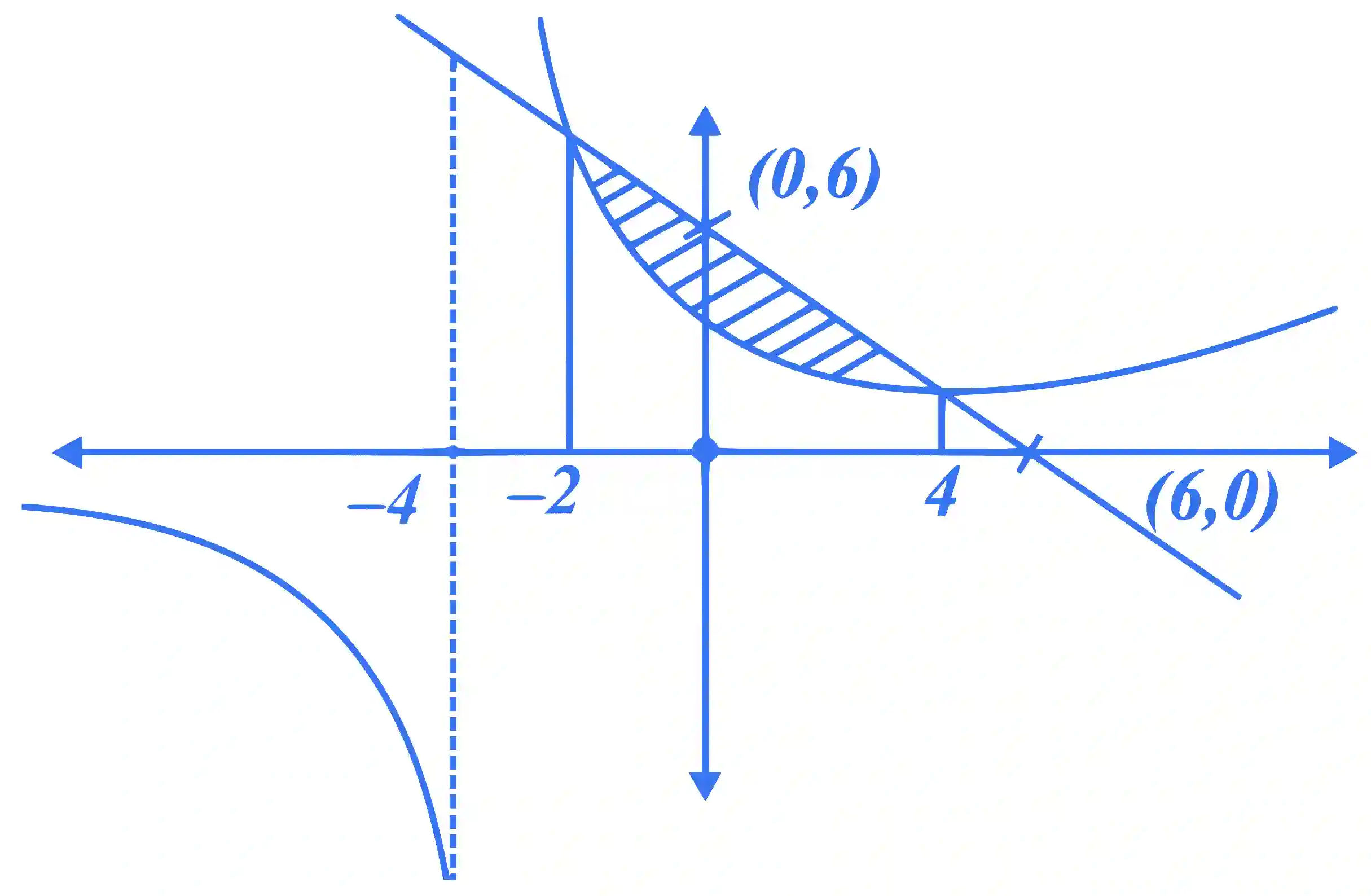
So we have two points of intersection: (4,2)(4,2) and (−2,8)(-2,8) .

JEE Main 2024 (Online) 1st February Morning Shift Mathematics - Area Under The Curves Question 30 English Explanation

Now, to find the area between xy+4y=16x y + 4y = 16 and x+y=6x + y = 6 , we'll integrate the top function minus the bottom function from x=−2x = -2 to x=4x = 4 . First, we need to express yy from both equations in terms of xx :

For xy+4y=16x y + 4 y = 16 , express yy in terms of xx :

y(x+4)=16y(x+4) = 16

y=16x+4y = \frac{16}{x+4}

For x+y=6x + y = 6 , we have:

y=6−xy = 6 - x

The area AA is therefore given by:

A=∫−24(6−x−16x+4)dxA = \int\limits_{-2}^{4}\left( 6 - x - \frac{16}{x+4} \right) dx

Now, we integrate:

A=∫−24(6−x)dx−∫−2416x+4dxA = \int\limits_{-2}^{4} (6 - x) dx - \int_{-2}^{4} \frac{16}{x + 4} dx

A=[6x−x22]−24−[16ln⁡∣x+4∣]−24A = \left[6x - \frac{x^2}{2}\right]_{-2}^{4} - \left[16 \ln|x + 4|\right]_{-2}^{4}

A=(6×4−12×42)−(6×−2−12×−22)−16(ln⁡∣4+4∣−ln⁡∣−2+4∣)A = \left( 6 \times 4 - \frac{1}{2} \times 4^2 \right) - \left( 6 \times -2 - \frac{1}{2} \times -2^2 \right) - 16 \left( \ln|4+4| - \ln|-2+4| \right)

A=(24−8)−(−12−2)−16(ln⁡8−ln⁡2)A = \left( 24 - 8 \right) - \left( -12 - 2 \right) - 16 \left( \ln 8 - \ln 2 \right)

A=16+14−16(ln⁡(23)−ln⁡2)A = 16 + 14 - 16 \left( \ln (2^3) - \ln 2 \right)

A=30−16(3ln⁡2−ln⁡2)A = 30 - 16 \left( 3 \ln 2 - \ln 2 \right)

A=30−16(2ln⁡2)A = 30 - 16 (2 \ln 2)

A=30−32ln⁡2A = 30- 32 \ln 2

Related Learning Resources & Exam Preparation