Verified Solution • 2025–26 Session moderate

QJEEM23Ma98fe: JEE Main 2023 Mathematics - Class 12 JEEM23Ma98fe Solution: One vertex of a rectangular parallelopiped is at the origin and …

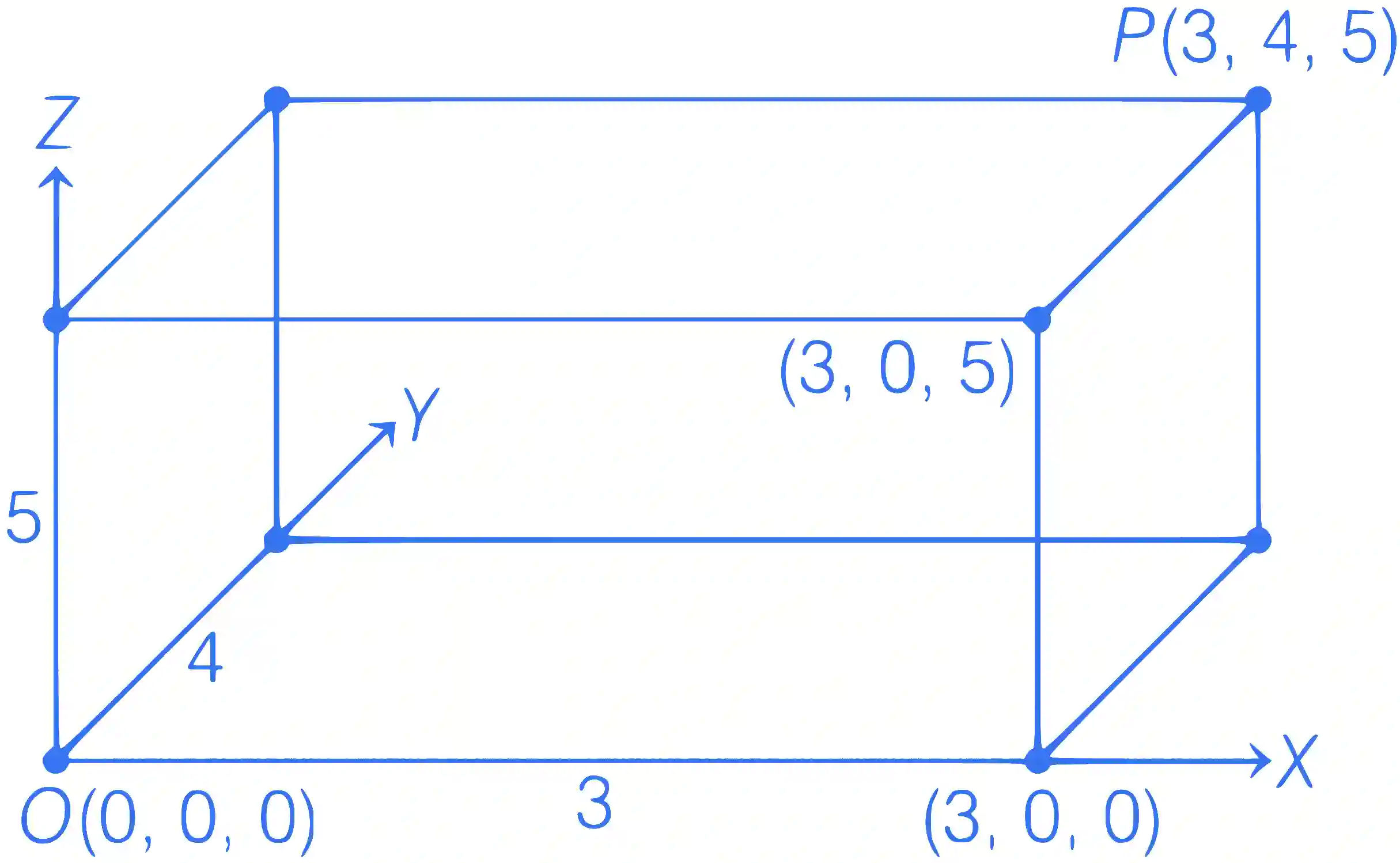
One vertex of a rectangular parallelopiped is at the origin O\mathrm{O} and the lengths of its edges along x,yx, y and zz axes are 3,43,4 and 55 units respectively. Let P\mathrm{P} be the vertex (3,4,5)(3,4,5) . Then the shortest distance between the diagonal OP and an edge parallel to z\mathrm{z} axis, not passing through O\mathrm{O} or P\mathrm{P} is :

Multiple Choice Options

  • A 125\frac{12}{\sqrt{5}}
  • B 12512 \sqrt{5}
  • C 125\frac{12}{5}
  • D 1255\frac{12}{5 \sqrt{5}}

Step-by-Step Verified Solution

JEE Main 2023 (Online) 6th April Morning Shift Mathematics - 3D Geometry Question 63 English Explanation

Equation of OPO P is

amp;x−03−0=y−04−0=z−05−0amp;⇒x3=y4=z5\begin{aligned}&\frac{x-0}{3-0}=\frac{y-0}{4-0} =\frac{z-0}{5-0} \\\\&\Rightarrow \frac{x}{3} =\frac{y}{4}=\frac{z}{5}\end{aligned}

Equation of edge parallel to ZZ -axis is

x−30=y−00=z−51\frac{x-3}{0}=\frac{y-0}{0}=\frac{z-5}{1}

∴\therefore Shortest distance

=∣x2−x1amp;y2−y1amp;z2−z1a1amp;b1amp;c1a2amp;b2amp;c2∣(a1b2−a2b1)2+(b1c2−b2c1)2+(c1a2−c2a1)2=\frac{\left|\begin{array}{ccc}x_2-x_1 & y_2-y_1 & z_2-z_1 \\a_1 & b_1 & c_1 \\a_2 & b_2 & c_2\end{array}\right|}{\sqrt{\begin{array}{r}\left(a_1 b_2-a_2 b_1\right)^2+\left(b_1 c_2-b_2 c_1\right)^2+\left(c_1 a_2-c_2 a_1\right)^2\end{array}}}

Here,

amp;x1=0,y1=0,z1=0amp;x2=3,y2=0,z2=5amp;a1=3,b1=4,c1=5amp;a2=0,b2=0,c2=1\begin{aligned}& x_1=0, y_1=0, z_1=0 \\\\& x_2=3, y_2=0, z_2=5 \\\\& a_1=3, b_1=4, c_1=5 \\\\& a_2=0, b_2=0, c_2=1\end{aligned}

∴∣x2−x1amp;y2−y1amp;z2−z1a1amp;b1amp;c1a2amp;b2amp;c2∣=∣3amp;0amp;53amp;4amp;50amp;0amp;1∣=4(3)=12\therefore\left|\begin{array}{ccc}x_2-x_1 & y_2-y_1 & z_2-z_1 \\a_1 & b_1 & c_1 \\a_2 & b_2 & c_2\end{array}\right|=\left|\begin{array}{ccc}3 & 0 & 5 \\3 & 4 & 5 \\0 & 0 & 1\end{array}\right|=4(3)=12

amp; and (a1b2−a2b1)2+(b1c2−b2c1)2+(c1a2−c2a1)2amp;=0+(4−0)2+(0−3)2amp;=16+9=5amp;∴ Required shortest distance =125amp;\begin{aligned} & \text { and } \sqrt{\left(a_1 b_2-a_2 b_1\right)^2+\left(b_1 c_2-b_2 c_1\right)^2+\left(c_1 a_2-c_2 a_1\right)^2} \\\\ & =\sqrt{0+(4-0)^2+(0-3)^2} \\\\ & =\sqrt{16+9}=5 \\\\ & \therefore \text { Required shortest distance }=\frac{12}{5} \\\\ & \end{aligned}

Related Learning Resources & Exam Preparation