Verified Solution • 2025–26 Session moderate

QJEEM23Ma7337: JEE Main 2023 Mathematics - Class 12 JEEM23Ma7337 Solution: Let the tangent at any point P on a curve passing through the…

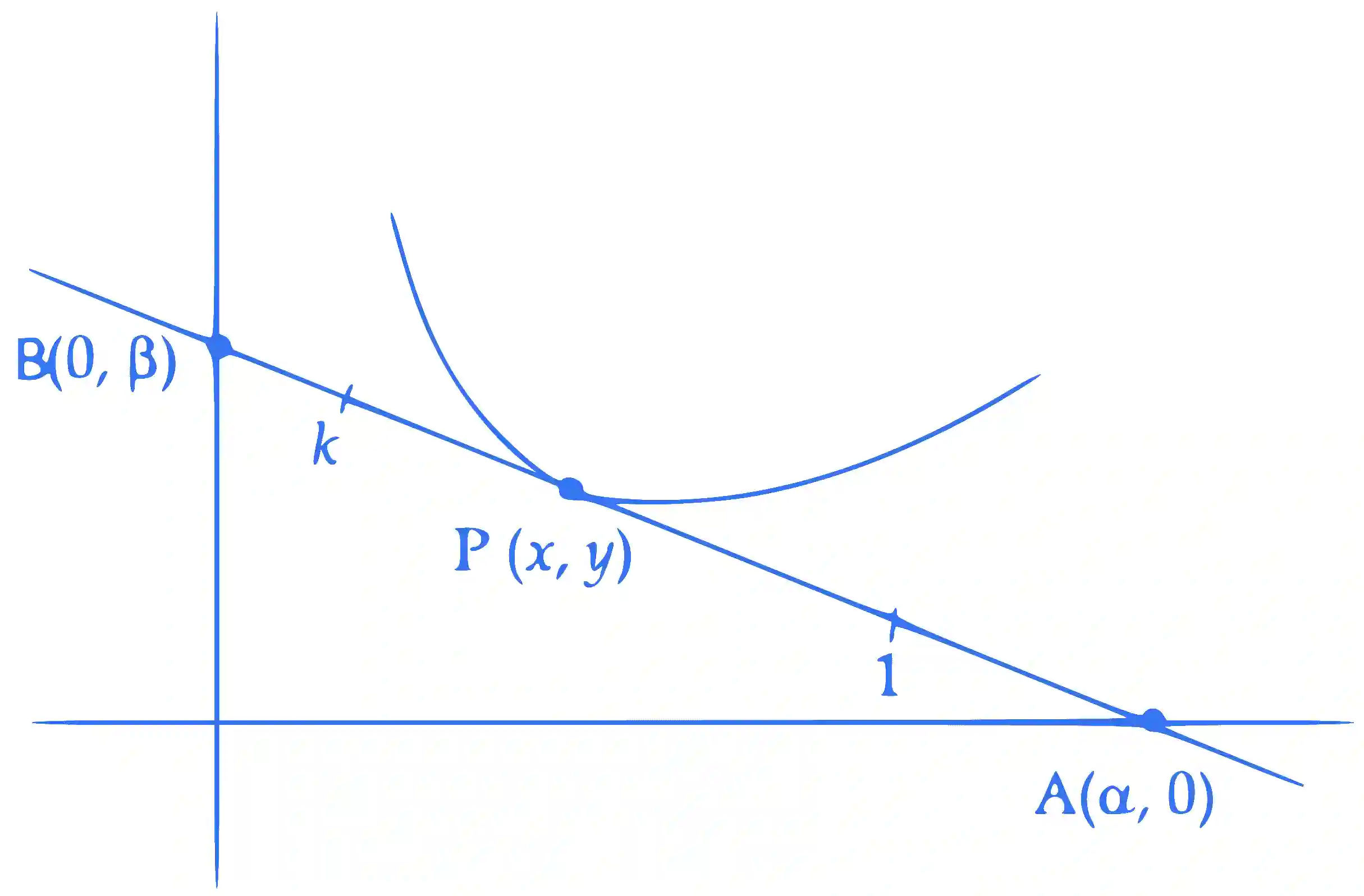
Let the tangent at any point P on a curve passing through the points (1, 1) and (110,100)\left(\frac{1}{10}, 100\right) , intersect positive xx -axis and yy -axis at the points A and B respectively. If PA:PB=1:k\mathrm{PA}: \mathrm{PB}=1: k and y=y(x)y=y(x) is the solution of the differential equation edydx=kx+k2,y(0)=ke^{\frac{d y}{d x}}=k x+\frac{k}{2}, y(0)=k , then 4y(1)−6log⁡e34 y(1)-6 \log _{\mathrm{e}} 3 is equal to ____________.

Step-by-Step Verified Solution

Let the equation of tangent to the curve at (x,y)(x, y) .

Whose slope is dydx\frac{d y}{d x} is

JEE Main 2023 (Online) 10th April Evening Shift Mathematics - Differential Equations Question 57 English Explanation

amp;Y−y=dydx(X−x)amp;amp; Putting Y=0⇒X=x−y(dydx)tamp;⇒α=x−y(dydx)\begin{aligned}&\mathrm{Y}-y=\frac{d y}{d x}(\mathrm{X}-x)\\\\&\begin{aligned}& \text { Putting } Y=0 \Rightarrow X=x-\frac{y}{\left(\frac{d y}{d x}\right)} \mathrm{t} \\\\& \Rightarrow \alpha=x-\frac{y}{\left(\frac{d y}{d x}\right)}\end{aligned}\end{aligned}

and putting X=0⇒Y=y−xdydx\mathrm{X}=0 \Rightarrow \mathrm{Y}=y-x \frac{d y}{d x}

⇒β=y−xdydx\Rightarrow \beta=y-x \frac{d y}{d x}

∵P\because \mathrm{P} divides AB\mathrm{AB} in 1:k1: k

x=kα+0k+1 and y=k×0+βk+1x=\frac{k \alpha+0}{k+1} \text { and } y=\frac{k \times 0+\beta}{k+1}

amp;⇒x(k+1)=k(x−ydydx)amp;⇒xk+x=xk−ykdydxamp;⇒xdydx=−yk\begin{aligned}& \Rightarrow x(k+1)=k\left(x-\frac{y}{\frac{d y}{d x}}\right) \\\\& \Rightarrow x k+x=x k-\frac{y k}{\frac{d y}{d x}} \\\\&\Rightarrow x \frac{d y}{d x}=-y k\end{aligned}

amp; or ∫dyy=−k×∫1xdxamp;⇒log⁡y=−klog⁡x+log⁡Camp; or log⁡y×xk=log⁡Camp;⇒yxk=Camp; putting x=1,y=1⇒c=1amp; so yxk=1\begin{aligned}& \text { or } \int \frac{d y}{y}=-k \times \int \frac{1}{x} d x \\\\& \Rightarrow \log y=-k \log x+\log \mathrm{C} \\\\& \text { or } \log y \times x^k=\log \mathrm{C} \\\\& \Rightarrow y x^k=\mathrm{C} \\\\& \text { putting } x=1, y=1 \Rightarrow c=1 \\\\& \text { so } y x^k=1\end{aligned}

Putting x=110,y=100⇒100×(1100)k=1⇒k=2x=\frac{1}{10}, y=100 \Rightarrow 100 \times\left(\frac{1}{100}\right)^k=1 \Rightarrow k=2

so yx2=1y x^2=1 or y=1x2y=\frac{1}{x^2}

Now edydx=kx+k2e^{\frac{d y}{d x}}=k x+\frac{k}{2}

⇒dydx=log⁡e(kx+k2)=log⁡e(2x+1)\Rightarrow \frac{d y}{d x}=\log _e\left(k x+\frac{k}{2}\right)=\log _e(2 x+1)

On integrating

amp;y=∫1⋅log⁡e(2x+1)dxamp;=xlog⁡e(2x+1)−∫1×22x+1×xdxamp;=xlog⁡e(2x+1)−∫1−12x+1dxamp;y=xlog⁡e(2x+1)−x+12log⁡e(2x+1)+c\begin{aligned}& y=\int 1 \cdot \log _e(2 x+1) d x \\\\& =x \log _e(2 x+1)-\int \frac{1 \times 2}{2 x+1} \times x d x \\\\& =x \log _e(2 x+1)-\int 1-\frac{1}{2 x+1} d x \\\\& y=x \log _e(2 x+1)-x+\frac{1}{2} \log _e(2 x+1)+c\end{aligned}

Put x=0,y=k=2⇒c=2x=0, y=k=2 \Rightarrow c=2 putting x=1x=1

amp;y(1)=log⁡e3−1+12log⁡e3+2=32log⁡e3−1+2amp;⇒4y(1)=6log⁡e3+4amp;⇒4y(1)−6log⁡e3=4\begin{aligned}& y(1)=\log _e 3-1+\frac{1}{2} \log _e 3+2=\frac{3}{2} \log _e 3-1+2 \\\\& \Rightarrow 4 y(1)=6 \log _e 3+4 \\\\& \Rightarrow 4 y(1)-6 \log _e 3= 4\end{aligned}

Related Learning Resources & Exam Preparation