Verified Solution • 2025–26 Session moderate

QJEEM23Ch63ad: JEE Main 2023 Chemistry - Class 11 JEEM23Ch63ad Solution: The electron in the orbit of is excited to orbit using the…
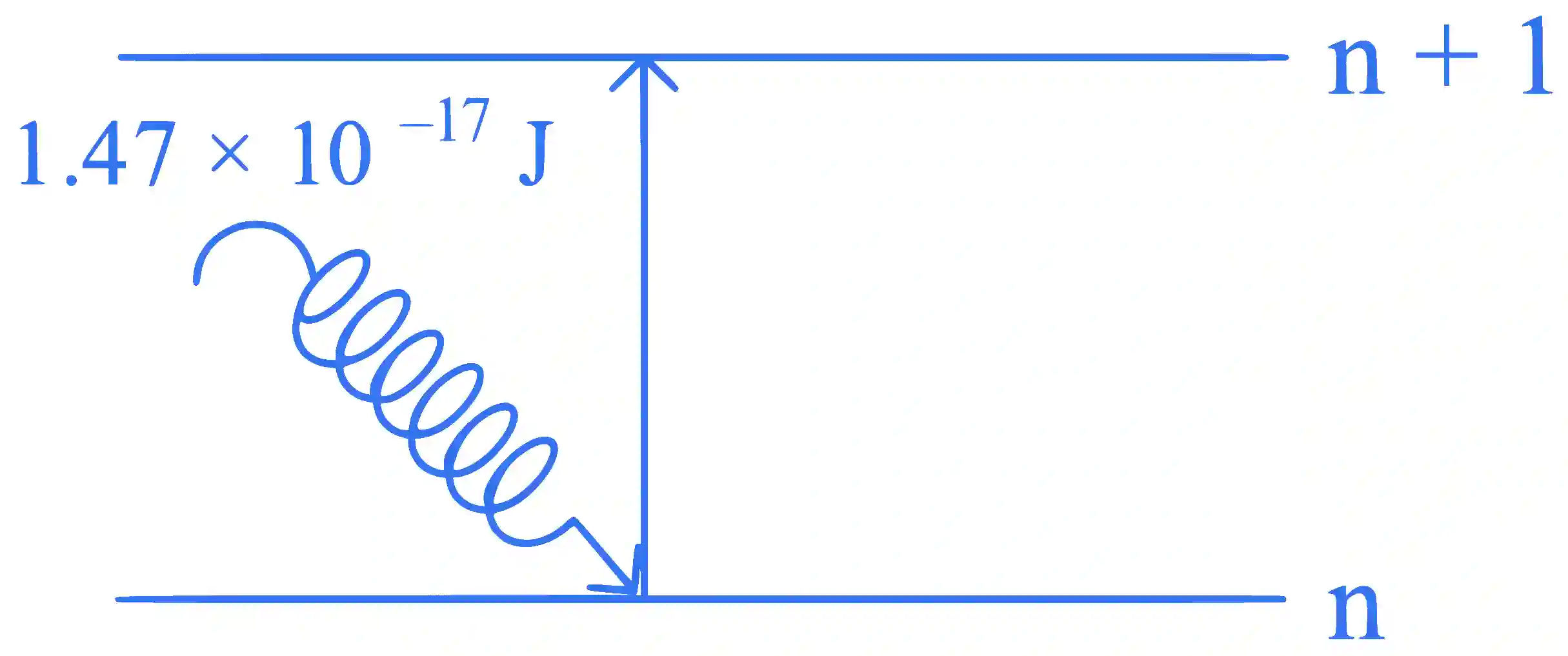
JEE Main 2023 (Online) 10th April Evening Shift Chemistry - Structure of Atom Question 41 English

The electron in the nth \mathrm{n}^{\text {th }} orbit of Li2+\mathrm{Li}^{2+} is excited to (n+1)(\mathrm{n}+1) orbit using the radiation of energy 1.47×10⁻¹⁷ J1.47 \times 10^{-17} \mathrm{~J} (as shown in the diagram). The value of n\mathrm{n} is ___________

Given: RH=2.18×10⁻¹⁸ J\mathrm{R}_{\mathrm{H}}=2.18 \times 10^{-18} \mathrm{~J}

Step-by-Step Verified Solution

The energy levels of a hydrogen-like atom (such as Li²⁺ in this case) can be calculated using the formula:

E=−RH⋅Z2n2E = -R_H \cdot \frac{Z^2}{n^2}

where:

  • EE is the energy of the electron,
  • RHR_H is the Rydberg constant (in joules),
  • ZZ is the atomic number, and
  • nn is the principal quantum number.

The change in energy (∆E) between two energy levels is given by the difference in the energies of the two levels. In this case, the electron is excited from the nth level to the (n+1)th level, and the energy of the radiation is given as 1.47×10−171.47 \times 10^{-17} J. Therefore:

ΔE=En+1−En=1.47×10⁻¹⁷ J\Delta E = E_{n+1} - E_n = 1.47 \times 10^{-17} \mathrm{~J}

Substituting the formula for EnE_{n} and En+1E_{n+1} :

ΔE=−RH⋅Z2(n+1)2−(−RH⋅Z2n2)\Delta E = -R_H \cdot \frac{Z^2}{(n+1)^2} - \left(-R_H \cdot \frac{Z^2}{n^2}\right)

Simplifying this, we get:

ΔE=RH⋅Z2(1n2−1(n+1)2)\Delta E = R_H \cdot Z^2 \left(\frac{1}{n^2} - \frac{1}{(n+1)^2}\right)

We know that Z=3Z=3 for Li2+\mathrm{Li}^{2+} , RH=2.18×10⁻¹⁸ JR_H = 2.18 \times 10^{-18} \mathrm{~J} and ΔE=1.47×10⁻¹⁷ J\Delta E = 1.47 \times 10^{-17} \mathrm{~J} .

We substitute the given values into the formula

1.47×10⁻¹⁷ J=2.18×10−18 J×32(1n2−1(n+1)2)1.47 \times 10^{-17} \mathrm{~J} = 2.18 \times 10^{-18} \mathrm{~J} \times 3^2 \left(\frac{1}{n^2} - \frac{1}{(n+1)^2}\right)

Simplify to

1.471.96=1n2−1(n+1)2\frac{1.47}{1.96} = \frac{1}{n^2} - \frac{1}{(n+1)^2}

Solving this quadratic equation for n, we get two possible solutions. However, we disregard the negative solution since n (the principal quantum number) can't be negative. So, the only valid solution is n=1.

Thus, the value of n is 1.

Related Learning Resources & Exam Preparation