Verified Solution • 2025–26 Session
moderate
QJEEM22Phd19d: JEE Main 2022 Physics - Class 11 JEEM22Phd19d Solution: A pendulum of length 2 m consists of a wooden bob of mass 50 g. …
A pendulum of length 2 m consists of a wooden bob of mass 50 g. A bullet of mass 75 g is fired towards the stationary bob with a speed v. The bullet emerges out of the bob with a speed and the bob just completes the vertical circle. The value of v is ___________ ms 1. (if g = 10 m/s2).
Step-by-Step Verified Solution
Let minimum velocity at the lowest point for the bob to compleate the circular path = v'
And we know, v' =
From the conservation of momentum, we have
According to question, the bob completes a vertical circle of radius, therefore
Note :

At the point , both the tension and the weight of the body act towards the centre of the circle. So provides the centripetal force necessary for the rotation of the body.
At the point , the tension acts vertically upwards i.e., towards the centre of the circle and the weight of the body acts vertically downwards i.e., in an opposite direction. So provides the necessary centripetal force here.
If the tension in the string just vanishes at i.e., if , then
If the velocity of the body at the highest point be less than , the string will slack and the body will drop down instead of rotating in the circular path. So this minimum velocity of the body at the highest point is called the critical velocity.
Minimum velocity at the lowest point for maintaining the critical velocity :
Now, as the body goes from to , its height increases by . So its potential energy increases by . From the principle of conservation of mechanical energy, we have
The K.E. of the body at - Its K.E. at Increase in P.E.
or,
or,
When is minimurn
Minimum tension :
When the body moves with the critical velocity at the highest point, the tension in the string becomes zero; then When this condition is satisfied, the tension in the string at the lowest point becomes minimum.
So,
And we know, v' =
From the conservation of momentum, we have
According to question, the bob completes a vertical circle of radius, therefore
Note :
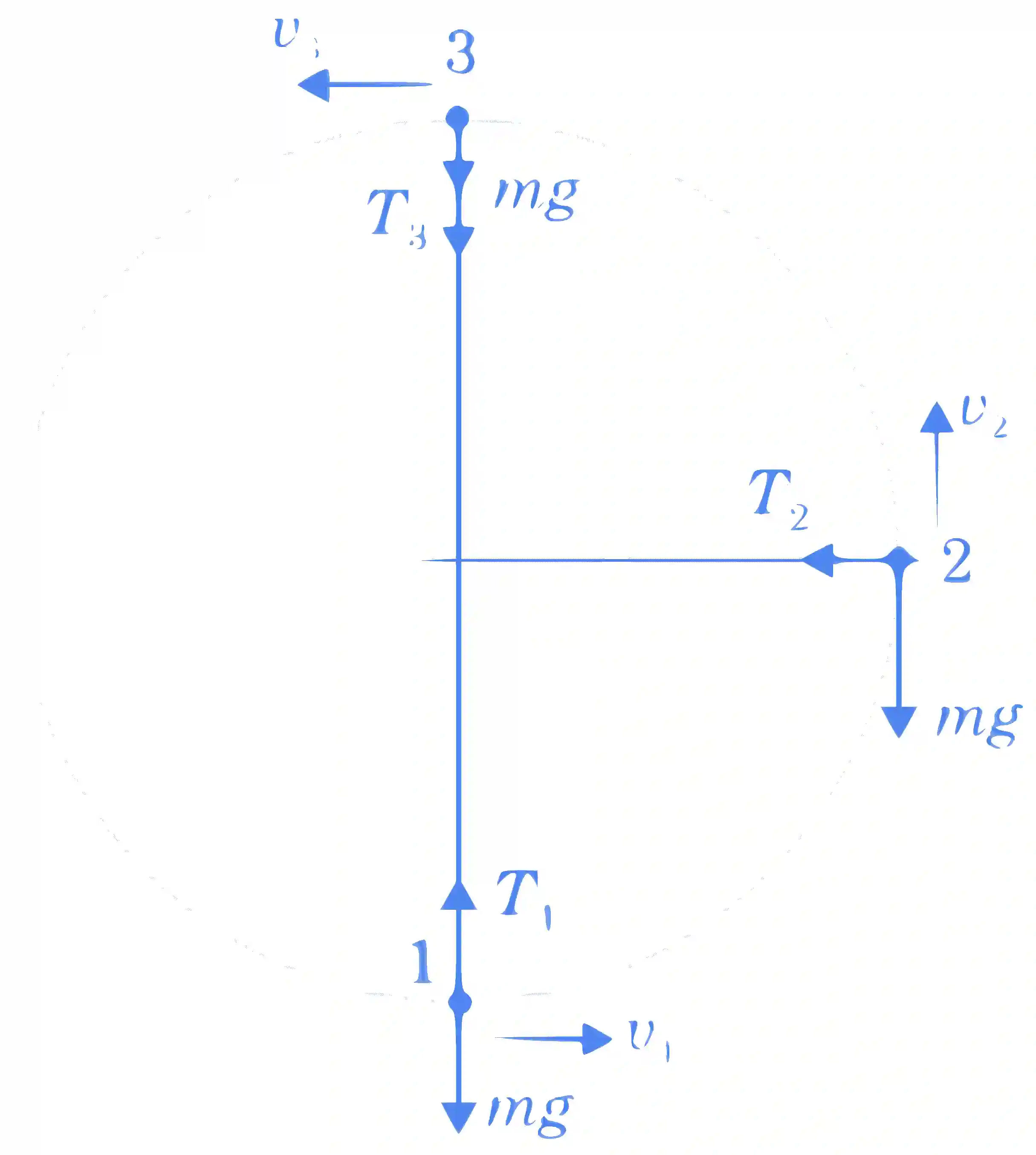
At the point , both the tension and the weight of the body act towards the centre of the circle. So provides the centripetal force necessary for the rotation of the body.
At the point , the tension acts vertically upwards i.e., towards the centre of the circle and the weight of the body acts vertically downwards i.e., in an opposite direction. So provides the necessary centripetal force here.
If the tension in the string just vanishes at i.e., if , then
If the velocity of the body at the highest point be less than , the string will slack and the body will drop down instead of rotating in the circular path. So this minimum velocity of the body at the highest point is called the critical velocity.
Minimum velocity at the lowest point for maintaining the critical velocity :
Now, as the body goes from to , its height increases by . So its potential energy increases by . From the principle of conservation of mechanical energy, we have
The K.E. of the body at - Its K.E. at Increase in P.E.
or,
or,
When is minimurn
Minimum tension :
When the body moves with the critical velocity at the highest point, the tension in the string becomes zero; then When this condition is satisfied, the tension in the string at the lowest point becomes minimum.
So,