QJEEM21Ph0b93: JEE Main 2021 Physics - Class 11 JEEM21Ph0b93 Solution: Two identical particles of mass 1 kg each go round a circle of…
Multiple Choice Options
- A
- B
- C
- D
Step-by-Step Verified Solution
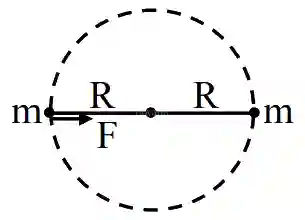
The problem describes two identical particles of mass m=1kg each moving in a circle of radius R under the action of their mutual gravitational attraction. This means that the particles are moving around a common center, and the distance between the particles is 2R (as the diameter of the circle).
In this case, the force providing the centripetal force for each particle to move in a circular path is the gravitational force between the particles.
The gravitational force between two masses m1 and m2 separated by a distance r is given by Newton's law of universal gravitation:
Since the two particles are identical, m1=m2=m=1kg. And the distance between them r is 2R. Substituting these into the above equation gives the gravitational force between the two particles:
This gravitational force is also equal to the centripetal force needed for each particle to move in a circular path of radius R. The centripetal force is given by:
Setting these two equations equal to each other gives:
Rearranging this to solve for ω (the angular speed) gives:
So, the angular speed of each particle is: .