Verified Solution • 2025–26 Session moderate

QJEEM20Phd995: JEE Main 2020 Physics - Class 12 JEEM20Phd995 Solution: A square loop of side 2 and carrying current I is kept in xz…

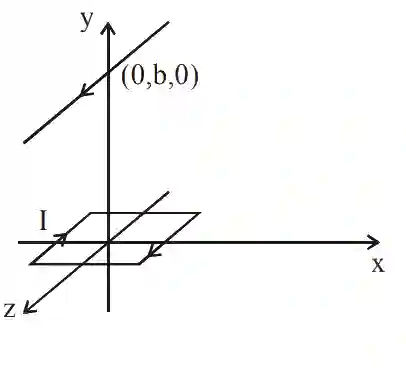
A square loop of side 2 aa and carrying current I is kept in xz plane with its centre at origin. A long wire carrying the same current I is placed parallel to z-axis and passing through point (0, b, 0), (b >> a). The magnitude of torque on the loop about z-axis will be :

Multiple Choice Options

  • A 2μ0I2a2πb{{2{\mu _0}{I^2}{a^2}} \over {\pi b}}
  • B 2μ0I2a2bπ(a2+b2){{2{\mu _0}{I^2}{a^2}b} \over {\pi \left( {{a^2} + {b^2}} \right)}}
  • C μ0I2a2b2π(a2+b2){{{\mu _0}{I^2}{a^2}b} \over {2\pi \left( {{a^2} + {b^2}} \right)}}
  • D μ0I2a22πb{{{\mu _0}{I^2}{a^2}} \over {2\pi b}}

Step-by-Step Verified Solution

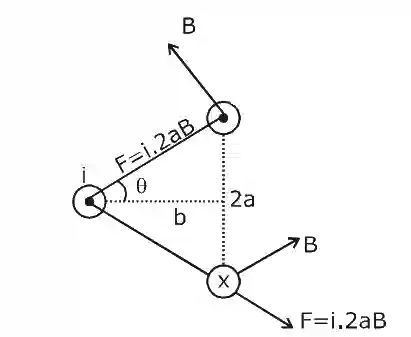
JEE Main 2020 (Online) 6th September Evening Slot Physics - Magnetic Effect of Current Question 124 English Explanation 1 JEE Main 2020 (Online) 6th September Evening Slot Physics - Magnetic Effect of Current Question 124 English Explanation 2

First, let's consider the magnetic field created by the long wire carrying a current II at a distance bb . According to Ampere's Law, the magnetic field BB at a distance bb from a long straight wire is given by:

B=μ0I2πbB = \frac{{\mu_0 I}}{{2\pi b}}

where μ0\mu_0 is the permeability of free space.

Given that the square loop of side 2a2a is carrying the same current II and is located in the xz-plane with its center at the origin, we can analyze the forces on each side of the loop. The sides of the loop parallel to the x-axis will experience forces due to the magnetic field from the long wire. Considering symmetry and the directions of forces, the net force on these sides will not contribute to the torque around the z-axis.

The contribution to the torque around the z-axis will predominantly come from the sides of the loop parallel to the y-axis. For these sides, the magnetic forces will be in opposite directions and will create a torque around the z-axis.

Let's calculate the forces on the sides parallel to the y-axis. For a current element IdlIdl in the presence of a magnetic field BB , the force dFdF is given by:

dF=Idl×BdF = I dl \times B

For the sides at x=ax = a and x=−ax = -a , the distances to the wire are a+ba + b and a−ba - b , respectively.

The magnetic fields at these positions due to the long wire are:

For x=ax = a :

Ba=μ0I2π(a+b)B_a = \frac{{\mu_0 I}}{{2 \pi (a+b)}}

For x=−ax = -a :

B−a=μ0I2π(a−b)B_{-a} = \frac{{\mu_0 I}}{{2 \pi (a-b)}}

Since b≫ab \gg a , we can approximate these fields using binomial expansion for small (ab)\left(\frac{a}{b}\right) :

Ba≈μ0I2πb(1−ab)B_a \approx \frac{{\mu_0 I}}{{2 \pi b}} \left(1 - \frac{a}{b}\right)

B−a≈μ0I2πb(1+ab)B_{-a} \approx \frac{{\mu_0 I}}{{2 \pi b}} \left(1 + \frac{a}{b}\right)

The forces on each side of the loop with length 2a2a are:

For x=ax = a :

Fa=I⋅2a⋅Ba=I⋅2a⋅μ0I2πb(1−ab)F_a = I \cdot 2a \cdot B_a = I \cdot 2a \cdot \frac{{\mu_0 I}}{{2 \pi b}} \left(1 - \frac{a}{b}\right)

For x=−ax = -a :

F−a=I⋅2a⋅B−a=I⋅2a⋅μ0I2πb(1+ab)F_{-a} = I \cdot 2a \cdot B_{-a} = I \cdot 2a \cdot \frac{{\mu_0 I}}{{2 \pi b}} \left(1 + \frac{a}{b}\right)

The net torque τ\tau around the z-axis is due to these forces, with lever arms aa and −a-a respectively:

τ=2a(Fa−F−a)\tau = 2a \left( F_a - F_{-a} \right)

Substituting the expressions for FaF_a and F−aF_{-a} :

τ=2a[I⋅2a⋅μ0I2πb(1−ab)−I⋅2a⋅μ0I2πb(1+ab)]\tau = 2a \left[ I \cdot 2a \cdot \frac{{\mu_0 I}}{{2 \pi b}} \left(1 - \frac{a}{b}\right) - I \cdot 2a \cdot \frac{{\mu_0 I}}{{2 \pi b}} \left(1 + \frac{a}{b}\right) \right]

Simplifying this expression, we get:

τ=2a[2aI⋅μ0I2πb(−2ab)]\tau = 2a \left[ 2a I \cdot \frac{{\mu_0 I}}{{2 \pi b}} \left( -\frac{2a}{b} \right) \right]

τ=−2a⋅4a2μ0I22πb2\tau = -2a \cdot \frac{{4a^2 \mu_0 I^2}}{{2 \pi b^2}}

The negative sign indicates the direction of the torque, but the magnitude is:

τ=4a3μ0I2πb2\tau = \frac{{4a^3 \mu_0 I^2}}{{\pi b^2}}

Since a≪ba \ll b , the approximate magnitude of the torque around the z-axis simplifies to:

τ=2μ0I2a2πb\tau = \frac{{2 \mu_0 I^2 a^2}}{{\pi b}}

Therefore, the correct answer is:

Option A

2μ0I2a2πb\frac{{2\mu_0 I^2 a^2}}{{\pi b}}

Related Learning Resources & Exam Preparation