Verified Solution • 2025–26 Session
moderate
QJEEM20Phca54: JEE Main 2020 Physics - Class 12 JEEM20Phca54 Solution: A charged particle of mass 'm' and charge 'q' moving under the…
A charged particle of mass 'm' and charge 'q' moving under the influence of uniform electric field and a uniform magnetic field follows a trajectory from point P to Q as shown in figure. The velocities at P and Q are respectively, and . Then which of the following statements (A, B, C, D) are the correct ?
(Trajectory shown is schematic and not to scale) :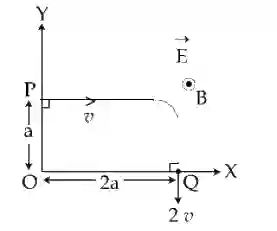
(A) E =
(B) Rate of work done by the electric field at P is
(C) Rate of work done by both the fields at Q is zero
(D) The difference between the magnitude of angular momentum of the particle at P and Q is 2mav.
(Trajectory shown is schematic and not to scale) :
(A) E =
(B) Rate of work done by the electric field at P is
(C) Rate of work done by both the fields at Q is zero
(D) The difference between the magnitude of angular momentum of the particle at P and Q is 2mav.
Multiple Choice Options
- A (A), (B), (C), (D)
- B (A), (B), (C)
- C (A), (C), (D)
- D (B), (C), (D)
Step-by-Step Verified Solution
For the particle moving from point P to point Q,
WElectric field + WMagnetic field = KE
qE(2 ) + 0 =
2qE =
E =
Point (A) is correct.
Rate of work done(Power) by electric
field at p = = qEv =
Point (B) is also correct.
Angle between electric force and velocity is 90º, hence rate of work done will be zero at Q.
Point (C) is also correct.
Initial angular momentum at P, i = mv
Final angular momentum at Q, f = m(2v)
Change in angular momentum f – i =
Magnitude in the change in angular momentum =
Point (D) is wrong.