Verified Solution • 2025–26 Session moderate

QJEEM20Ph80fb: JEE Main 2020 Physics - Class 12 JEEM20Ph80fb Solution: A charged particle (mass m and charge q) moves along X-axis…

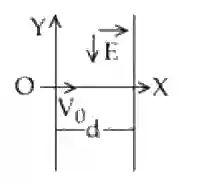
A charged particle (mass m and charge q)
moves along X-axis with velocity V0. When it
passes through the origin it enters a region having uniform electric field
E→=−Ej^\overrightarrow E = - E\widehat j which extends upto x = d.
Equation of path of electron in the region x > d is JEE Main 2020 (Online) 2nd September Morning Slot Physics - Electrostatics Question 154 English
Multiple Choice Options

  • A y = qEdmV02(x−d){{qEd} \over {mV_0^2}}\left( {x - d} \right)
  • B y = qEdmV02(d2−x){{qEd} \over {mV_0^2}}\left( {{d \over 2} - x} \right)
  • C y = qEdmV02x{{qEd} \over {mV_0^2}}x
  • D y = qEd2mV02x{{qE{d^2}} \over {mV_0^2}}x

Step-by-Step Verified Solution

JEE Main 2020 (Online) 2nd September Morning Slot Physics - Electrostatics Question 154 English Explanation
Let particle have charge q and mass 'm

We know, F = may = qE

∴\therefore ay=qEm{a_y} = {{qE} \over m}

As electric field is along vertical direction so horizontal component of acceleration is zero.

∴\therefore ax = 0

Applying, S=uyt+12ayt2S = {u_y}t + {1 \over 2}{a_y}{t^2}

−y=0×t+12(qEm)t2- y = 0\times t + {1 \over 2}\left( {{{qE} \over m}} \right){t^2} ....(1)

Also, x=V0tx = {V_0}t

⇒t=xV0\Rightarrow t = {x \over {{V_0}}}

Putting in (1) we get,

y=−12(qEm)(xV0)2y = - {1 \over 2}\left( {{{qE} \over m}} \right){\left( {{x \over {{V_0}}}} \right)^2}

Differentiating with respect to x,

dydx=−qEm(xV02){{dy} \over {dx}} = - {{qE} \over m}\left( {{x \over {V_0^2}}} \right)

∴\therefore Slope = m=tan⁡θ=−qEm(xV02)m = \tan \theta = - {{qE} \over m}\left( {{x \over {V_0^2}}} \right)

when x = d, then m=−qEm(dV02)m = - {{qE} \over m}\left( {{d \over {V_0^2}}} \right)

We know, equation of straight line whose slope is m,

y = mx + c

Here m = (−qEdmV02)\left( { - {{qEd} \over {mV_0^2}}} \right) ,

∴\therefore −12(qEm)(dV0)2=(−qEdmV02)d+c- {1 \over 2}\left( {{{qE} \over m}} \right){\left( {{d \over {{V_0}}}} \right)^2} = \left( { - {{qEd} \over {mV_0^2}}} \right)d + c

⇒\Rightarrow c = qEd2mV02{{{qEd} \over {2mV_0^2}}}

Putting the value of c, we get

y=−(qEdmV02)x+qEd22mV02y = - \left( {{{qEd} \over {mV_0^2}}} \right)x + {{qE{d^2}} \over {2mV_0^2}}

=qEdmV02(d2−x)= {{qEd} \over {mV_0^2}}\left( {{d \over 2} - x} \right)

Related Learning Resources & Exam Preparation