Verified Solution • 2025–26 Session
moderate
QJEEM19Ph4ece: JEE Main 2019 Physics - Class 12 JEEM19Ph4ece Solution: An alternating voltage v(t) = 220 sin 100 t volt is applied to…
An alternating voltage v(t) = 220 sin 100 t volt is applied to a purely resistance load of 50 . The time taken for the current to rise from half of the peak value to the peak value is :
Multiple Choice Options
- A 5 ms
- B 2.2 ms
- C 3.3 ms
- D 7.2 ms
Step-by-Step Verified Solution
In an AC resistive circuit, current and voltage are in phase.
So, ..... (i)
Time period of one complete cycle of current is
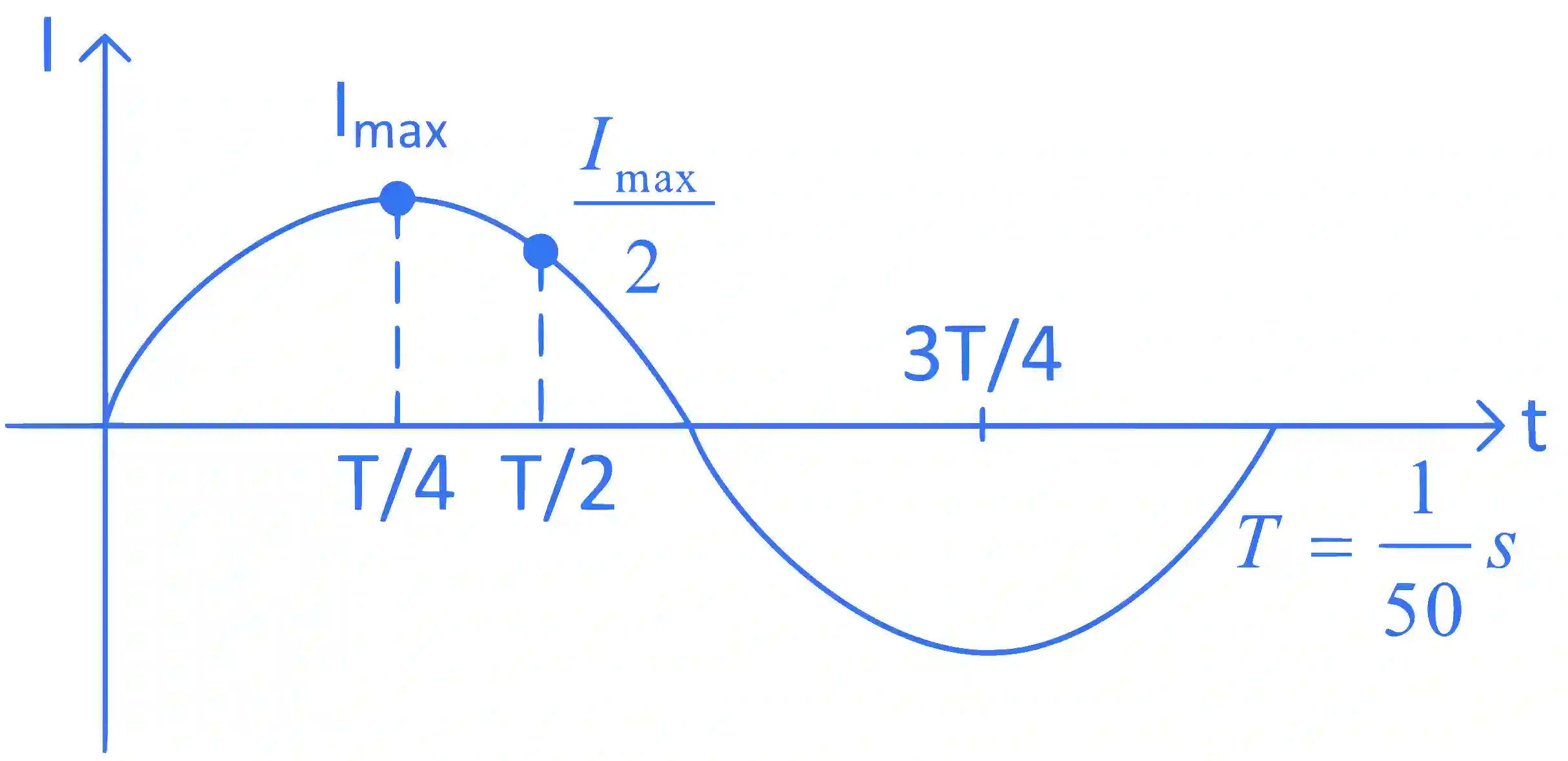
So, current reaches its maximum value at
When current is half of its maximum value, then from Eq.(i), we have
So, instantaneous time at which current is half of maximum value is
Hence, time duration in which current reaches half of its maximum value after reaching maximum value is
ms