Verified Solution • 2025–26 Session moderate

QJEEM19Ph3aed: JEE Main 2019 Physics - Class 11 JEEM19Ph3aed Solution: A slab is subjected to two forces and of same magnitude F as…

A slab is subjected to two forces F1→\overrightarrow {{F_1}} and F2→\overrightarrow {{F_2}} of same magnitude F as shown in the figure. Force F2→\overrightarrow {{F_2}} is in XY-plane while force F1→\overrightarrow {{F_1}} acts along z = axis at the point (2i→+3j→).\left( {2\overrightarrow i + 3\overrightarrow j } \right). . The moment of these forces about point O will be :
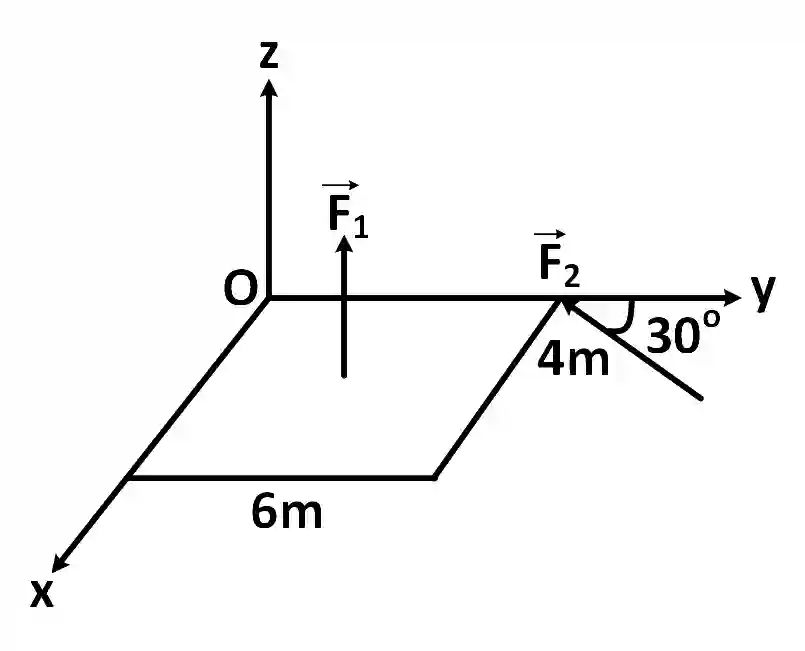
JEE Main 2019 (Online) 11th January Morning Slot Physics - Rotational Motion Question 170 English

Multiple Choice Options

  • A (3i^−2j^−3k^)F\left( {3\widehat i - 2\widehat j - 3\widehat k} \right)F
  • B (3i^+2j^−3k^)F\left( {3\widehat i + 2\widehat j - 3\widehat k} \right)F
  • C (3i^+2j^+3k^)F\left( {3\widehat i + 2\widehat j + 3\widehat k} \right)F
  • D (3i^−2j^+3k^)F\left( {3\widehat i - 2\widehat j + 3\widehat k} \right)F

Step-by-Step Verified Solution

To determine the moment of the forces about point O, we need to calculate the moments of each force and then combine them vectorially.

First, consider force F1→\overrightarrow{F_1} . This force acts along the z-axis at the point (2i→+3j→)(2\overrightarrow{i} + 3\overrightarrow{j}) .

The position vector of the point of application of F1→\overrightarrow{F_1} relative to the origin O is:

r1→=2i→+3j→\overrightarrow{r_1} = 2\overrightarrow{i} + 3\overrightarrow{j}

Since F1→\overrightarrow{F_1} acts along the z-axis, we can express it as:

F1→=Fk→\overrightarrow{F_1} = F\overrightarrow{k}

The moment of force F1→\overrightarrow{F_1} about point O is given by the cross product:

M1→=r1→×F1→\overrightarrow{M_1} = \overrightarrow{r_1} \times \overrightarrow{F_1}

Substitute the values:

M1→=(2i→+3j→)×Fk→\overrightarrow{M_1} = (2\overrightarrow{i} + 3\overrightarrow{j}) \times F\overrightarrow{k}

Compute the cross product:

M1→=2F(i→×k→)+3F(j→×k→)\overrightarrow{M_1} = 2F(\overrightarrow{i} \times \overrightarrow{k}) + 3F(\overrightarrow{j} \times \overrightarrow{k}) M1→=2F(−j→)+3Fi→\overrightarrow{M_1} = 2F(-\overrightarrow{j}) + 3F\overrightarrow{i} M1→=−2Fj→+3Fi→\overrightarrow{M_1} = -2F\overrightarrow{j} + 3F\overrightarrow{i}

So, the moment due to force F1→\overrightarrow{F_1} is:

M1→=3Fi→−2Fj→\overrightarrow{M_1} = 3F\overrightarrow{i} - 2F\overrightarrow{j}

Torque for F2 force

F→2{\overrightarrow F _2} = F2(−i^)+F32(−j^){F \over 2}\left( { - \widehat i} \right) + {{F\sqrt 3 } \over 2}\left( { - \widehat j} \right)

r→1=0i^+6j^{\overrightarrow r _1} = 0\widehat i + 6\widehat j

τ→F2=r1→×F1→=3Fk^{\overrightarrow \tau _{_{{F_2}}}} = \overrightarrow {{r_1}} \times \overrightarrow {{F_1}} = 3F\widehat k

τ→net=τ→F1+τ→f2{\overrightarrow \tau _{net}} = {\overrightarrow \tau _{{F_1}}} + {\overrightarrow \tau _{{f_2}}}

=3Fi^+2F(−j^)+3F(k^)= 3F\widehat i + 2F\left( { - \widehat j} \right) + 3F\left( {\widehat k} \right)

Related Learning Resources & Exam Preparation