QJEEM19Ph25ed: JEE Main 2019 Physics - Class 11 JEEM19Ph25ed Solution: A wedge of mass M = 4m lies on a frictionless plane. A particle …
Multiple Choice Options
- A
- B
- C
- D
Step-by-Step Verified Solution
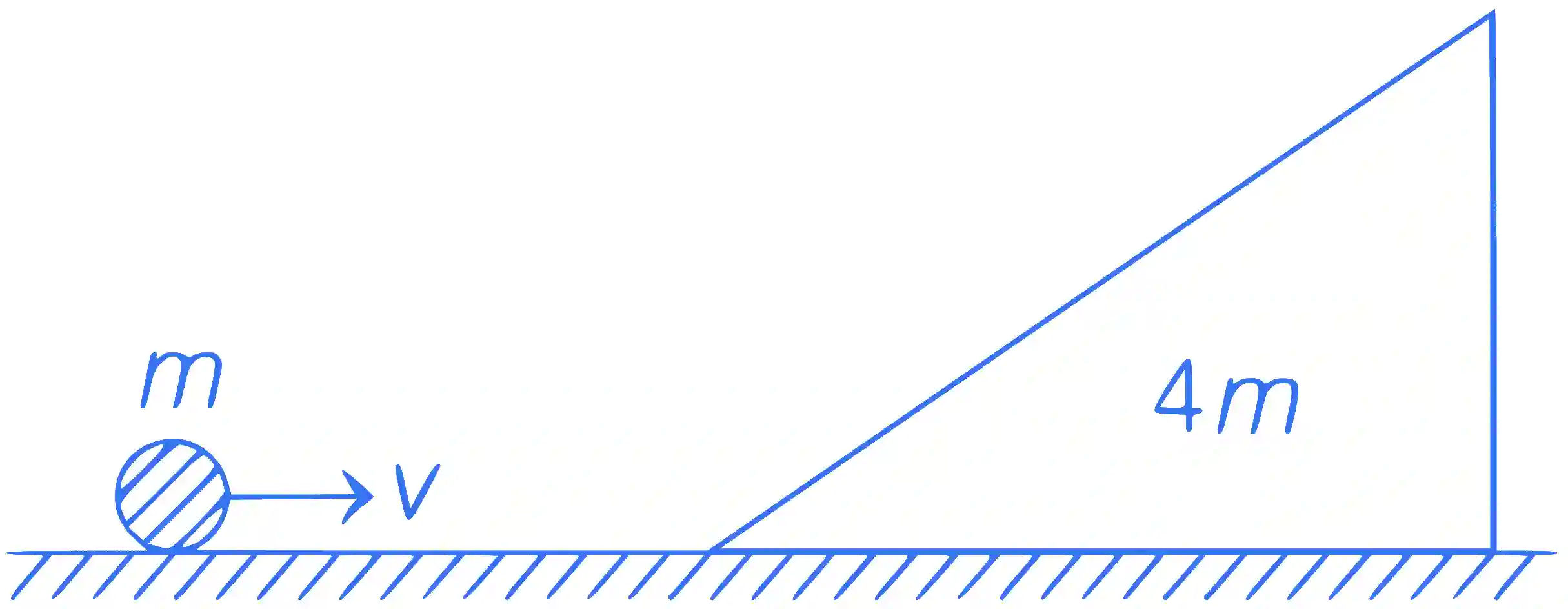
As mass collides with wedge, let both wedge and mass move with speed . Then,
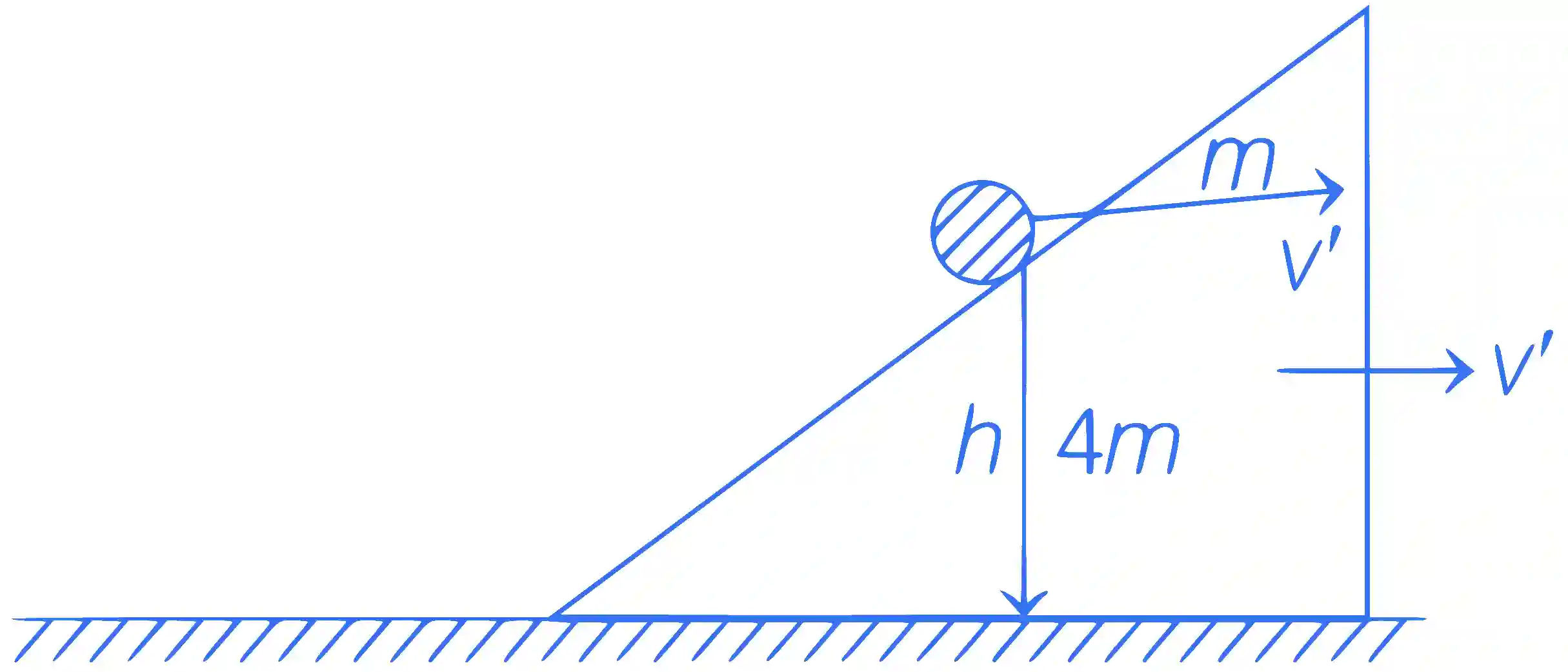
Given:
Mass of the wedge (M) = 4m
Mass of the particle (m)
Initial speed of the particle (v)
There is no friction.
Step 1 : Conservation of Linear Momentum
Before the collision, the momentum of the system is just the momentum of the particle because the wedge is at rest. After the collision, both the particle and the wedge will be moving. Let's denote the final common velocity as .
We can write the conservation of momentum as :
which simplifies to
v' = \frac{v}{5} \tag{1}
Step 2 : Conservation of Mechanical Energy
We apply the conservation of energy before and after the collision. Before the collision, only the particle has kinetic energy. After the collision, both the particle and the wedge have kinetic energy and the particle has potential energy due to its height h on the wedge.
We can write the conservation of energy as :
which simplifies to
Substituting equation (1) into this equation gives
which simplifies to
So, the maximum height climbed by the particle on the wedge is given by .
Therefore, the correct answer is Option D :