Verified Solution • 2025–26 Session moderate

QJEEM16Ph630d: JEE Main 2016 Physics - Class 11 JEEM16Ph630d Solution: A uniformly tapering conical wire is made from a material of…

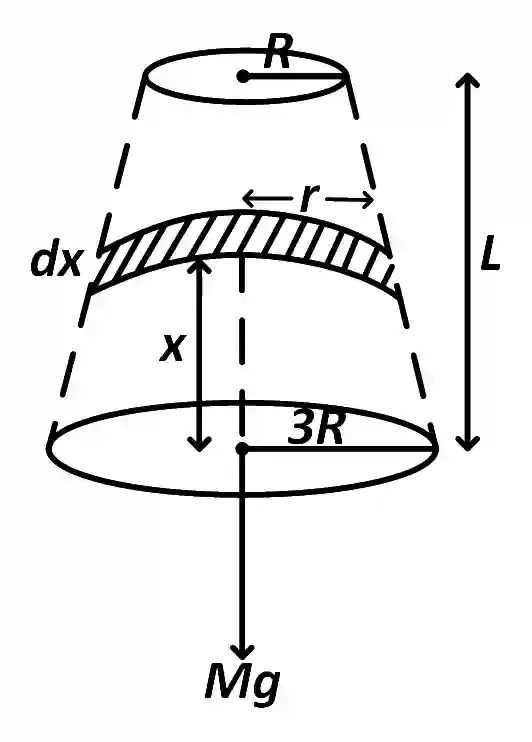
A uniformly tapering conical wire is made from a material of Young’s modulus Y and has a normal, unextended length L. The radii, at the upper and lower ends of this conical wire, have values R and 3 R, respectively. The upper end of the wire is fixed to a rigid support and a mass M is suspended from its lower end. The equilibrium extended length, of this wire, would equal :

Multiple Choice Options

  • A L (1+29MgπYR2)\left( {1 + {2 \over 9}{{Mg} \over {\pi Y{R^2}}}} \right)
  • B L (1+13MgπYR2)\left( {1 + {1 \over 3}{{Mg} \over {\pi Y{R^2}}}} \right)
  • C L (1+19MgπYR2)\left( {1 + {1 \over 9}{{Mg} \over {\pi Y{R^2}}}} \right)
  • D L (1+23MgπYR2)\left( {1 + {2 \over 3}{{Mg} \over {\pi Y{R^2}}}} \right)

Step-by-Step Verified Solution

JEE Main 2016 (Online) 9th April Morning Slot Physics - Properties of Matter Question 230 English Explanation

Here r = 3R −- 2RL{{2R} \over L} x

∴\therefore    Extension in the wire of length dx,

dl = FdxAY{{Fdx} \over {AY}}

= Mg dxπr2 Y{{Mg\,dx} \over {\pi {r^2}\,Y}}

= Mg dxπ(3R−2RLx)2Y{{Mg\,dx} \over {\pi {{\left( {3R - {{2R} \over L}x} \right)}^2}Y}}

∴\therefore    Change in wire length,

Δ\Delta L = ∫0Ldl\int\limits_0^L {dl}

= ∫0LMg dxπ(3R−2RLx)2Y\int\limits_0^L {{{Mg\,dx} \over {\pi {{\left( {3R - {{2R} \over L}x} \right)}^2}Y}}}

= MgπY∫0Ldx(3R−2RLx)2{{Mg} \over {\pi Y}}\int\limits_0^L {{{dx} \over {{{\left( {3R - {{2R} \over L}x} \right)}^2}}}}

= MgπY[−1(3R−2RLx)×(−L2R)]0L{{Mg} \over {\pi Y}}\left[ { - {1 \over {\left( {3R - {{2R} \over L}x} \right)}} \times \left( { - {L \over {2R}}} \right)} \right]_0^L

= MgπY{{Mg} \over {\pi Y}} [(L2R2−L6R2)]\left[ {\left( {{L \over {2{R^2}}} - {L \over {6{R^2}}}} \right)} \right]

= MgπY(2L6R2){{Mg} \over {\pi Y}}\left( {{{2L} \over {6{R^2}}}} \right)

= MgL3πR2Y{{MgL} \over {3\pi {R^2}Y}}

∴\therefore    The equilibrium extended length of the wire,

= L + Δ\Delta L

= L + MgL3πR2Y{{MgL} \over {3\pi {R^2}Y}}

= L (1 + 13{1 \over 3} MgπR2Y{{Mg} \over {\pi {R^2}Y}} )

Related Learning Resources & Exam Preparation