Verified Solution • 2025–26 Session
moderate
QJEEAdv23Ph80af: JEE Advanced 2023 Physics - Class 11 JEEAdv23Ph80af Solution: A thin circular coin of mass and radius is initially in a…
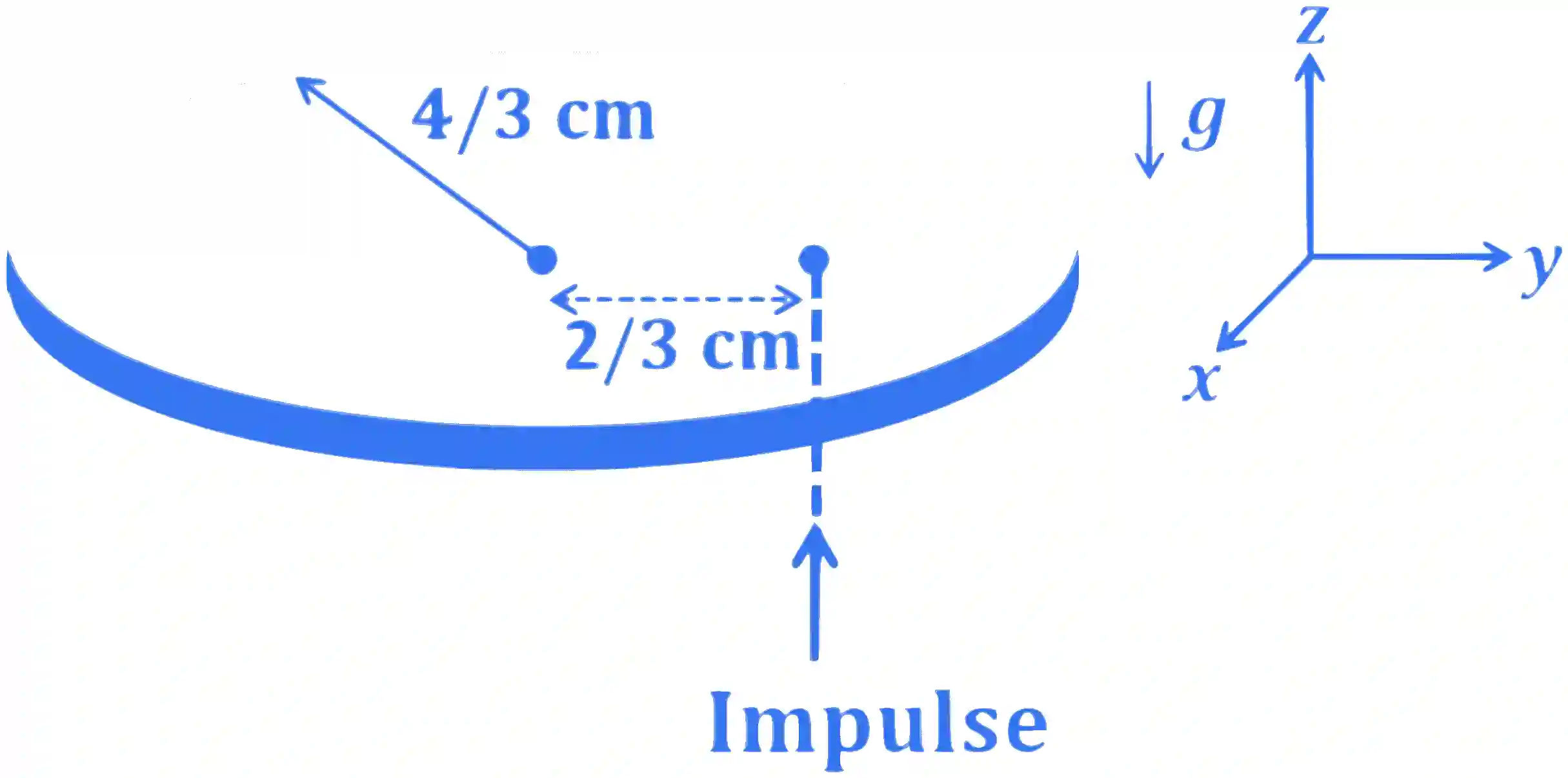
A thin circular coin of mass and radius is initially in a horizontal -plane. The coin is tossed vertically up ( direction) by applying an impulse of -s at a distance from its center. The coin spins about its diameter and moves along the direction. By the time the coin reaches back to its initial position, it completes rotations. The value of is ________.
[Given: The acceleration due to gravity ]

[Given: The acceleration due to gravity ]
Step-by-Step Verified Solution
A coin with a radius of and a mass of is thrown upwards. An impulse of is applied perpendicularly to the plane of the coin. This impulse is delivered at a distance of from the center of the coin.
Initially at rest, the coin experiences a change in linear momentum due to the applied linear impulse, leading to the equation :
.
where is the mass of the coin, is its center of mass velocity after the impulse, and is the magnitude of the linear impulse.
After the impulse, the center of mass of the coin ascends with an initial velocity . Under the influence of gravity, the coin returns to its original position in a time duration expressed by :
,
where is the acceleration due to gravity, is the linear impulse applied, and is the mass of the coin.
The coin undergoes rotation about its axis, and the angular impulse exerted on it around its center is described by the equation :
,
where is the angular impulse, is the distance from the center at which the linear impulse is applied, and is the radius of the coin.
The angular impulse leads to a change in the angular momentum of the coin about a horizontal axis passing through its center. This relationship is given by :
,
where is the moment of inertia of the coin about its center of mass, is the angular velocity after the impulse, and is the angular momentum resulting from the angular impulse .
The angular speed of the coin, denoted as , is determined by the equation :
,
where is the radius of the coin, is the linear impulse applied, is the mass of the coin, and is its moment of inertia about the center of mass.
After tossing, the angular speed of the coin remains constant because there is no external torque. The number of rotations
Substituting the given values, it becomes :
.
where is the total angular displacement, is the angular speed of the coin, is the linear impulse, is the mass of the coin, is the acceleration due to gravity, and is the radius of the coin.