Verified Solution • 2025–26 Session moderate

QJEEAdv23Ph6256: JEE Advanced 2023 Physics - Class 12 JEEAdv23Ph6256 Solution: An optical arrangement consists of two concave mirrors and ,…

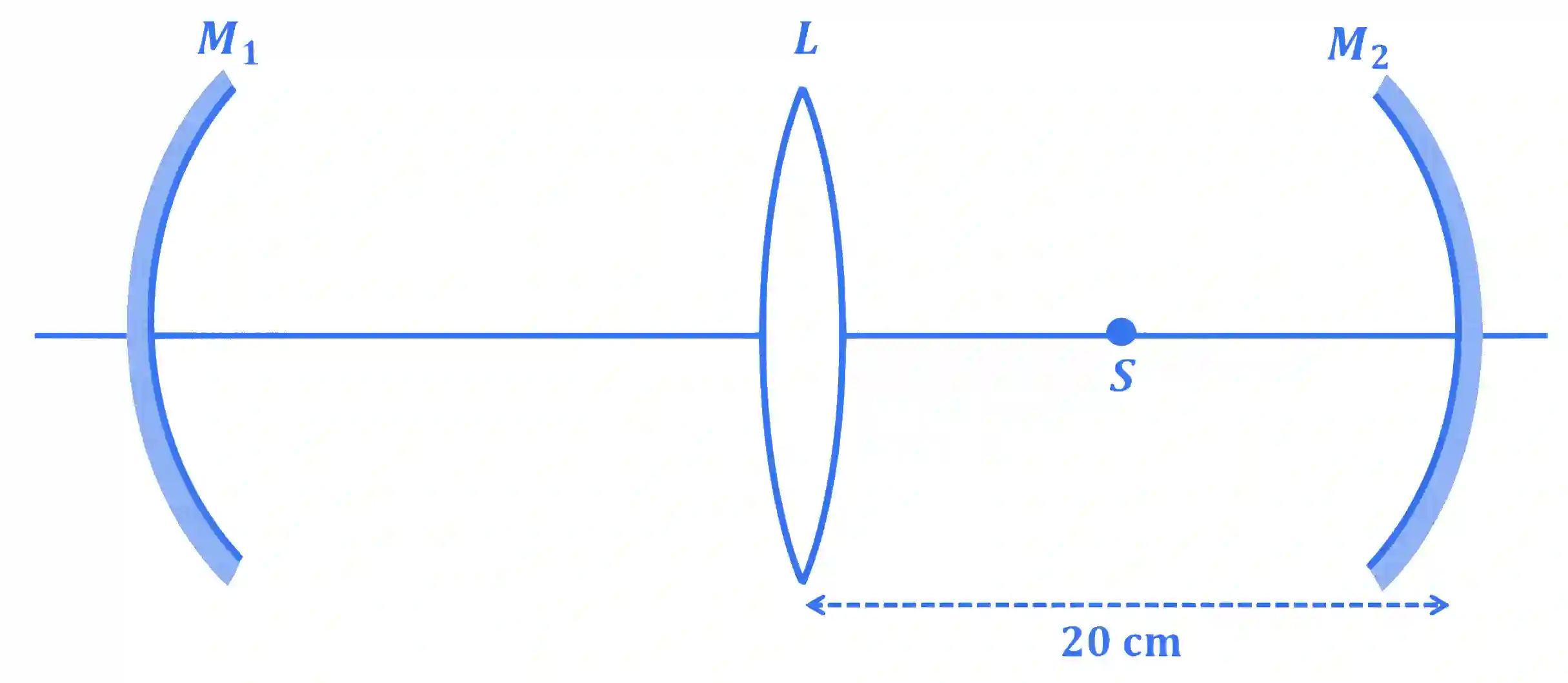
An optical arrangement consists of two concave mirrors M1M_1 and M2M_2 , and a convex lens LL with a common principal axis, as shown in the figure. The focal length of L\mathrm{L} is 10 cm10 \mathrm{~cm} . The radii of curvature of M1M_1 and M2M_2 are 20 cm20 \mathrm{~cm} and 24 cm24 \mathrm{~cm} , respectively. The distance between LL and M2M_2 is 20 cm20 \mathrm{~cm} . A point object SS is placed at the mid-point between L\mathrm{L} and M2M_2 on the axis. When the distance between L\mathrm{L} and M1\mathrm{M}_1 is n/7 cmn / 7 \mathrm{~cm} , one of the images coincides with S\mathrm{S} . The value of nn is _______.

JEE Advanced 2023 Paper 1 Online Physics - Geometrical Optics Question 5 English

Step-by-Step Verified Solution

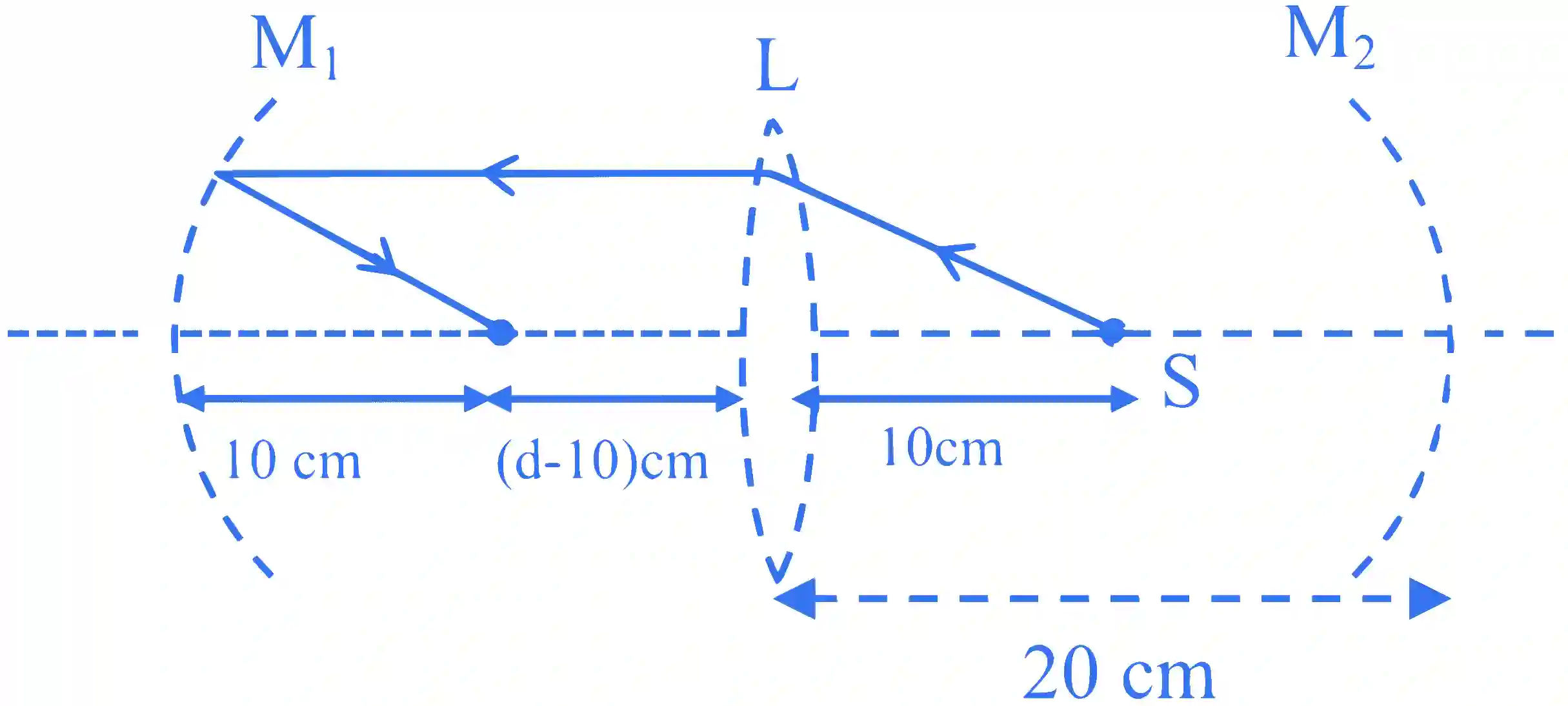
Case-1 : if Ist \mathrm{I}^{\text {st }} refraction on lens : JEE Advanced 2023 Paper 1 Online Physics - Geometrical Optics Question 5 English Explanation 1

Given that the object is positioned at the focal point, the resulting light rays will transition to a parallel alignment.

Upon the first reflection at Mirror M1M_1 :
As the incoming light rays are parallel, the resultant image will be formed at the focal point.


IInd \mathrm{II}^{\text {nd }} refraction from L\mathrm{L} :-

amp;u=−(d−10)amp;f=10 cmamp;1v−1μ=1famp;1v+1 d−10=110amp;1v=110−1( d−10).......(i)\begin{aligned}& \mathrm{u}=-(\mathrm{d}-10) \\\\& \mathrm{f}=10 \mathrm{~cm} \\\\& \frac{1}{\mathrm{v}}-\frac{1}{\mu}=\frac{1}{\mathrm{f}} \\\\& \frac{1}{\mathrm{v}}+\frac{1}{\mathrm{~d}-10}=\frac{1}{10} \\\\& \frac{1}{\mathrm{v}}=\frac{1}{10}-\frac{1}{(\mathrm{~d}-10)} .......(i)\end{aligned}

This vv will be object for M2M_2 , and image should be at 10 cm10 \mathrm{~cm}

amp;1μ+1v1=1famp;−1(20−v)−110=−112amp;112−110=120−vamp;−2120=120−vamp;20−v=−60amp;v=80 cm\begin{aligned}& \frac{1}{\mu}+\frac{1}{v_1}=\frac{1}{f} \\\\& -\frac{1}{(20-v)}-\frac{1}{10}=-\frac{1}{12} \\\\& \frac{1}{12}-\frac{1}{10}=\frac{1}{20-v} \\\\& -\frac{2}{120}=\frac{1}{20-v} \\\\& 20-v=-60 \\\\& v=80 \mathrm{~cm}\end{aligned}

From equation (i), we get

amp;180=110−1d−10amp;1d−10=110−180amp;1d−10=80−10800=70800amp;d−10=807⇒d=10+807=1507amp;n=150\begin{aligned}& \frac{1}{80}=\frac{1}{10}-\frac{1}{d-10} \\\\& \frac{1}{d-10}=\frac{1}{10}-\frac{1}{80} \\\\& \frac{1}{d-10}=\frac{80-10}{800}=\frac{70}{800} \\\\& d-10=\frac{80}{7} \Rightarrow d=10+\frac{80}{7}=\frac{150}{7} \\\\& n=150\end{aligned}

Case-2 : If 1st 1^{\text {st }} reflection on mirror m2m_2 :

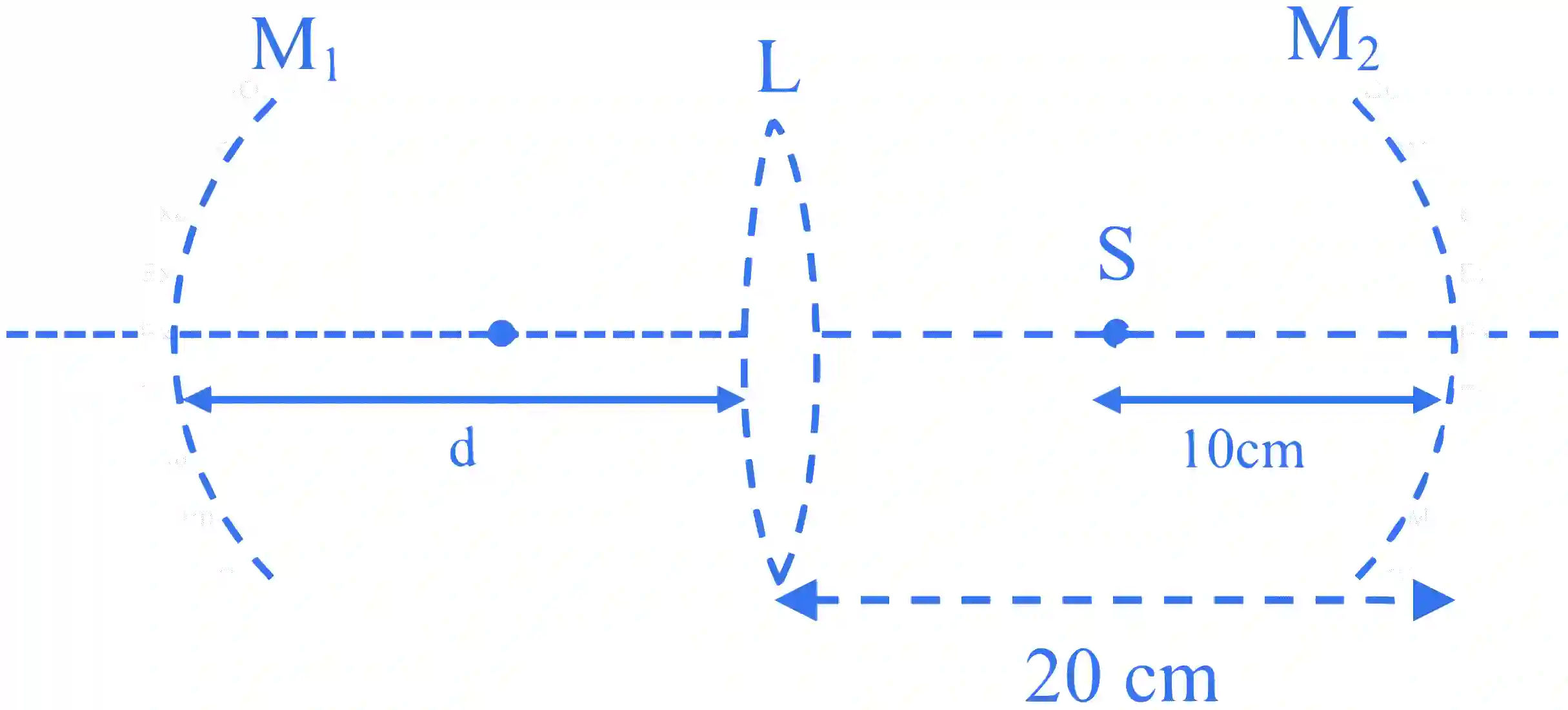
JEE Advanced 2023 Paper 1 Online Physics - Geometrical Optics Question 5 English Explanation 2

For m2\mathrm{m}_2

amp;1 V1+1−10=1−12amp; V1=60 cm\begin{aligned}& \frac{1}{\mathrm{~V}_1}+\frac{1}{-10}=\frac{1}{-12} \\\\& \mathrm{~V}_1=60 \mathrm{~cm}\end{aligned}

Then refraction on lens L\mathrm{L}

amp;u2=80 cmamp;1 V2−1−60=110amp; V2=807\begin{aligned}& \mathrm{u}_2=80 \mathrm{~cm} \\\\& \frac{1}{\mathrm{~V}_2}-\frac{1}{-60}=\frac{1}{10} \\\\& \mathrm{~V}_2=\frac{80}{7}\end{aligned}

Then reflection on m2\mathrm{m}_2

Either V2V_2 is at centre (normal incidence)

amp;d−807=20amp; d=2207amp;n7=2207amp;n=220\begin{aligned}& \mathrm{d}-\frac{80}{7}=20 \\\\& \mathrm{~d}=\frac{220}{7} \\\\& \frac{\mathrm{n}}{7}=\frac{220}{7} \\\\& \mathrm{n}=220\end{aligned}

V2V_2 is at pole of m2m_2

amp;d−807=0amp; d=807amp;n7=807amp;n=80\begin{aligned}& \mathrm{d}-\frac{80}{7}=0 \\\\& \mathrm{~d}=\frac{80}{7} \\\\& \frac{\mathrm{n}}{7}=\frac{80}{7} \\\\& \mathrm{n}=80\end{aligned}

Related Learning Resources & Exam Preparation