Verified Solution • 2025–26 Session
moderate
QJEEAdv23Ph45d0: JEE Advanced 2023 Physics - Class 11 JEEAdv23Ph45d0 Solution: An annular disk of mass , inner radius and outer radius is…
An annular disk of mass , inner radius and outer radius is placed on a horizontal surface with coefficient of friction , as shown in the figure. At some time, an impulse is applied at a height above the center of the disk. If then the disk rolls without slipping along the -axis. Which of the following statement(s) is(are) correct?

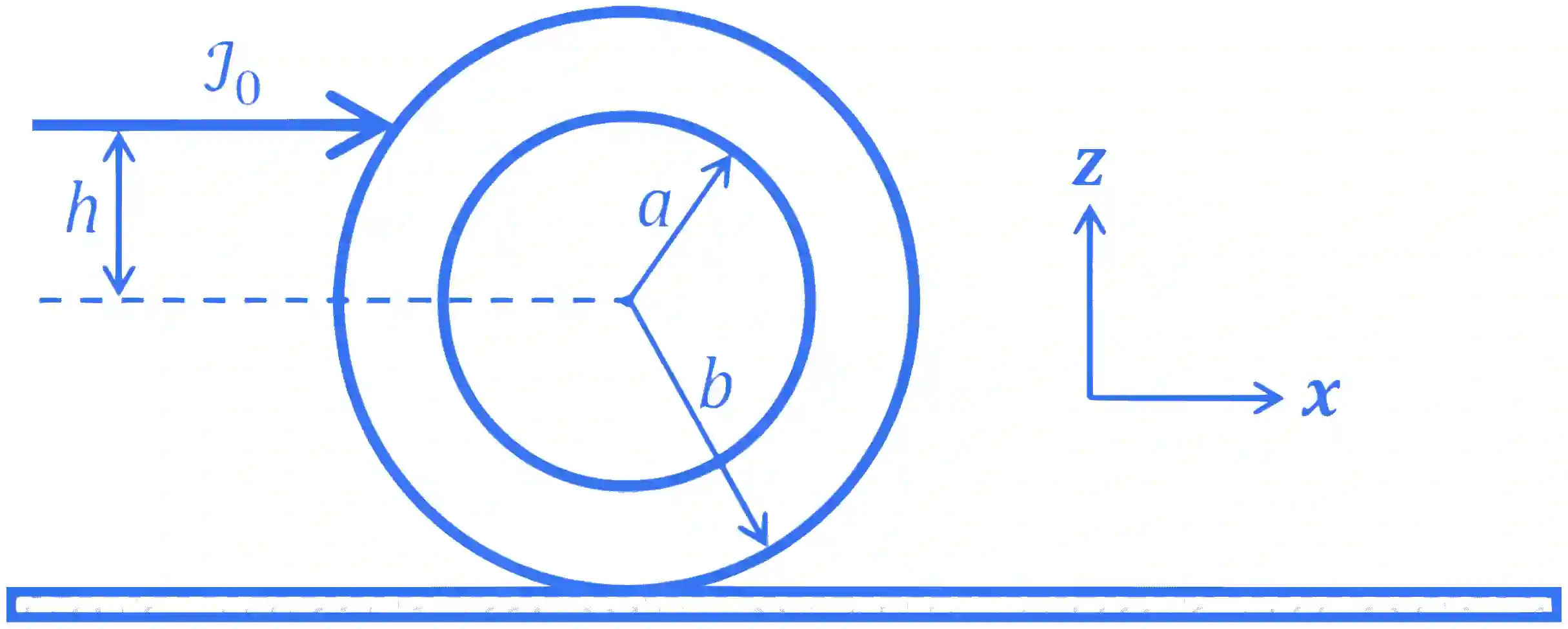
Multiple Choice Options
- A For and .
- B For and .
- C For , the initial angular velocity does not depend on the inner radius .
- D For and , the wheel always slides without rolling.
Step-by-Step Verified Solution
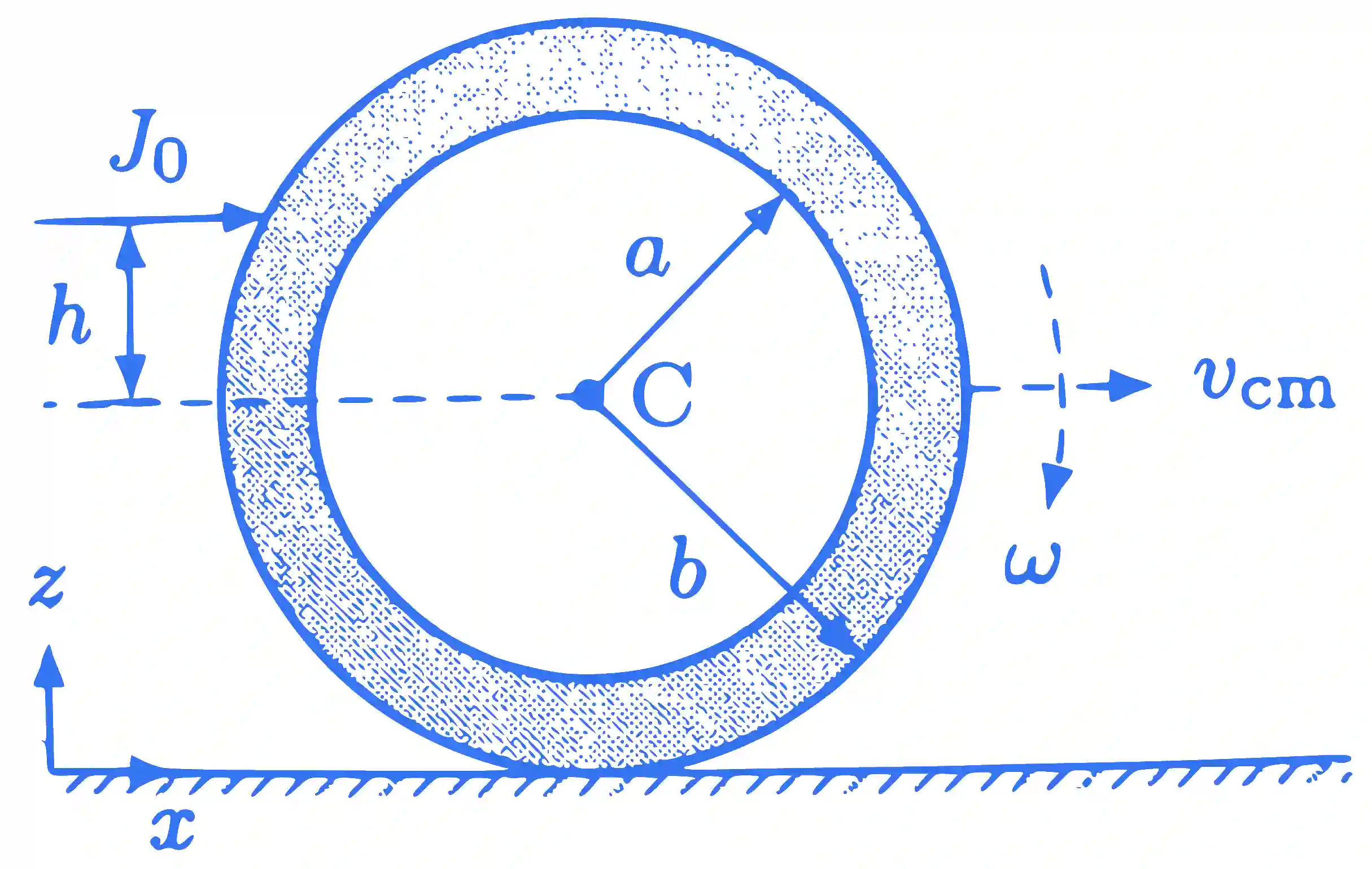
The moment of inertia of an annular disc, with an inner radius , an outer radius , and a mass , about an axis perpendicular to the disc and passing through its center , is given by :
,
where and are the squares of the inner and outer radii, respectively.

The linear impulse alters the linear momentum of the disc. Right after the impulse is applied, the linear momentum can be represented as :
,
where is the mass of the disc and is the velocity of the center of mass resulting from the impulse.
The angular impulse about the center of mass of the disc is applied in a clockwise direction, with its magnitude being . This impulse changes the angular momentum of the disc about point , expressed as :
,
where is the moment of inertia of the disc about its center of mass, is the angular velocity resulting from the angular impulse, is the linear impulse, and is a factor relating the angular impulse to the linear impulse.
For the disc to roll without slipping, given that the friction coefficient is non-zero, the condition is . By substituting the expressions for and and solving, we obtain the following relationship for the minimum value of (denoted as ) :
,
where is the moment of inertia of the disc about its center of mass, is the mass of the disc, is the inner radius, and is the outer radius of the disc.
By substituting into the formula, we find that . This implies that a solid disc will roll without slipping if the impulse is applied midway along the upper half of the disc.
Similarly, substituting yields . This indicates that a ring (an annular disc with equal inner and outer radii) will roll without slipping when the horizontal impulse is applied at the very top of the ring.
For the condition where , the initial angular velocity is given by :
.
This expression for the angular velocity is independent of the inner radius of the disc.
When a wheel is placed on a smooth surface with no friction ( ) and an impulse is applied directly at its center ( ), there is no torque generated to initiate rotation. Consequently, under these conditions, if an impulse is delivered to the center of a wheel on a frictionless surface, the wheel will invariably slide and not roll.
,
where and are the squares of the inner and outer radii, respectively.
The linear impulse alters the linear momentum of the disc. Right after the impulse is applied, the linear momentum can be represented as :
,
where is the mass of the disc and is the velocity of the center of mass resulting from the impulse.
The angular impulse about the center of mass of the disc is applied in a clockwise direction, with its magnitude being . This impulse changes the angular momentum of the disc about point , expressed as :
,
where is the moment of inertia of the disc about its center of mass, is the angular velocity resulting from the angular impulse, is the linear impulse, and is a factor relating the angular impulse to the linear impulse.
For the disc to roll without slipping, given that the friction coefficient is non-zero, the condition is . By substituting the expressions for and and solving, we obtain the following relationship for the minimum value of (denoted as ) :
,
where is the moment of inertia of the disc about its center of mass, is the mass of the disc, is the inner radius, and is the outer radius of the disc.
By substituting into the formula, we find that . This implies that a solid disc will roll without slipping if the impulse is applied midway along the upper half of the disc.
Similarly, substituting yields . This indicates that a ring (an annular disc with equal inner and outer radii) will roll without slipping when the horizontal impulse is applied at the very top of the ring.
For the condition where , the initial angular velocity is given by :
.
This expression for the angular velocity is independent of the inner radius of the disc.
When a wheel is placed on a smooth surface with no friction ( ) and an impulse is applied directly at its center ( ), there is no torque generated to initiate rotation. Consequently, under these conditions, if an impulse is delivered to the center of a wheel on a frictionless surface, the wheel will invariably slide and not roll.