Verified Solution • 2025–26 Session
moderate
QJEEAdv23Ph32a5: JEE Advanced 2023 Physics - Class 11 JEEAdv23Ph32a5 Solution: A bar of mass and length is lying on a horizontal frictionless…
A bar of mass and length is lying on a horizontal frictionless surface. One end of the bar is pivoted at a point about which it is free to rotate. A small mass is moving on the same horizontal surface with speed on a path perpendicular to the bar. It hits the bar at a distance from the pivoted end and returns back on the same path with speed v. After this elastic collision, the bar rotates with an angular velocity .
Which of the following statement is correct?
Which of the following statement is correct?
Multiple Choice Options
- A and
- B and
- C and
- D and
Step-by-Step Verified Solution
A bar, having a mass of kg and a length of m, is hinged at a point P. A particle with a mass of kg moves in a direction perpendicular to the bar at a velocity of m/s. This particle collides elastically with the bar at a point that is (0.1 m) away from the pivot point P. As a result of this collision, the bar begins to rotate with an angular velocity , and the particle recoils with a new velocity .
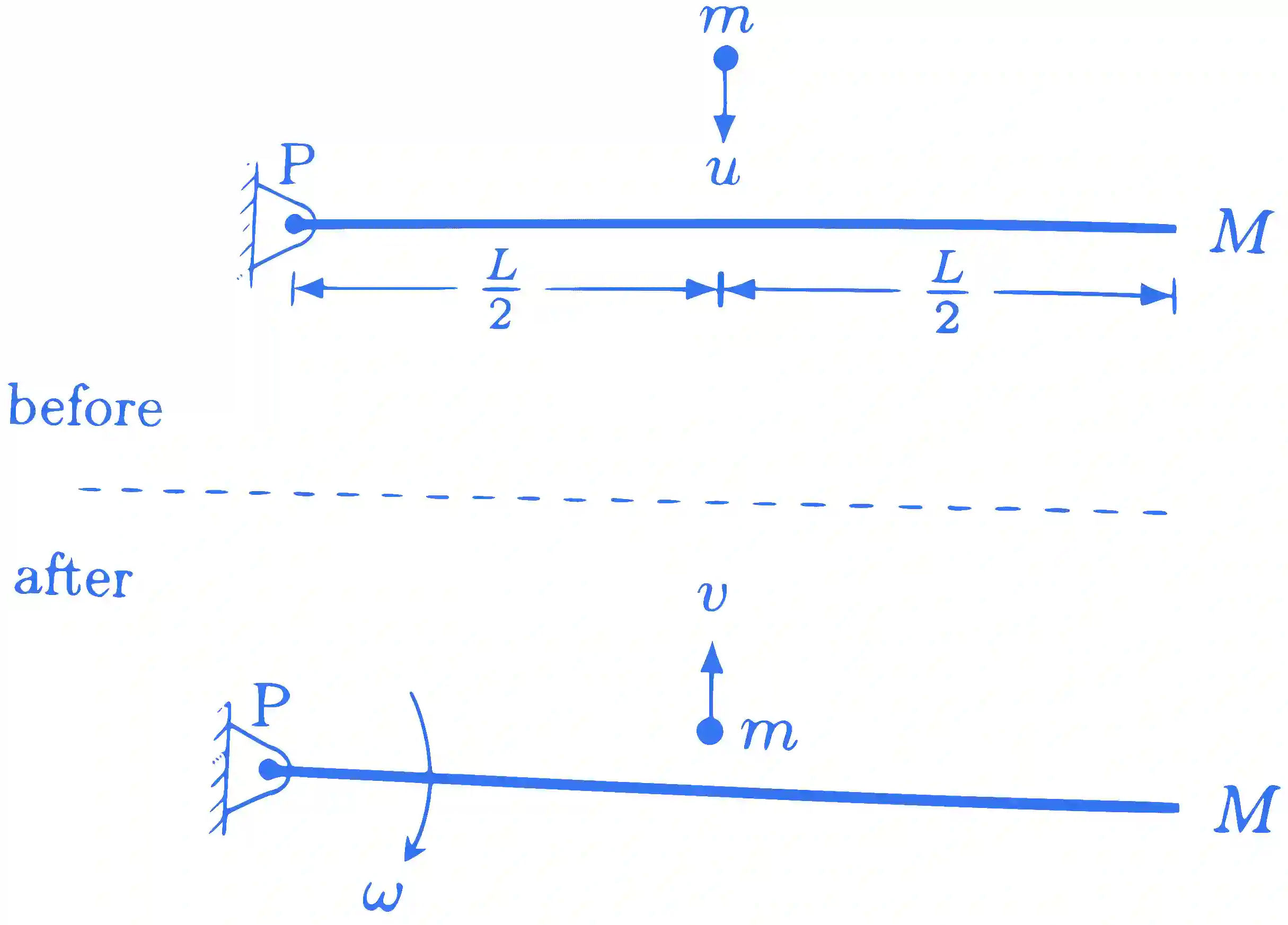
We can analyze the bar and the particle as a combined system. Initially, before the impact occurs, the system's angular momentum around the pivot point P is in a clockwise direction. The magnitude of this initial angular momentum can be expressed as
Following the collision, the angular momentum of the system about the pivot point P changes. This final angular momentum can be represented as
Here, , the moment of inertia of the bar, is given by , and the term accounts for the particle's contribution post-collision.
During the collision, the angular momentum of the system around the pivot point P is conserved. This means . Applying this principle, we derive the following relationship :
..........(i)
This equation represents the conservation of angular momentum in the system, correlating the initial and final states of the bar and the particle.
The kinetic energy of the system is conserved in an elastic collision. The kinetic energy of the system before the collision is
In an elastic collision, the total kinetic energy of the system is preserved. Prior to the collision, the kinetic energy of the system can be quantified as
This equation denotes the initial kinetic energy, primarily attributed to the particle's motion.
After the collision takes place, the kinetic energy of the system can be expressed as :
Here, the first term represents the kinetic energy due to the particle's velocity post-collision, and the second term represents the rotational kinetic energy of the bar.
By applying the principle of conservation of kinetic energy, which states , we obtain the following relation :
............(ii)
This equation links the initial and final kinetic energies of the system, comprising the particle and the rotating bar.
By resolving equations (i) and (ii), we determine that the velocity of the particle post-collision is m/s and the angular velocity of the bar is rad/s.