QJEEAdv23Ph0ee4: JEE Advanced 2023 Physics - Class 12 JEEAdv23Ph0ee4 Solution: A monochromatic light wave is incident normally on a glass slab …
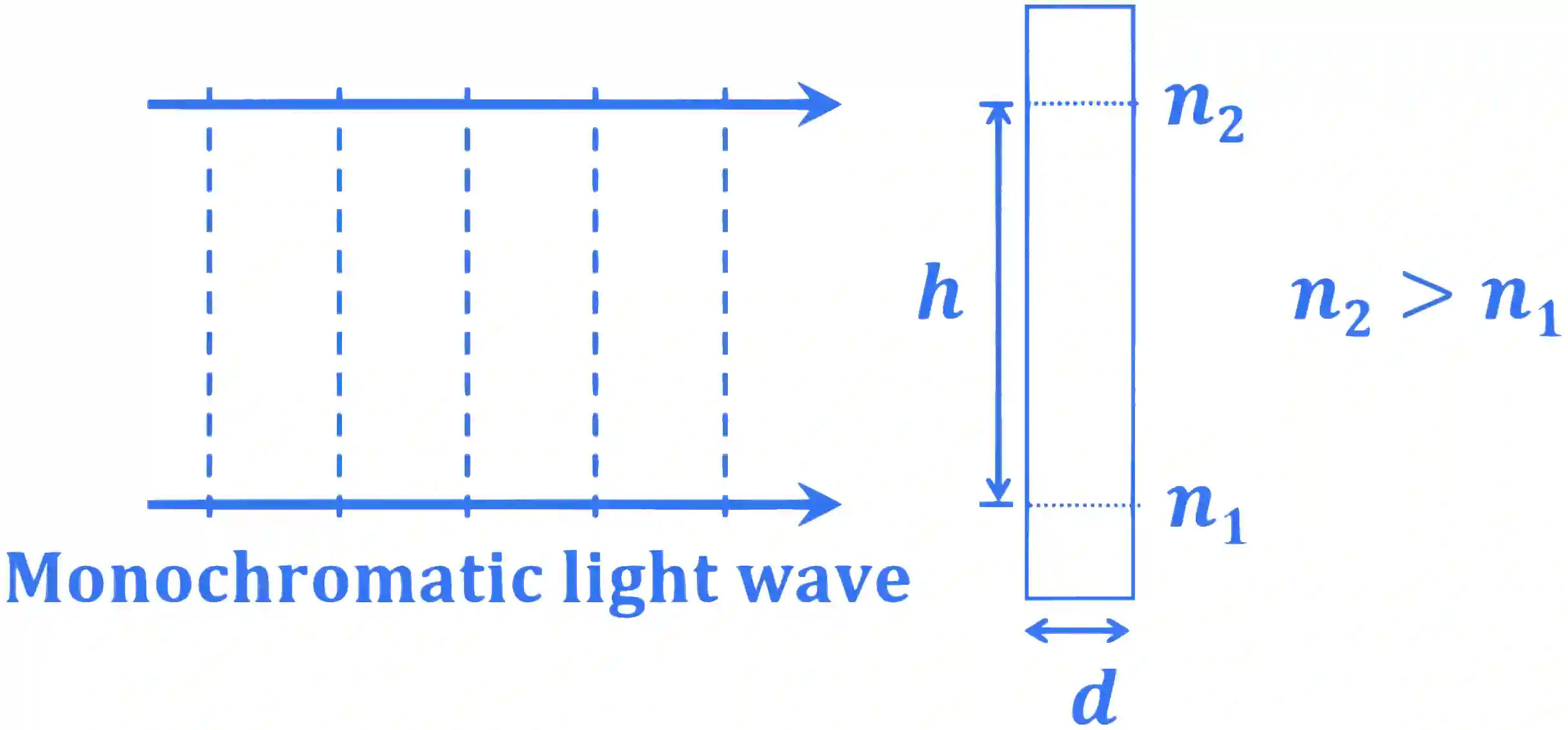
Multiple Choice Options
- A It will deflect up by an angle .
- B It will deflect up by an angle .
- C It will not deflect.
- D The deflection angle depends only on and not on the individual values of and .
Step-by-Step Verified Solution
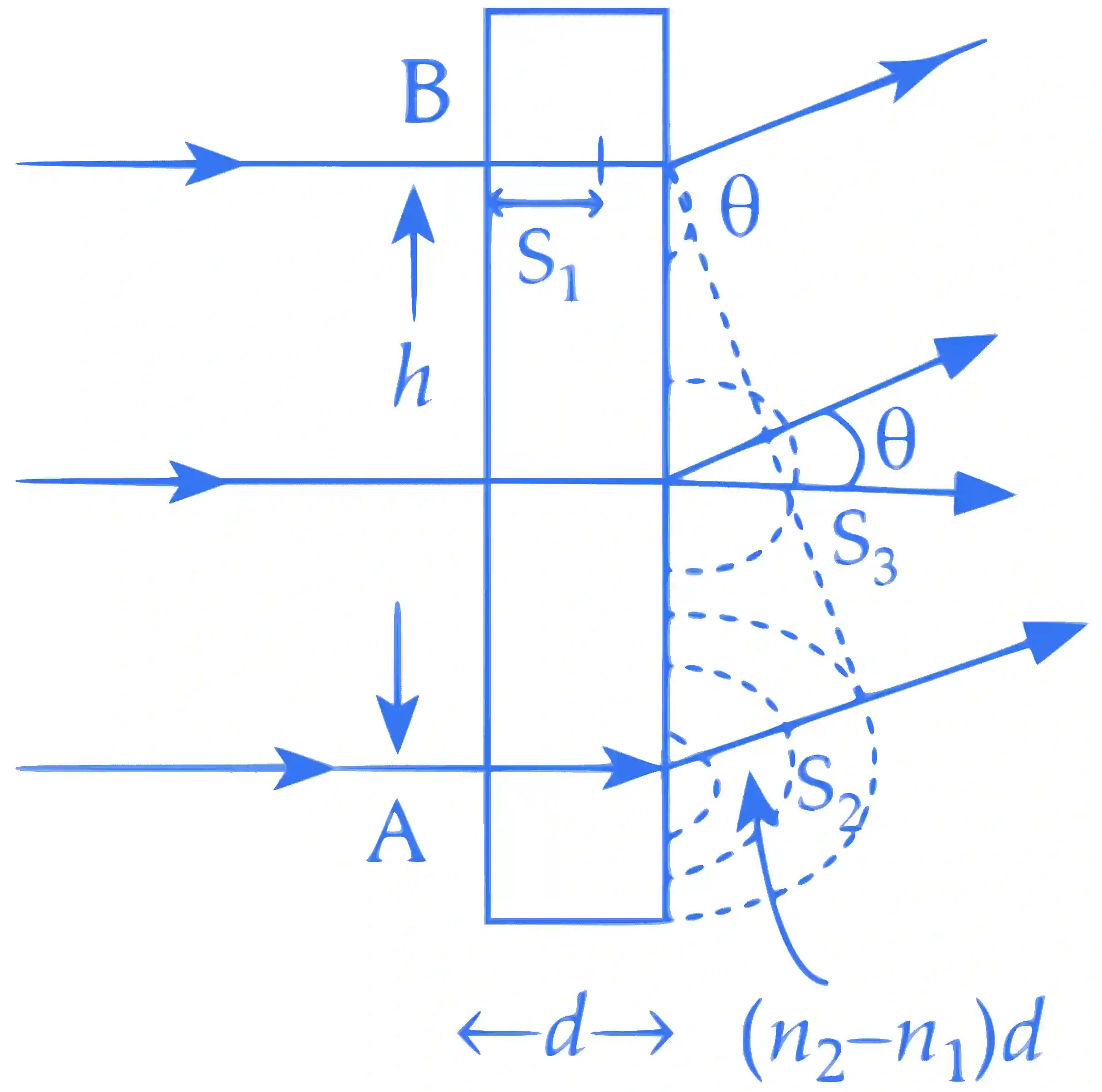
At point A on one end of the slab, the wavefront takes a time to reach the other end. The time can be expressed as the ratio of the distance traveled, , to the speed of the wave in the medium, which is (where is the speed of light in vacuum and is the refractive index of the medium at A). Therefore, the time taken is given by .
Simultaneously, consider the wavefront at point B, located in a different medium with a refractive index . In the same time , the wavefront at B travels a distance . The distance can be calculated as the product of the speed of light in the medium at B, , and the time , yielding .
Once the wavefront at B reaches the end of the slab, an additional time elapses. The time can be determined by considering the remaining distance the wavefront must travel in the slab, which is , and dividing it by the speed of light in the medium at B. This gives us .
During this time , the wavefront at A will travel a distance . The distance is simply the speed of light in vacuum multiplied by the time , leading to .
Finally, the angle can be determined using the tangent function, where is the ratio of the difference in distances traveled by the wavefronts in the two media to the height of the slab.
Therefore, .