Verified Solution • 2025–26 Session moderate

QJEEAdv23Ma9b6d: JEE Advanced 2023 Physics - Class 11 JEEAdv23Ma9b6d Solution: Let the position vectors of the points and be , and ,…

Let the position vectors of the points P,Q,RP, Q, R and SS be a⃗=i^+2j^−5k^,b⃗=3i^+6j^+3k^\vec{a}=\hat{i}+2 \hat{j}-5 \hat{k}, \vec{b}=3 \hat{i}+6 \hat{j}+3 \hat{k} , c⃗=175i^+165j^+7k^\vec{c}=\frac{17}{5} \hat{i}+\frac{16}{5} \hat{j}+7 \hat{k} and d⃗=2i^+j^+k^\vec{d}=2 \hat{i}+\hat{j}+\hat{k} , respectively. Then which of the following statements is true?

Multiple Choice Options

  • A The points P,Q,RP, Q, R and SS are NOT coplanar
  • B b⃗+2d⃗3\frac{\vec{b}+2 \vec{d}}{3} is the position vector of a point which divides PRP R internally in the ratio 5:45: 4
  • C b⃗+2d⃗3\frac{\vec{b}+2 \vec{d}}{3} is the position vector of a point which divides PRP R externally in the ratio 5:45: 4
  • D The square of the magnitude of the vector b⃗×d⃗\vec{b} \times \vec{d} is 95

Step-by-Step Verified Solution

amp;P(a⃗)=i^+2j^−5k^amp;Q(b⃗)=3i^+6j^+3k^amp;R(c⃗)=175i^+165j^+7k^amp;S(d⃗)=2i^+j^+k^\begin{aligned} & P(\vec{a})=\hat{i}+2 \hat{j}-5 \hat{k} \\\\ & Q(\vec{b})=3 \hat{i}+6 \hat{j}+3 \hat{k} \\\\ & R(\vec{c})=\frac{17}{5} \hat{i}+\frac{16}{5} \hat{j}+7 \hat{k} \\\\ & S(\vec{d})=2 \hat{i}+\hat{j}+\hat{k}\end{aligned}

From option (A) :

JEE Advanced 2023 Paper 2 Online Mathematics - Vector Algebra Question 4 English Explanation 1
amp;[PQ→,PR→,PS→]→ S.T.P amp;∣2amp;4amp;6125amp;65amp;121amp;−1amp;6∣=0\begin{aligned}& {[\overrightarrow{P Q}, \overrightarrow{P R}, \overrightarrow{P S}] \rightarrow \text { S.T.P }} \\\\& \left|\begin{array}{ccc}2 & 4 & 6 \\\frac{12}{5} & \frac{6}{5} & 12 \\1 & -1 & 6\end{array}\right|=0\end{aligned}

Hence P, Q, R, S are coplanar.

From option (B) :

b⃗+2d⃗3=7i+8j+5k3\frac{\vec{b}+2 \vec{d}}{3}=\frac{7 i+8 j+5 k}{3}

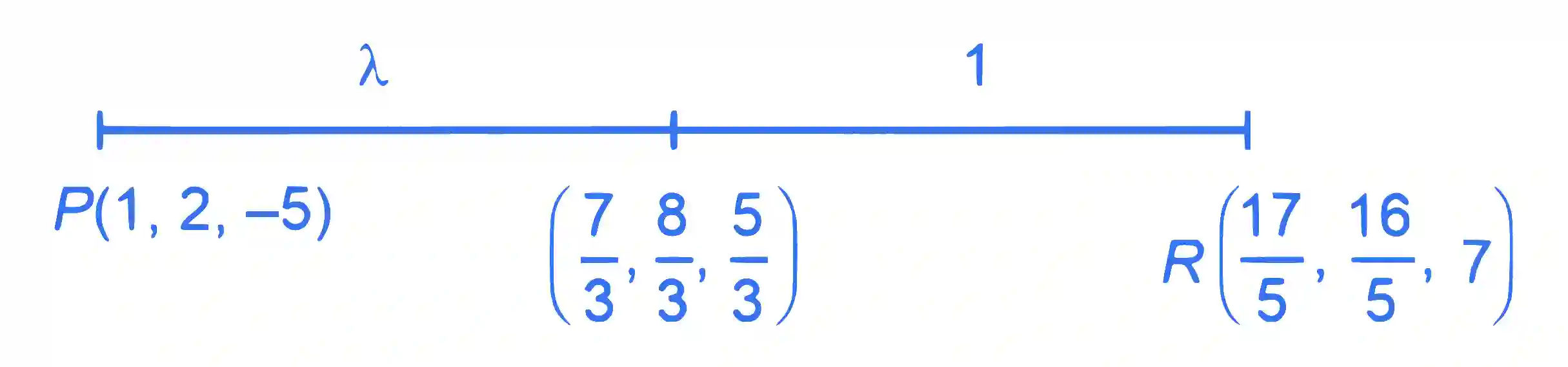
JEE Advanced 2023 Paper 2 Online Mathematics - Vector Algebra Question 4 English Explanation 2
amp;⇒17λ5+11+λ=73amp;⇒(17λ+5)1+λ=353amp;⇒15λ+15=35+35λamp;⇒16λ=20amp;⇒λ=54\begin{aligned}& \Rightarrow \frac{\frac{17 \lambda}{5}+1}{1+\lambda}=\frac{7}{3} \\\\& \Rightarrow \frac{(17 \lambda+5)}{1+\lambda}=\frac{35}{3} \\\\& \Rightarrow 15 \lambda+15=35+35 \lambda \\\\& \Rightarrow 16 \lambda=20 \\\\& \Rightarrow \lambda=\frac{5}{4}\end{aligned}

Hence option (B) is correct.

(D)

∣b⃗×d⃗∣2amp;=∣b⃗∣2∣d⃗∣2−(b⃗⋅d⃗)2amp;=54×6−225amp;=324−225amp;=99\quad \begin{aligned}|\vec{b} \times \vec{d}|^2 & =|\vec{b}|^2|\vec{d}|^2-(\vec{b} \cdot \vec{d})^2 \\\\ & =54 \times 6-225 \\\\ & =324-225 \\\\ & =99\end{aligned}

Related Learning Resources & Exam Preparation