Verified Solution • 2025–26 Session moderate

QJEEAdv23Chfc75: JEE Advanced 2023 Chemistry - Class 11 JEEAdv23Chfc75 Solution: One mole of an ideal monoatomic gas undergoes two reversible…

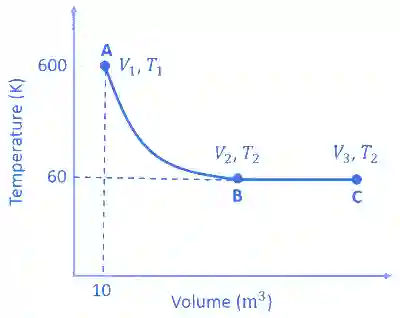
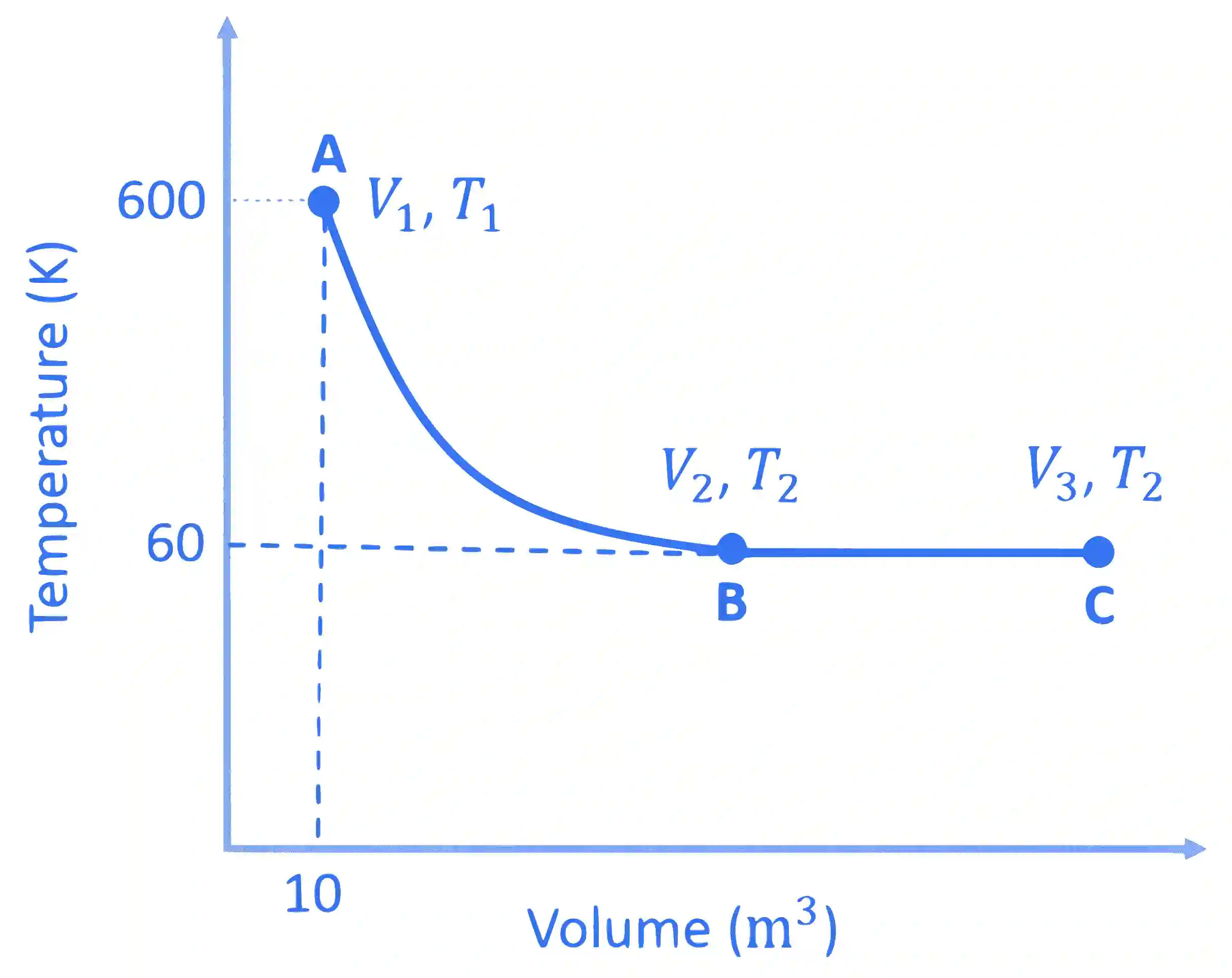
One mole of an ideal monoatomic gas undergoes two reversible processes (A→B(\mathrm{A} \rightarrow \mathrm{B} and B→C)\mathrm{B} \rightarrow \mathrm{C}) as shown in the given figure:

JEE Advanced 2023 Paper 1 Online Chemistry - Thermodynamics Question 6 English
A→B\mathrm{A} \rightarrow \mathrm{B} is an adiabatic process. If the total heat absorbed in the entire process (A→B(\mathrm{A} \rightarrow \mathrm{B} and B→C)\mathrm{B} \rightarrow \mathrm{C}) is RT2ln⁡10\mathrm{R} T_2 \ln 10 , the value of 2log⁡V32 \log V_3 is _______.

[Use, molar heat capacity of the gas at constant pressure, Cp,m=52RC_{\mathrm{p}, \mathrm{m}}=\frac{5}{2} \mathrm{R} ]

Step-by-Step Verified Solution

Since ABA B is Adiabatic process

amp;⇒(T1 T2)=(V2 V1)V−1amp;⇒ T1 V1γ−1=T2 V2γ−1amp;⇒600(10)2/3=60( V2)2/3amp;⇒( V2)2/3=(10)5/3amp;⇒ V2=(10)5/2amp;⇒QAB=0\begin{aligned}&\Rightarrow \left(\frac{\mathrm{T}_1}{\mathrm{~T}_2}\right) =\left(\frac{\mathrm{V}_2}{\mathrm{~V}_1}\right)^{\mathrm{V}-1} \\\\&\Rightarrow\mathrm{~T}_1 \mathrm{~V}_1^{\gamma-1} =\mathrm{T}_2 \mathrm{~V}_2^{\gamma-1} \\\\&\Rightarrow600(10)^{2 / 3} =60\left(\mathrm{~V}_2\right)^{2 / 3} \\\\&\Rightarrow\left(\mathrm{~V}_2\right)^{2 / 3} =(10)^{5 / 3} \\\\&\Rightarrow\mathrm{~V}_2 =(10)^{5 / 2} \\\\&\Rightarrow\mathrm{Q}_{\mathrm{AB}} =0\end{aligned}

QACamp;=nRT2ln⁡(V3 V2)amp;=RT2ln⁡(V3 V2).........(i)\begin{aligned} \mathrm{Q}_{\mathrm{AC}} & =\mathrm{nRT}_2 \ln \left(\frac{\mathrm{V}_3}{\mathrm{~V}_2}\right) \\\\ & =\mathrm{RT}_2 \ln \left(\frac{\mathrm{V}_3}{\mathrm{~V}_2}\right) .........(i)\end{aligned}

 Total heat absorbed =RT2ln⁡(V3 V2)=RT2ln⁡(10)........(ii)\begin{gathered}\text { Total heat absorbed }=\mathrm{RT}_2 \ln \left(\frac{\mathrm{V}_3}{\mathrm{~V}_2}\right) \\\\ =\mathrm{RT}_2 \ln (10) ........(ii)\end{gathered}

Equating equation (i) and equation (ii)

amp;RT2ln⁡(V3 V2)=RT2ln⁡(10)amp;⇒ln⁡(V3 V2)=ln⁡(10)\begin{aligned}&\mathrm{RT}_2 \ln \left(\frac{\mathrm{V}_3}{\mathrm{~V}_2}\right) =\mathrm{RT}_2 \ln (10) \\\\&\Rightarrow\ln \left(\frac{\mathrm{V}_3}{\mathrm{~V}_2}\right) =\ln (10)\end{aligned}

V3=10 V2\mathrm{V}_3=10 \mathrm{~V}_2

Substitute value of V2\mathrm{V}_2

amp;=10(10)5/2=(10)7/2V3amp;=(10)7/2\begin{aligned}& =10(10)^{5 / 2}=(10)^{7 / 2} \\\\V_3 & =(10)^{7 / 2}\end{aligned}

Taking log⁡\log on both side, we get

amp;⇒log⁡(V3)=log⁡(10)7/2amp;⇒log⁡(V3)=72log⁡(10)amp;⇒2log⁡(V3)=7log⁡(10)∴2log⁡(V3)=7\begin{aligned}&\Rightarrow \log \left(\mathrm{V}_3\right) =\log (10)^{7 / 2} \\\\&\Rightarrow \log \left(\mathrm{V}_3\right) =\frac{7}{2} \log (10) \\\\&\Rightarrow 2 \log \left(\mathrm{V}_3\right) =7 \log (10) \\\\\therefore 2 \log \left(\mathrm{V}_3\right) =7\end{aligned}

Related Learning Resources & Exam Preparation