Verified Solution • 2025–26 Session moderate

QJEEAdv23Ch8874: JEE Advanced 2023 Chemistry - Class 11 JEEAdv23Ch8874 Solution: In a one-litre flask, 6 moles of undergoes the reaction . The…

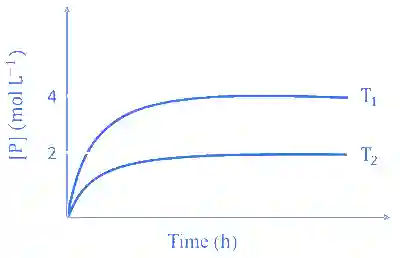
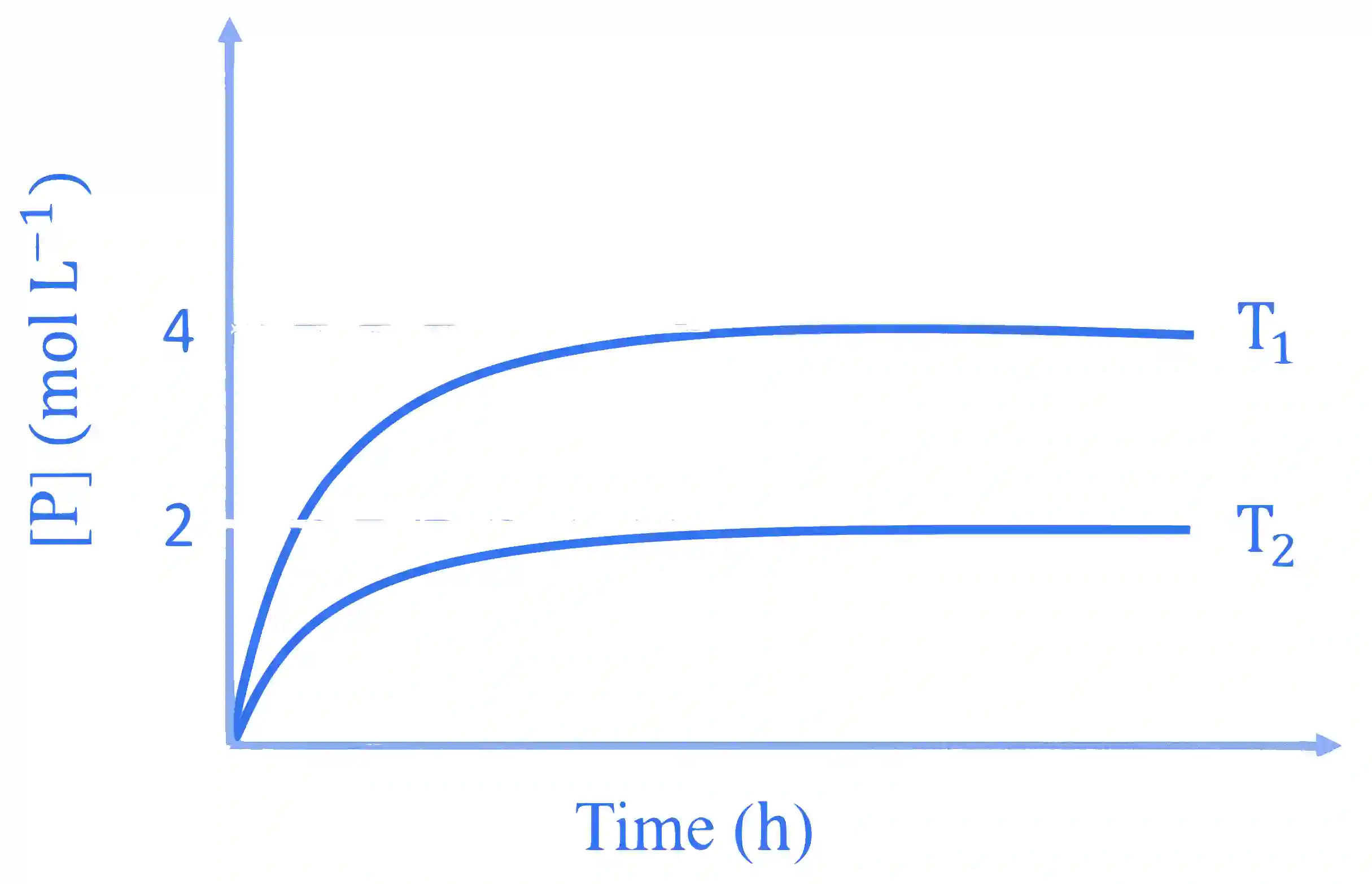
In a one-litre flask, 6 moles of AA undergoes the reaction A( g)⇌P( g)A(\mathrm{~g}) \rightleftharpoons P(\mathrm{~g}) . The progress of product formation at two temperatures (in Kelvin), T1\mathrm{T}_1 and T2\mathrm{T}_2 , is shown in the figure:

JEE Advanced 2023 Paper 1 Online Chemistry - Thermodynamics Question 5 English
If T1=2 T2\mathrm{T}_1=2 \mathrm{~T}_2 and (ΔG2Θ−ΔG1Θ)=RT2ln⁡x\left(\Delta \mathrm{G}_2^{\Theta}-\Delta \mathrm{G}_1^{\Theta}\right)=\mathrm{RT}_2 \ln \mathrm{x} , then the value of x\mathrm{x} is _______.

[ΔG1Θ\left[\Delta \mathrm{G}_1^{\Theta}\right. and ΔG2Θ\Delta \mathrm{G}_2^{\Theta} are standard Gibb's free energy change for the reaction at temperatures T1\mathrm{T}_1 and T2\mathrm{T}_2 , respectively.]

Step-by-Step Verified Solution

 At T1 K:amp;A(g)⇌P(g)t=0amp;6t=∞amp;6−xx=4 (from plot) \begin{array}{ll}\text { At } \mathrm{T}_1 \mathrm{~K}: & \mathrm{A}(\mathrm{g}) \rightleftharpoons \mathrm{P}(\mathrm{g}) \\\\ \mathrm{t}=0 & 6 \\\\ \mathrm{t}=\infty & 6-\mathrm{x} \quad \mathrm{x}=4 \text { (from plot) }\end{array}

⇒\Rightarrow At T1 K:KP1=42=2\mathrm{T}_1 \mathrm{~K}: \mathrm{K}_{\mathrm{P}_1}=\frac{4}{2}=2

 At T2 K:amp;A(g)⇌P(g)t=0amp;6t=∞amp;6−yy=2 (from plot) \begin{array}{ll}\text { At } \mathrm{T}_2 \mathrm{~K}: & \mathrm{A}(\mathrm{g}) \rightleftharpoons \mathrm{P}(\mathrm{g}) \\\\\mathrm{t}=0 & 6 \\\\\mathrm{t}=\infty & 6-\mathrm{y} \quad \mathrm{y}=2 \text { (from plot) }\end{array}

⇒ At T2 K:KP2=24=12\Rightarrow \text { At } \mathrm{T}_2 \mathrm{~K}: \mathrm{K}_{\mathrm{P}_2}=\frac{2}{4}=\frac{1}{2}

Since

ΔG10amp;=−RT1ln⁡KT1............(i)ΔG20amp;=−RT2ln⁡KT2............(ii)\begin{aligned}\Delta \mathrm{G}_1^0 & =-\mathrm{RT}_1 \ln \mathrm{KT}_1 ............(i) \\\\\Delta \mathrm{G}_2^0 & =-\mathrm{RT}_2 \ln \mathrm{KT}_2 ............(ii)\end{aligned}

ΔG20−ΔG10amp;=−RT2ln⁡KT2+RT1ln⁡KT1amp;=−RT2ln⁡12+RT1ln⁡2amp;=−RT2ln⁡12+R(2 T2)ln⁡2amp;=RT2ln⁡2+2RT2ln⁡2amp;=RT2ln⁡2+2RT2ln⁡2\begin{aligned} \Delta \mathrm{G}_2^0-\Delta \mathrm{G}_1^0 & =-\mathrm{RT}_2 \ln \mathrm{KT}_2+\mathrm{RT}_1 \ln \mathrm{KT}_1 \\\\ & =-\mathrm{RT}_2 \ln \frac{1}{2}+\mathrm{RT}_1 \ln 2 \\\\ & =-\mathrm{RT}_2 \ln \frac{1}{2}+\mathrm{R}\left(2 \mathrm{~T}_2\right) \ln 2 \\\\ & =\mathrm{RT}_2 \ln 2+2 \mathrm{RT}_2 \ln 2 \\\\ & =\mathrm{RT}_2 \ln 2+2 \mathrm{RT}_2 \ln 2\end{aligned}

ΔG20−ΔG10amp;=3RT2ln⁡2amp;=RT2(ln⁡23)amp;=RT2ln⁡8\begin{aligned} \Delta \mathrm{G}_2^0-\Delta \mathrm{G}_1^0 & =3 \mathrm{RT}_2 \ln 2 \\\\ & =\mathrm{RT}_2\left(\ln 2^3\right) \\\\ & =\mathrm{RT}_2 \ln 8\end{aligned}

Related Learning Resources & Exam Preparation