Verified Solution • 2025–26 Session
moderate
QJEEAdv22Phe860: JEE Advanced 2022 Physics - Class 11 JEEAdv22Phe860 Solution: An ideal gas of density enters a chimney of height at the rate…
An ideal gas of density enters a chimney of height at the rate of from its lower end, and escapes through the upper end as shown in the figure. The cross-sectional area of the lower end is and the upper end is . The pressure and the temperature of the gas at the lower end are and , respectively, while its temperature at the upper end is . The chimney is heat insulated so that the gas undergoes adiabatic expansion. Take and the ratio of specific heats of the gas . Ignore atmospheric pressure.
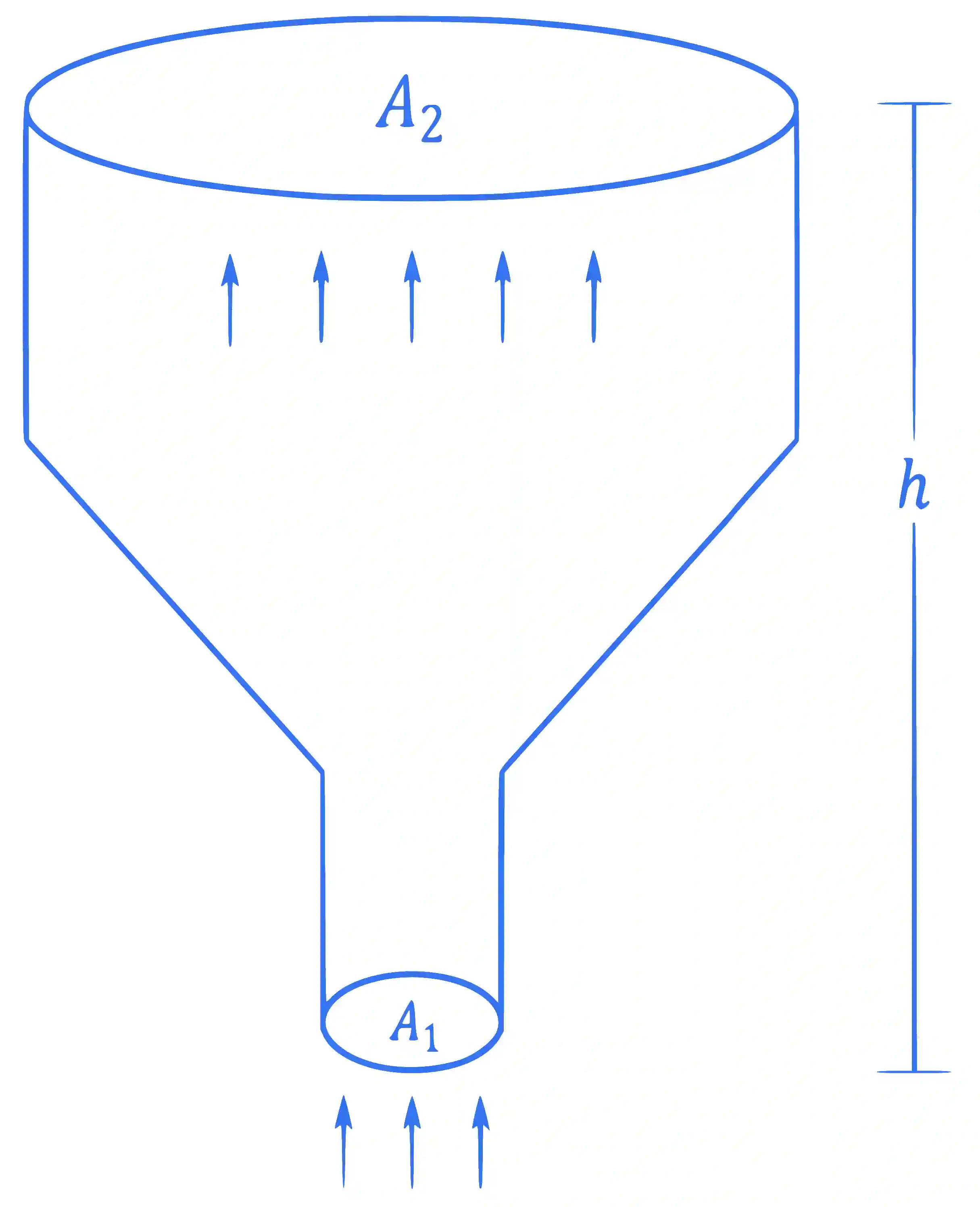
Which of the following statement(s) is(are) correct?
Multiple Choice Options
- A The pressure of the gas at the upper end of the chimney is .
- B The velocity of the gas at the lower end of the chimney is and at the upper end is .
- C The height of the chimney is .
- D The density of the gas at the upper end is .
Step-by-Step Verified Solution
Given,
The process described is adiabatic. In an adiabatic process (a process during which no heat is gained or lost), the following relationship holds:
Where :
- and are the initial and final pressures,
- and are the initial and final temperatures,
- is the ratio of specific heats (given as 2).
Given that , , , and , solve for :
Using the ideal gas law in the form (where R is the specific gas constant), and rearranging to find the relationship between and :
Next, use the principle of conservation of mass flow rate to determine the velocity of the gas at the lower and upper ends.
Mass flow rate, ,
The mass flow rate is conserved, and given by . Thus, you have:
Similarly, for the upper end :
Work done on the gas total energy internal energy