Given,
α=k=1∑αsin2k(6π)
=sin2(6π)+sin4(6π)+sin6(6π)+......
This is a infinite G.P.
∴ α=1−sin2(6π)sin2(6π)
=1−4141
=41×34
=31
∴ g(x)=23x+231(1−x)
Given x∈[0,1]
We know,
AM≥GM
For 23x and 231(1−x) both are positive in x∈[0,1]
2x3x+231(1−x)≥(23x.231(1−x))21
⇒223x+231(1−x)≥(231)21
⇒23x+231(1−x)≥2.261
⇒g(x)≥267
We know, AM=GM when terms are equal.
∴ g(x)=267 when
23x=231(1−x)
⇒3x=31−x
⇒2x=1
⇒x=21
∴ At x=21 , [g(x)]min=267
∴ Option (A) is correct.
And option (D) is wrong as at only at a single point x=21,g(x) is minimum.
Now, g(x)=23x+231(1−x)
=23x+23x231
=23x+231.2−3x
∴ g′(x)=23x.log2.31+231.2−3x.log2.(−31)
=31log2[23x−23x231]
=31log2[23x232x+231]
We already found that at x=21 g(x) is minimum.
∴ g′(x)=0 at x=21
Now, g'(x) > 0 when
{1 \over 3}\log \left[ {{{{2^{{{2x} \over 3}}} - {2^{{1 \over 3}}}} \over {{2^{{x \over 3}}}}}} \right] > 0
\Rightarrow {2^{{{2x} \over 3}}} > {2^{{1 \over 3}}}
\Rightarrow {{2x} \over 3} > {1 \over 3}
\Rightarrow x > {1 \over 2}
Similarly, g'(x) < 0 when x < {1 \over 2}
If we put it in number line we get this

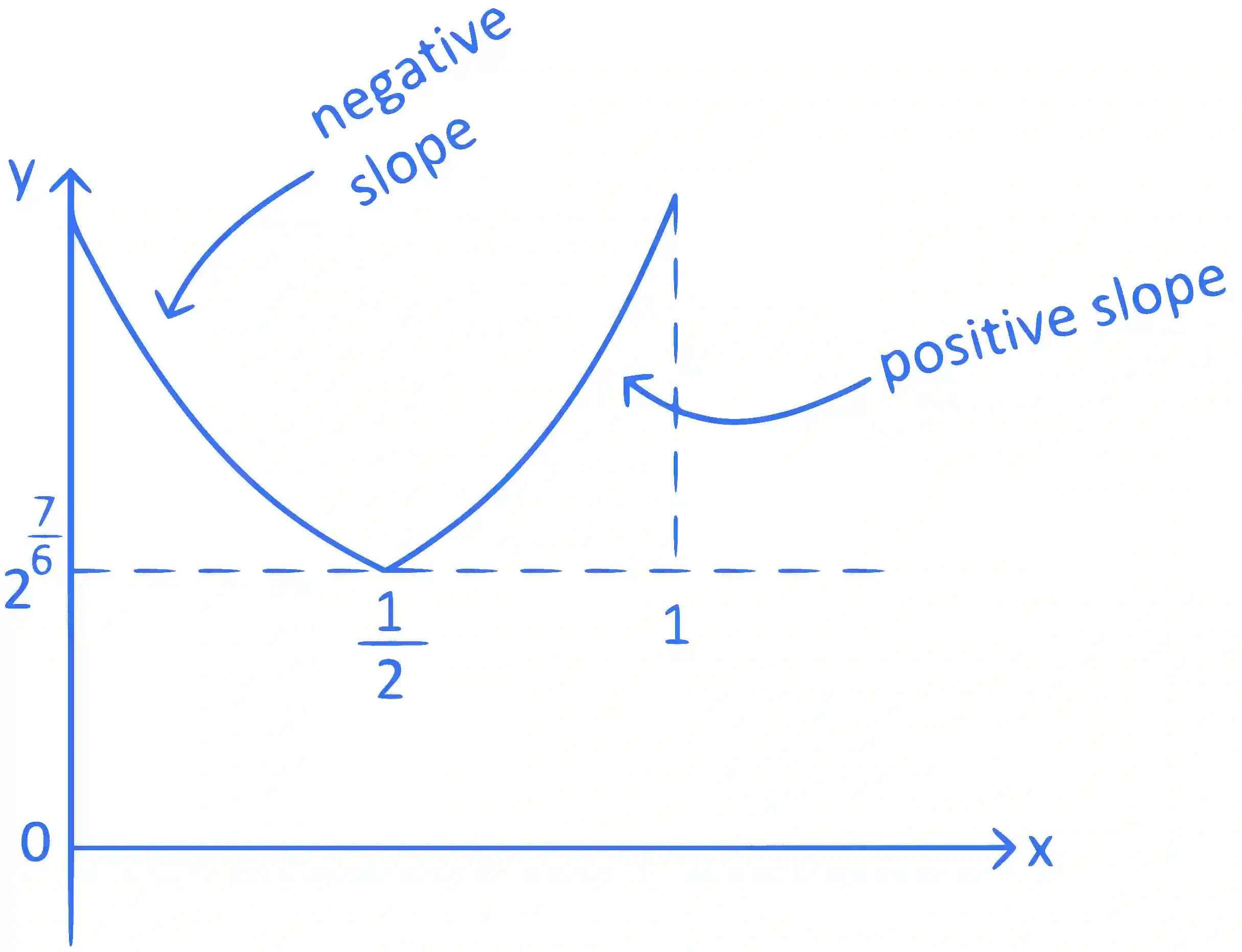
We know g′(x) represent slope of curve g(x) and it is negative when x < {1 \over 2} and positive when x > {1 \over 2} and zero when x=21 .
∴ Graph of g(x) is
From graph you can see value of g(x) is maximum either at x=0 or x=1 in the range x∈[0,1] .
∴ g(0)=20+231=1+231
g(1)=231+20=1+231
∴ We get maximum value at x=0 and x=1 both.
∴ B and C options are correct.