Verified Solution • 2025–26 Session moderate

QJEEAdv22Ma2efc: JEE Advanced 2022 Mathematics - Class 11 JEEAdv22Ma2efc Solution: Let be a circle of radius . Let be circles of equal radius .…

Let GG be a circle of radius R>0 . Let G1,G2,…,GnG_{1}, G_{2}, \ldots, G_{n} be nn circles of equal radius r>0 . Suppose each of the nn circles G1,G2,…,GnG_{1}, G_{2}, \ldots, G_{n} touches the circle GG externally. Also, for i=1,2,…,n−1i=1,2, \ldots, n-1 , the circle GiG_{i} touches Gi+1G_{i+1} externally, and GnG_{n} touches G1G_{1} externally. Then, which of the following statements is/are TRUE?

Multiple Choice Options

  • A If n=4n=4 , then (2−1)r<R(\sqrt{2}-1) r < R
  • B If n=5n=5 , then r<Rr < R
  • C If n=8n=8 , then (2−1)r<R(\sqrt{2}-1) r < R
  • D If n=12n=12 , then 2(3+1)r>R\sqrt{2}(\sqrt{3}+1) r > R

Step-by-Step Verified Solution

JEE Advanced 2022 Paper 2 Online Mathematics - Circle Question 4 English Explanation

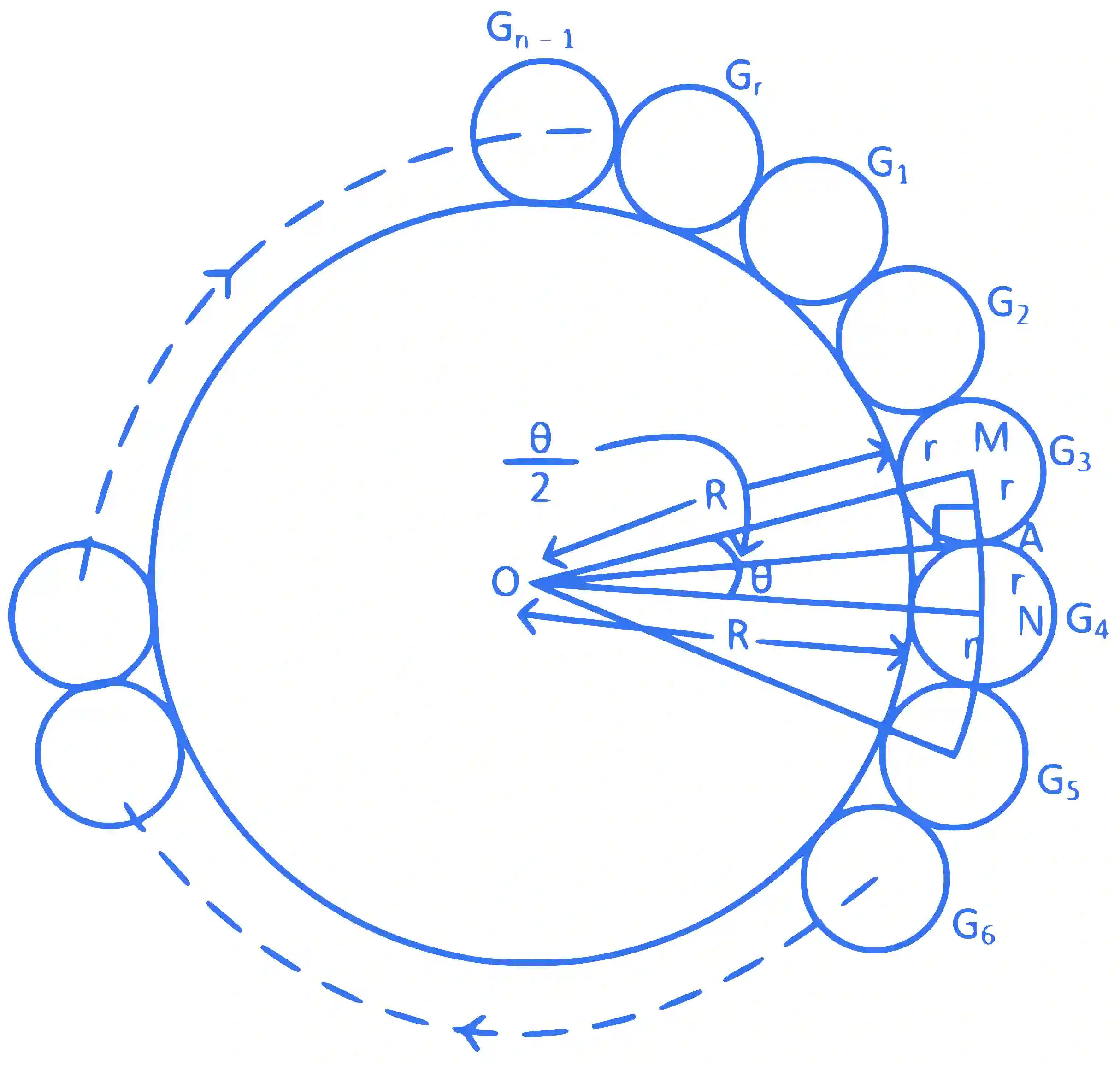
Here if we add center of circles G1, G2, G3 ....... Gn, then we get a polygon of n sides.

From figure you can see one side of polygon makes angle θ\theta with the center.

∴\therefore n sides make angle = n θ\theta

We know, nθ=2πn\theta = 2\pi

⇒θ=2πn\Rightarrow \theta = {{2\pi } \over n}

Here triangle OMN is an isosceles triangle. Line joining of point O and midpoint O of MN (point A) is perpendicular to line MN and perpendicular bisector of angle θ\theta .

∴\therefore ∠MOA=θ2=πn\angle MOA = {\theta \over 2} = {\pi \over n}

From right angle triangle OMA,

sin⁡πn=rR+r\sin {\pi \over n} = {r \over {R + r}}

⇒R+r=rcosecπn\Rightarrow R + r = r{\mathop{\rm cosec}\nolimits} {\pi \over n}

Option A:

When n=4n = 4 ,

R+r=rcosecπ4R + r = r{\mathop{\rm cosec}\nolimits} {\pi \over 4}

⇒R+r=2r\Rightarrow R + r = \sqrt 2 r

⇒R=(2−1)r\Rightarrow R = \left( {\sqrt 2 - 1} \right)r

∴\therefore Option (A) is wrong.

Option B :

When n=5n = 5 ,

R+r=rcosecπ5=rcosec36∘R + r = r{\mathop{\rm cosec}\nolimits} {\pi \over 5} = r{\mathop{\rm cosec}\nolimits} 36^\circ

We know, in 0 to π2{\pi \over 2} , cosecθ{\mathop{\rm cosec}\nolimits} \theta is decreasing.

∴\therefore {\mathop{\rm cosec}\nolimits} 45^\circ &lt; {\mathop{\rm cosec}\nolimits} 36^\circ &lt; {\mathop{\rm cosec}\nolimits} 30^\circ

\Rightarrow \sqrt 2 &lt; {\mathop{\rm cosec}\nolimits} 36^\circ &lt; 2

\Rightarrow \sqrt 2 r &lt; r{\mathop{\rm cosec}\nolimits} 36^\circ &lt; 2r

\Rightarrow \sqrt 2 r - r &lt; r{\mathop{\rm cosec}\nolimits} 36^\circ - r &lt; 2r - r

\Rightarrow \left( {\sqrt 2 - 1} \right)r &lt; R &lt; r

∴\therefore R &lt; r , when n=5n = 5

∴\therefore Option (B) is wrong.

Option C :

When n=8n = 8 ,

R+r=rcosecπ8R + r = r{\mathop{\rm cosec}\nolimits} {\pi \over 8}

cosecθ{\mathop{\rm cosec}\nolimits} \theta is decreasing function in 0 to π2{\pi \over 2} .

∴\therefore {\mathop{\rm cosec}\nolimits} {\pi \over 8} &gt; {\mathop{\rm cosec}\nolimits} {\pi \over 4}

\Rightarrow r{\mathop{\rm cosec}\nolimits} {\pi \over 8} &gt; \sqrt 2 r

\Rightarrow R + r &gt; \sqrt 2 r

\Rightarrow R &gt; \left( {\sqrt 2 - 1} \right)r

∴\therefore Option (C) is correct.

Option D :

When n=12n = 12 , then

R+r=r(cos⁡ecπ12)R + r = r\left( {\cos ec{\pi \over {12}}} \right)

⇒R+r=r×223−1\Rightarrow R + r = r \times {{2\sqrt 2 } \over {\sqrt 3 - 1}} [as cos⁡ecπ12=223−1\cos ec{\pi \over {12}} = {{2\sqrt 2 } \over {\sqrt 3 - 1}} ]

⇒R+r=r×22(3+1)2\Rightarrow R + r = r \times {{2\sqrt 2 \left( {\sqrt 3 + 1} \right)} \over 2}

⇒R+r=2r(3+1)\Rightarrow R + r = \sqrt 2 r\left( {\sqrt 3 + 1} \right)

⇒R=[2(3+1)−1]r\Rightarrow R = \left[ {\sqrt 2 \left( {\sqrt 3 + 1} \right) - 1} \right]r

\Rightarrow R &lt; \sqrt 2 \left( {\sqrt 3 + 1} \right)r

∴\therefore Option (D) is correct.

Related Learning Resources & Exam Preparation