Given,
Λ V m Y p ∘ = 250 S c m 2 m o l − 1 \Lambda_{\mathrm{V}_{\mathrm{m}} \mathrm{Y}_{\mathrm{p}}}^{\circ}=250 \mathrm{~S} \mathrm{~cm}^2 \mathrm{~mol}^{-1} Λ V m Y p ∘ = 250 S cm 2 mol − 1 Λ V m x n = 440 S c m 2 m o l − 1 \Lambda_{\mathrm{V}_m \mathrm{x}_n}=440 \mathrm{~S} \mathrm{~cm}^2 \mathrm{~mol}^{-1} Λ V m x n = 440 S cm 2 mol − 1 It is also given that
a m p ; λ ∘ Z n + = 50 S c m 2 m o l − 1 a m p ; λ V p + 0 = 25.0 S c m 2 m o l − 1 a m p ; λ V n + ∘ = 100.0 S c m 2 m o l − 1 a m p ; λ X m − ∘ = 80.0 S c m 2 m o l − 1 a m p ; λ Y m − ∘ = 100.0 S c m 2 m o l − 1 \begin{aligned}& \lambda^{\circ} \mathrm{Z}^{n+}=50 \mathrm{~S} \mathrm{~cm}^2 \mathrm{~mol}^{-1} \\\\& \lambda_{\mathrm{V} p+}^0=25.0 \mathrm{~S} \mathrm{~cm}^2 \mathrm{~mol}^{-1} \\\\& \lambda_{\mathrm{V}^{n+}}^{\circ}=100.0 \mathrm{~S} \mathrm{~cm}^2 \mathrm{~mol}^{-1} \\\\& \lambda_{\mathrm{X}^{m-}}^{\circ}=80.0 \mathrm{~S} \mathrm{~cm}^2 \mathrm{~mol}^{-1} \\\\& \lambda_{\mathrm{Y}^{m-}}^{\circ}=100.0 \mathrm{~S} \mathrm{~cm}^2 \mathrm{~mol}^{-1} \\\\\end{aligned} am p ; λ ∘ Z n + = 50 S cm 2 mol − 1 am p ; λ V p + 0 = 25.0 S cm 2 mol − 1 am p ; λ V n + ∘ = 100.0 S cm 2 mol − 1 am p ; λ X m − ∘ = 80.0 S cm 2 mol − 1 am p ; λ Y m − ∘ = 100.0 S cm 2 mol − 1 Now,
Λ V m Y p = m λ V + ∘ + p λ ∘ Y \Lambda_{\mathrm{V}_m \mathrm{Y}_p}=m \lambda_{\mathrm{V}^{+}}^{\circ}+p \lambda^{\circ}{ }_{\mathrm{Y}} Λ V m Y p = m λ V + ∘ + p λ ∘ Y 250 = 25 m + 100 p 250=25 m+100 p 250 = 25 m + 100 p 10 = m + 4 p 10=m+4p 10 = m + 4 p ..........(1)
Also,
Λ V m x n = m λ v + ∘ + n λ ∘ X − \Lambda_{\mathrm{V}_m \mathrm{x}_n}=m \lambda_{\mathrm{v}^{+}}^{\circ}+n \lambda^{\circ} \mathrm{X}^{-} Λ V m x n = m λ v + ∘ + n λ ∘ X − 440 = 100 m + 80 n 440=100 m+80 n 440 = 100 m + 80 n 22 = 5 m + 4 n 22=5 m+4 n 22 = 5 m + 4 n ........(2)
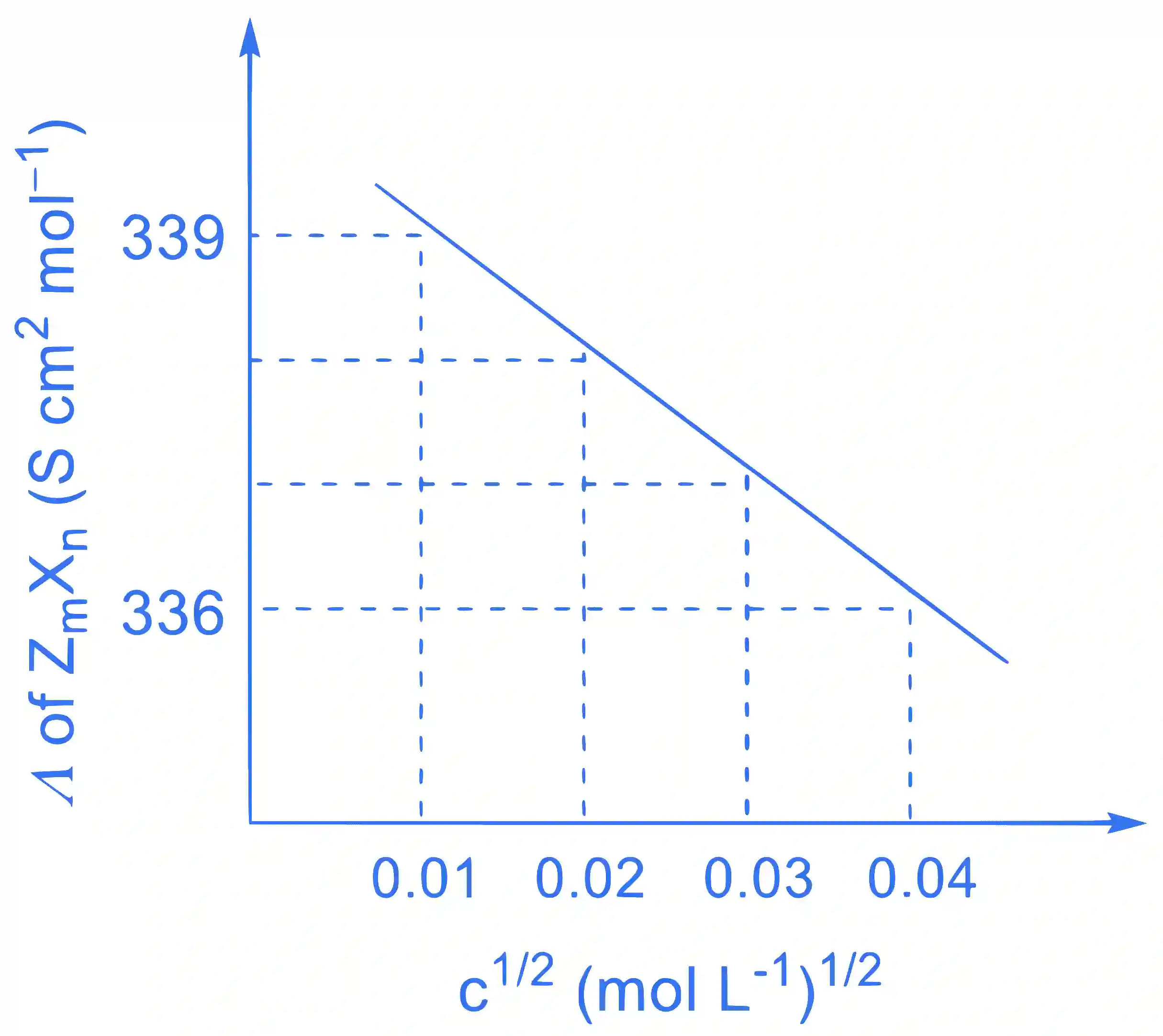
In the question, a graph of
( Λ ) (\Lambda) ( Λ ) of
Z m X n Z_m X_n Z m X n Vs
C 1 / 2 C^{1 / 2} C 1/2 is given,
We know,
λ m = λ m 0 − A C \lambda_m=\lambda_m^0-A \sqrt{C} λ m = λ m 0 − A C For electrolyte
Z m X n Z_m X_n Z m X n and from given curve
a m p ; λ m ( Z m X n ) = λ m 0 ( Z m X n ) − A C a m p ; − A = 336 − 339 0.04 − 0.01 = − 3 0.03 a m p ; ⇒ A = 100 a m p ; ∴ For λ m = 336 S c m 2 m o l − 1 a m p ; ⇒ 336 = λ m ∘ ( Z m X n ) − 100 × 0.04 a m p ; λ m ∘ = 336 + 4 = 340 S c m 2 m o l − 1 \begin{aligned}& \lambda_m\left(Z_m X_n\right)=\lambda_m^0\left(Z_m X_n\right)-A \sqrt{C} \\\\& -A=\frac{336-339}{0.04-0.01}=-\frac{3}{0.03} \\\\& \Rightarrow A=100 \\\\& \therefore \text { For } \lambda_m=336 \mathrm{~S} \mathrm{~cm}^2 \mathrm{~mol}^{-1} \\\\& \Rightarrow 336=\lambda_m^{\circ}\left(Z_m X_n\right)-100 \times 0.04 \\\\& \lambda_m^{\circ}=336+4=340 \mathrm{~S} \mathrm{~cm}{ }^2 \mathrm{~mol}^{-1}\end{aligned} am p ; λ m ( Z m X n ) = λ m 0 ( Z m X n ) − A C am p ; − A = 0.04 − 0.01 336 − 339 = − 0.03 3 am p ; ⇒ A = 100 am p ; ∴ For λ m = 336 S cm 2 mol − 1 am p ; ⇒ 336 = λ m ∘ ( Z m X n ) − 100 × 0.04 am p ; λ m ∘ = 336 + 4 = 340 S cm 2 mol − 1 So,
Λ Z m x n a m p ; = m λ Z + + n λ X − 340 a m p ; = 50 m + 80 n 34 a m p ; = 5 m + 8 n . . . . . . . . ( 3 ) \begin{aligned}\Lambda_{Z_m x_n} & =m \lambda_{\mathrm{Z}^{+}}+n \lambda_{\mathrm{X}^{-}} \\\\340 & =50 m+80 n \\\\34 & =5 m+8 n ........(3)\end{aligned} Λ Z m x n 340 34 am p ; = m λ Z + + n λ X − am p ; = 50 m + 80 n am p ; = 5 m + 8 n ........ ( 3 ) Solving eqn (2) and eqn (3),
n = 12 4 = 3 n=\frac{12}{4}=3 n = 4 12 = 3 ⇒ \Rightarrow ⇒ n = 3 n=3 n = 3 Substituting the value of
n n n in eqn (2), we get,
22 a m p ; = 5 m + 4 ( 3 ) ⇒ 22 a m p ; = 5 m + 12 ⇒ 5 m a m p ; = 22 − 12 = 10 ⇒ m a m p ; = 10 5 = 2 ⇒ m a m p ; = 2 \begin{aligned}22 & =5 m+4(3) \\\\\Rightarrow 22 & =5 m+12 \\\\\Rightarrow 5 m & =22-12=10 \\\\\Rightarrow m & =\frac{10}{5}=2 \\\\\Rightarrow m & =2\end{aligned} 22 ⇒ 22 ⇒ 5 m ⇒ m ⇒ m am p ; = 5 m + 4 ( 3 ) am p ; = 5 m + 12 am p ; = 22 − 12 = 10 am p ; = 5 10 = 2 am p ; = 2 Now, substituting the value of
m m m is eqn
( 1 ) (1) ( 1 ) , we get
10 a m p ; = m + 4 p ⇒ 10 a m p ; = 2 + 4 p ⇒ 8 a m p ; = 4 p ⇒ p a m p ; = 8 4 = 2 ⇒ p a m p ; = 22 \begin{aligned}10 & =m+4 p \\\\\Rightarrow 10 & =2+4 p \\\\\Rightarrow 8 & =4 p \\\\\Rightarrow p & =\frac{8}{4}=2 \\\\\Rightarrow p & =22\end{aligned} 10 ⇒ 10 ⇒ 8 ⇒ p ⇒ p am p ; = m + 4 p am p ; = 2 + 4 p am p ; = 4 p am p ; = 4 8 = 2 am p ; = 22 So,
m + n + p = 2 + 3 + 2 m+n+p=2+3+2 m + n + p = 2 + 3 + 2 ⇒ m + n + p = 7 \Rightarrow m+n+p=7 ⇒ m + n + p = 7 Hence, the required value of
m + n + p m+n+p m + n + p is 7 .