Verified Solution • 2025–26 Session
moderate
QJEEAdv21Ph6308: JEE Advanced 2021 Physics - Class 12 JEEAdv21Ph6308 Solution: A long straight wire carries a current, I = 2 ampere. A…
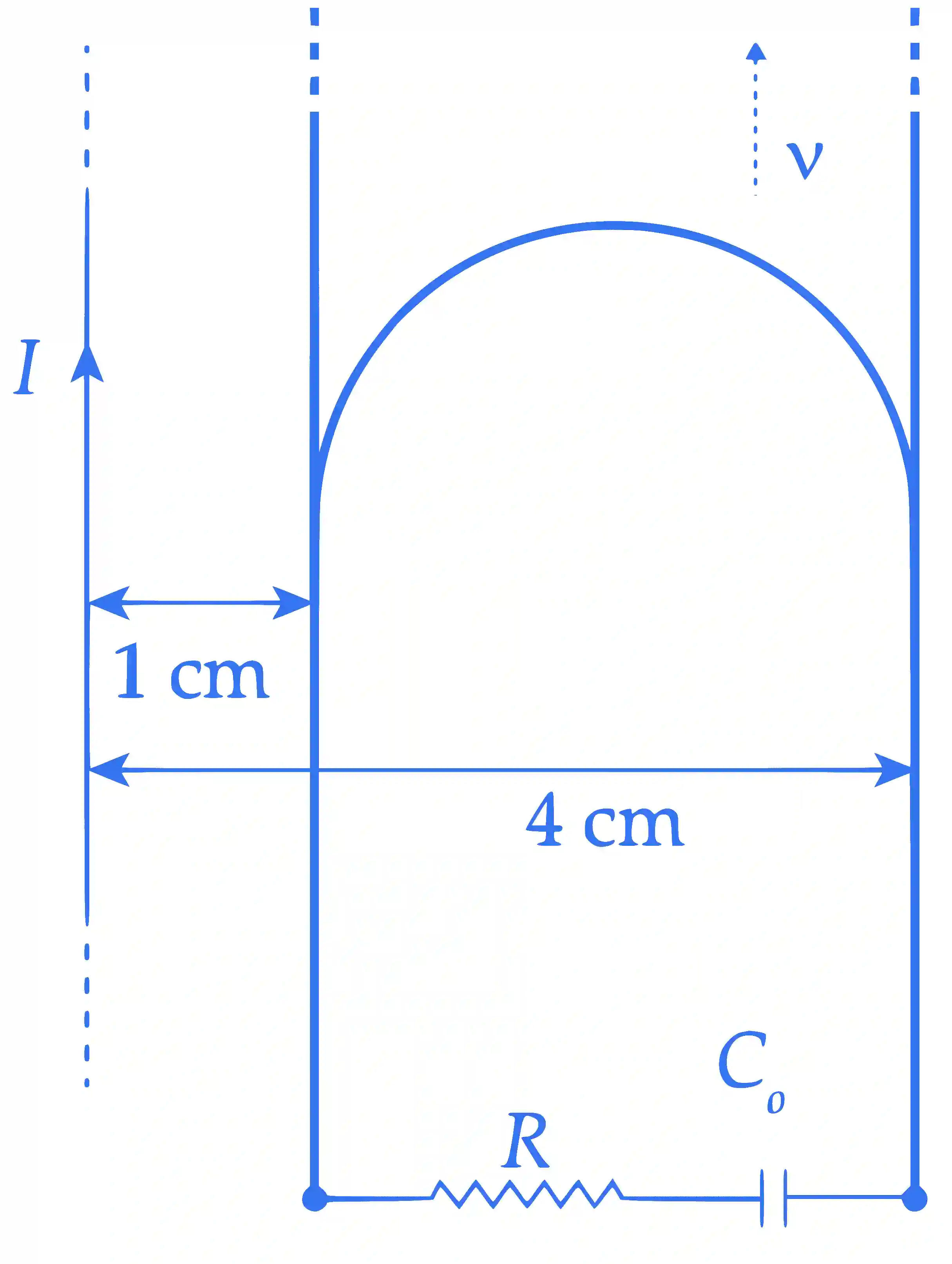
A long straight wire carries a current, I = 2 ampere. A semi-circular conducting rod is placed beside it on two conducting parallel rails of negligible resistance. Both the rails are parallel to the wire. The wire, the rod and the rails lie in the same horizontal plane, as shown in the figure. Two ends of the semi-circular rod are at the distances 1 cm and 4 cm from the wire. At time t = 0, the rod starts moving on the rails with a speed v = 3.0 m/s (see the figure).
A resistor R = 1.4 and a capacitor C0 = 5.0 F are connected in series between the rails. At time t = 0, C0 is uncharged. Which of the following statement(s) is(are) correct? [ 0 = 4 10 7 SI units. Take ln 2 = 0.7]

A resistor R = 1.4 and a capacitor C0 = 5.0 F are connected in series between the rails. At time t = 0, C0 is uncharged. Which of the following statement(s) is(are) correct? [ 0 = 4 10 7 SI units. Take ln 2 = 0.7]
Multiple Choice Options
- A Maximum current through R is 1.2 10 6 ampere
- B Maximum current through R is 3.8 10 6 ampere
- C Maximum charge on capacitor C0 is 8.4 10 12 coulomb
- D Maximum charge on capacitor C0 is 2.4 10 12 coulomb
Step-by-Step Verified Solution
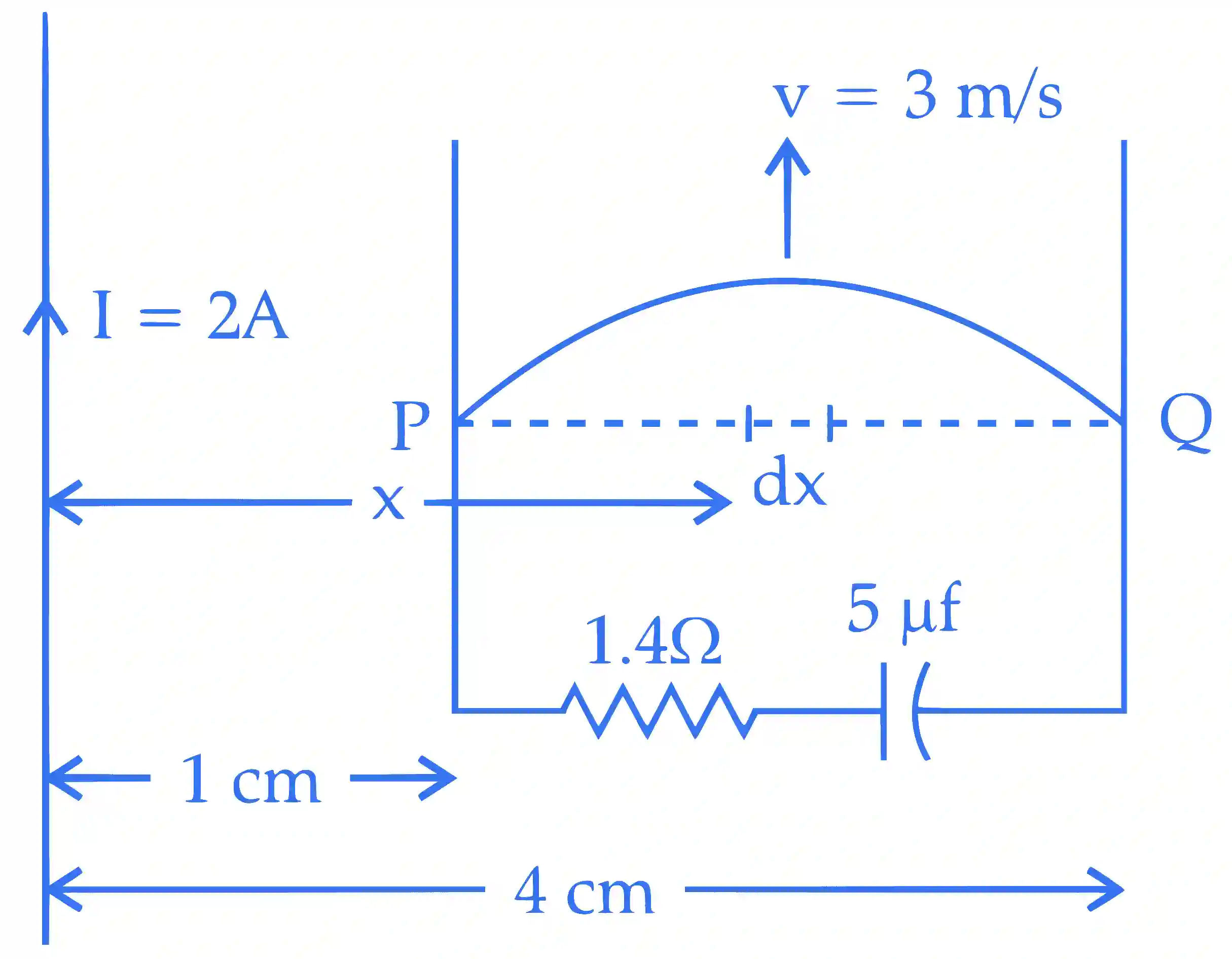
Let a small element of length be chosen at a distance from the wire. Induced emf de across it is given by
On substituting all the values in above, we get
At acts as a short. So, maximum current flows through .
At acts as on open. So,