Verified Solution • 2025–26 Session moderate

QJEEAdv21Ph3b61: JEE Advanced 2021 Physics - Class 12 JEEAdv21Ph3b61 Solution: For a prism of prism angle = 60 , the refractive indices of the …

For a prism of prism angle θ\theta = 60 ∘^\circ , the refractive indices of the left half and the right half are, respectively, n1 and n2 (n2 ≥\ge n1) as shown in the figure. The angle of incidence i is chosen such that the incident light rays will have minimum deviation if n1 = n2 = n = 1.5. For the case of unequal refractive indices, n1 = n and n2 = n + Δ\Delta n (where Δ\Delta n << n), the angle of emergence e = i + Δ\Delta e. Which of the following statement(s) is(are) correct?
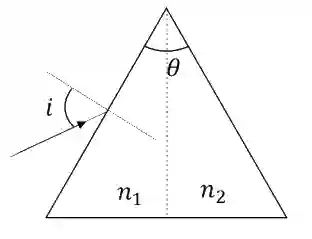
JEE Advanced 2021 Paper 2 Online Physics - Geometrical Optics Question 34 English

Multiple Choice Options

  • A The value of Δ\Delta e (in radians) is greater than that of Δ\Delta n
  • B Δ\Delta e is proportional to Δ\Delta n
  • C Δ\Delta e lies between 2.0 and 3.0 milliradians, if Δ\Delta n = 2.8 ×\times 10 −- 3
  • D Δ\Delta e lies between1.0 and 1.6 milliradians, if Δ\Delta n = 2.8 ×\times 10 −- 3

Step-by-Step Verified Solution

JEE Advanced 2021 Paper 2 Online Physics - Geometrical Optics Question 34 English Explanation
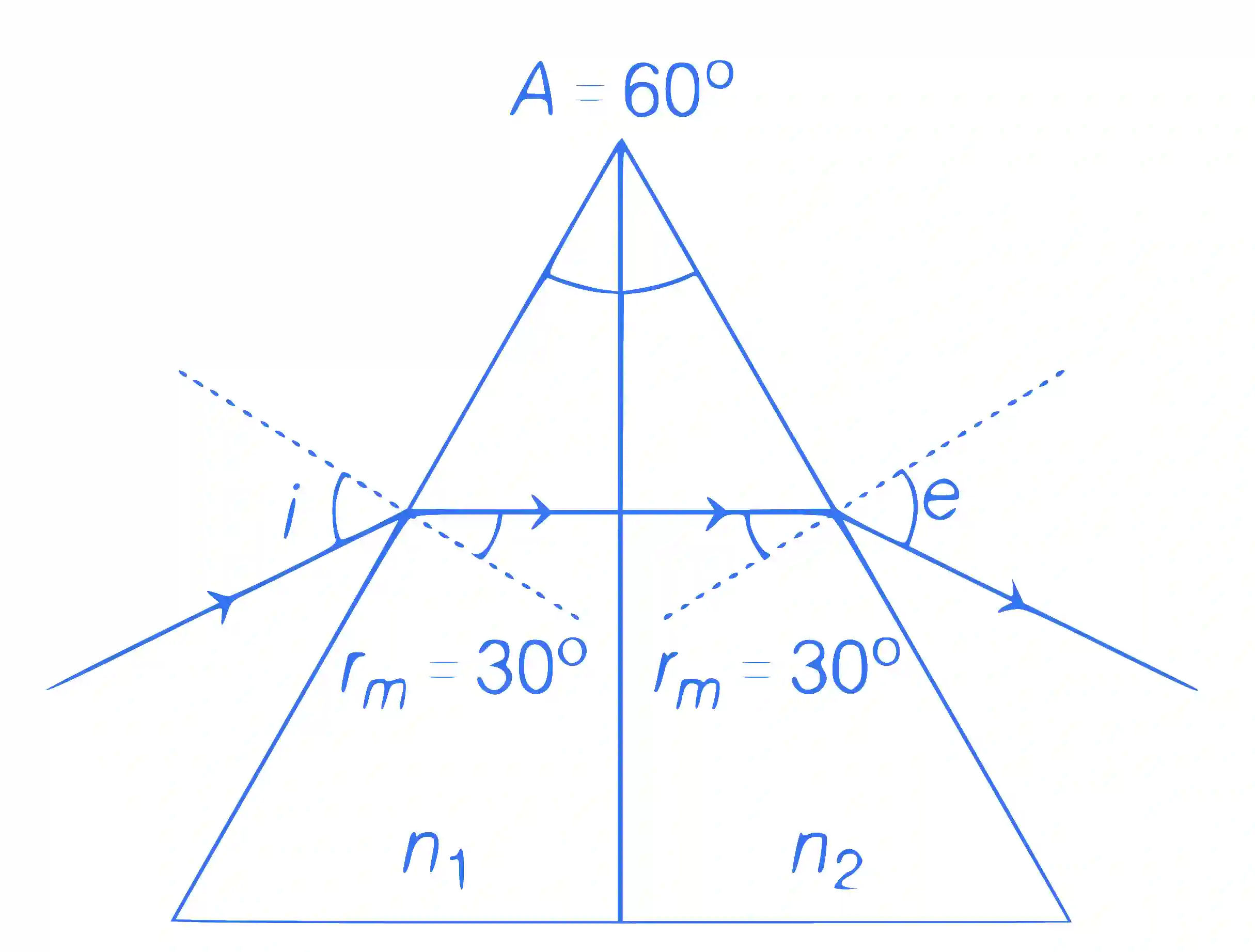
n1=n2=n=32{n_1} = {n_2} = n = {3 \over 2} for minimum deviation.

rm=A2=602=30∘{r_m} = {A \over 2} = {{60} \over 2} = 30^\circ and i=e=θi = e = \theta

n=sin⁡(δmin⁡+A2)sin⁡(A2)n = {{\sin \left( {{{{\delta _{\min }} + A} \over 2}} \right)} \over {\sin \left( {{A \over 2}} \right)}}

⇒32=sin⁡θsin⁡(602)\Rightarrow {3 \over 2} = {{\sin \theta } \over {\sin \left( {{{60} \over 2}} \right)}}

⇒sin⁡θ=34⇒cos⁡θ=74\Rightarrow \sin \theta = {3 \over 4} \Rightarrow \cos \theta = {{\sqrt 7 } \over 4}

If n1=n=32{n_1} = n = {3 \over 2} and n2=n+Δn{n_2} = n + \Delta n

e=θ+Δθe = \theta + \Delta \theta

(1)sin⁡θ=nsin⁡30∘(1)\sin \theta = n\sin 30^\circ

(n+Δn)sin⁡30∘=(1)sin⁡(θ+Δθ)(n + \Delta n)\sin 30^\circ = (1)\sin (\theta + \Delta \theta )

Solving 12(Δn)=sin⁡(θ+Δθ)−sin⁡θ{1 \over 2}(\Delta n) = \sin (\theta + \Delta \theta ) - \sin \theta

Δn2=sin⁡(θ+Δθ)−sinθΔθ×Δθ{{\Delta n} \over 2} = {{\sin (\theta + \Delta \theta ) - sin\theta } \over {\Delta \theta }} \times \Delta \theta

d(sin⁡θ)dθ=cos⁡θ{{d(\sin \theta )} \over {d\theta }} = \cos \theta

Δn2=(cos⁡θ)(Δθ)⇒Δn2=74(Δθ){{\Delta n} \over 2} = (\cos \theta )(\Delta \theta ) \Rightarrow {{\Delta n} \over 2} = {{\sqrt 7 } \over 4}(\Delta \theta )

⇒ΔnΔθ=72=2.642\Rightarrow {{\Delta n} \over {\Delta \theta }} = {{\sqrt 7 } \over 2} = {{2.64} \over 2}

{{\Delta n} \over {\Delta \theta }} = 1.34 &gt; 1

⇒\Rightarrow Δ\Delta n > Δ\Delta θ\theta , so option (a) is incorrect.

Δn=(1.34)Δθ\Delta n = (1.34)\Delta \theta

⇒Δθ∝Δn⇒\Rightarrow \Delta \theta \propto \Delta n \Rightarrow option (b) is correct.

ΔnΔθ=72⇒2.8×10⁻³Δθ=72{{\Delta n} \over {\Delta \theta }} = {{\sqrt 7 } \over 2} \Rightarrow {{2.8 \times {{10}^{ - 3}}} \over {\Delta \theta }} = {{\sqrt 7 } \over 2}

Δθ=5.6×10−37=7×0.8×10−3\Delta \theta = {{5.6 \times {{10}^{ - 3}}} \over {\sqrt 7 }} = \sqrt 7 \times 0.8 \times {10^{ - 3}}

Δθ=(2.64×0.8)×10−3=2.11×10⁻³\Delta \theta = (2.64 \times 0.8) \times {10^{ - 3}} = 2.11 \times {10^{ - 3}} rad

So, option (c) is correct.

Related Learning Resources & Exam Preparation