Verified Solution • 2025–26 Session
moderate
QJEEAdv21Ch55e5: JEE Advanced 2021 Chemistry - Class 11 JEEAdv21Ch55e5 Solution: For the following reaction scheme, percentage yields are given…
For the following reaction scheme, percentage yields are given along the arrow:
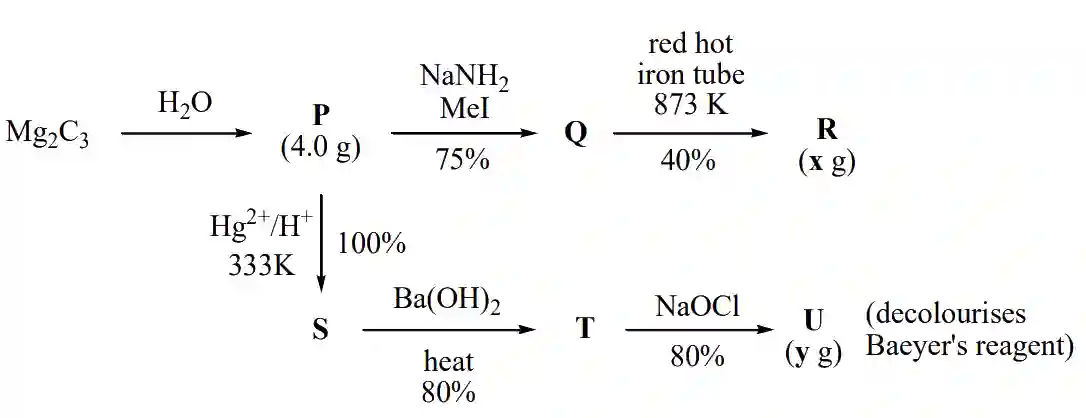
x g and y g are mass of R and U, respectively.
(Use : Molar mass (in g mol 1) of H, C and O as 1, 12 and 16, respectively)
The value of x is ________.
x g and y g are mass of R and U, respectively.
(Use : Molar mass (in g mol 1) of H, C and O as 1, 12 and 16, respectively)
The value of x is ________.
Step-by-Step Verified Solution
Mg2C3 reacts with water to give propyne.
Sodium amide (NaNH2) takes proton from alkyne to form acetylide ion which, attacks on Me I to give an alkyne with one more carbon.

Mass of P formed = 4.0 g
Molar mass of P formed = 40 g mol 1
Number of moles of P = mol
1 mole of P forms 75% i.e., 0.75 = 0.075 mole of Q
Polymerisation of alkyne (Butyne) occurs in presence of red hot iron tube to form benzene derivative.
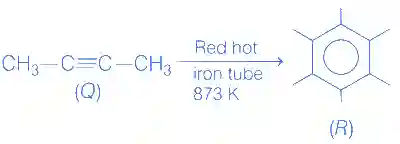
3 moles of alkyne forms 40% i.e., 0.40 mole of benzene derivative, R.
0.075 mole of Q forms mole of R.
Molar mass of R = 162 g/mol
Mass of R formed or value of x = Molar mass Number of moles = 162 0.01 = 1.62 g
Sodium amide (NaNH2) takes proton from alkyne to form acetylide ion which, attacks on Me I to give an alkyne with one more carbon.

Mass of P formed = 4.0 g
Molar mass of P formed = 40 g mol 1
Number of moles of P = mol
1 mole of P forms 75% i.e., 0.75 = 0.075 mole of Q
Polymerisation of alkyne (Butyne) occurs in presence of red hot iron tube to form benzene derivative.
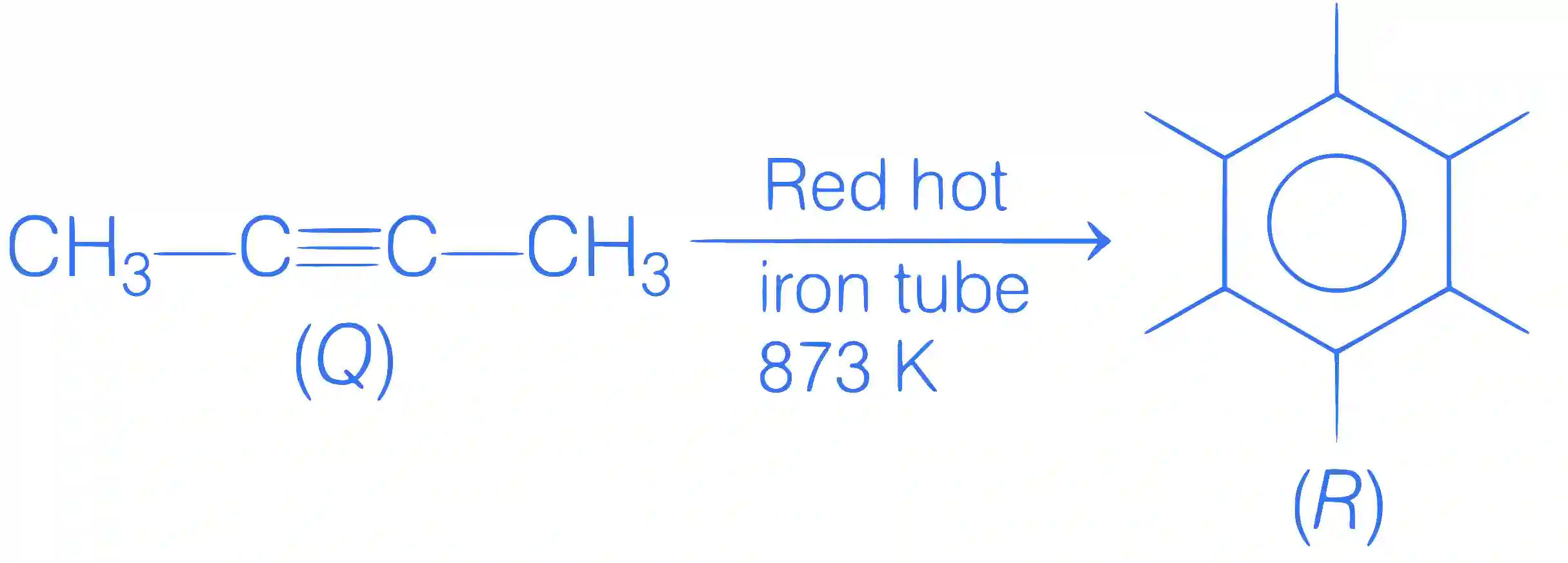
3 moles of alkyne forms 40% i.e., 0.40 mole of benzene derivative, R.
0.075 mole of Q forms mole of R.
Molar mass of R = 162 g/mol
Mass of R formed or value of x = Molar mass Number of moles = 162 0.01 = 1.62 g