Verified Solution • 2025–26 Session moderate

QJEEAdv20Ph5a75: JEE Advanced 2020 Physics - Class 12 JEEAdv20Ph5a75 Solution: One end of a spring of negligible unstretched length and spring …

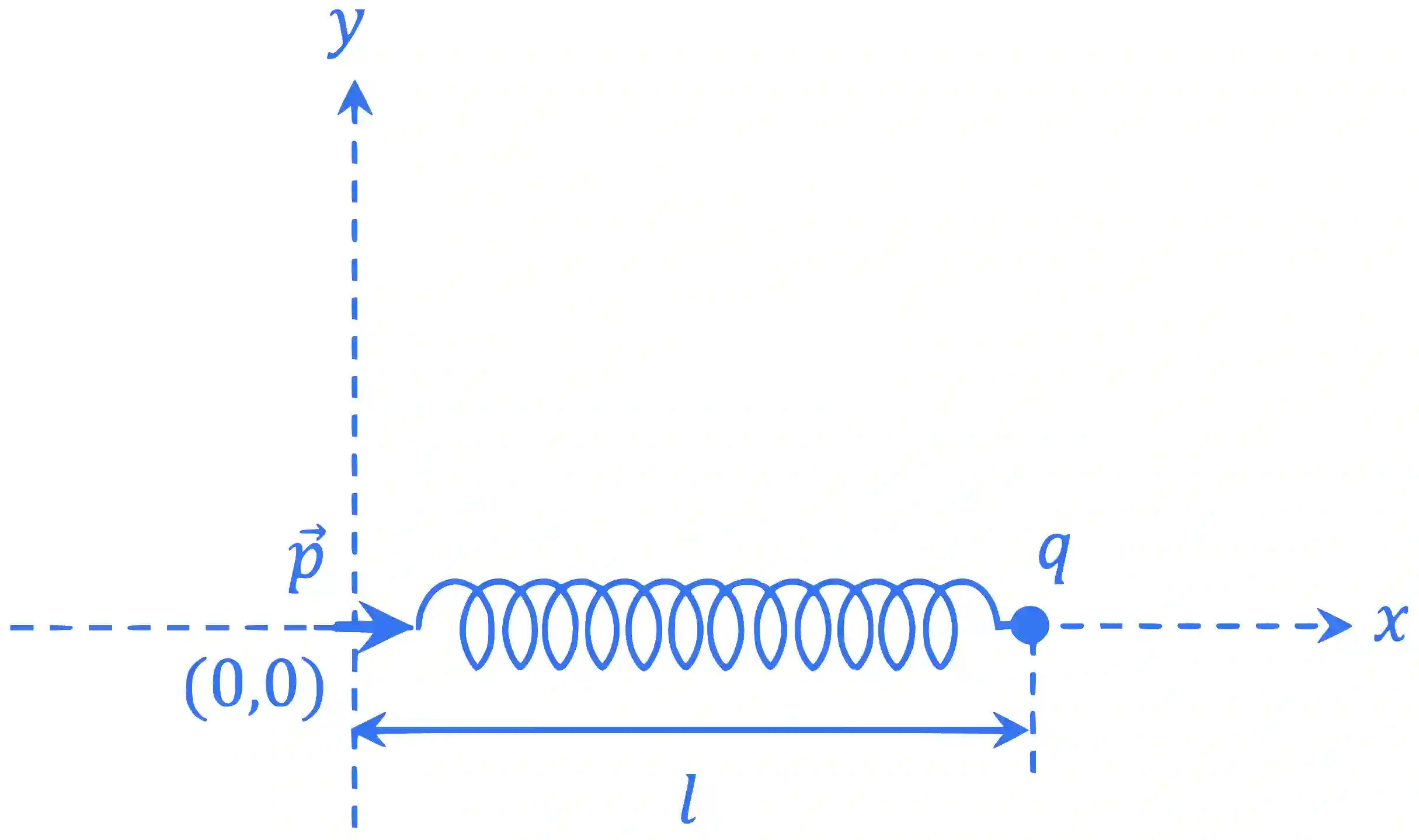
One end of a spring of negligible unstretched length and spring constant k is fixed at the origin (0, 0). A point particle of mass m carrying a positive charge q is attached at its other end. The entire system is kept on a smooth horizontal surface. When a point dipole p→\overrightarrow p pointing towards the charge q is fixed at the origin, the spring gets stretched to a length l and attains a new equilibrium position (see figure below). If the point mass is now displaced slightly by Δ\Delta l << l from its equilibrium position and released, it is found to oscillate at frequency 1δkm{1 \over \delta }\sqrt {{k \over m}} . The value of δ\delta is ______.

JEE Advanced 2020 Paper 1 Offline Physics - Electrostatics Question 37 English

Step-by-Step Verified Solution

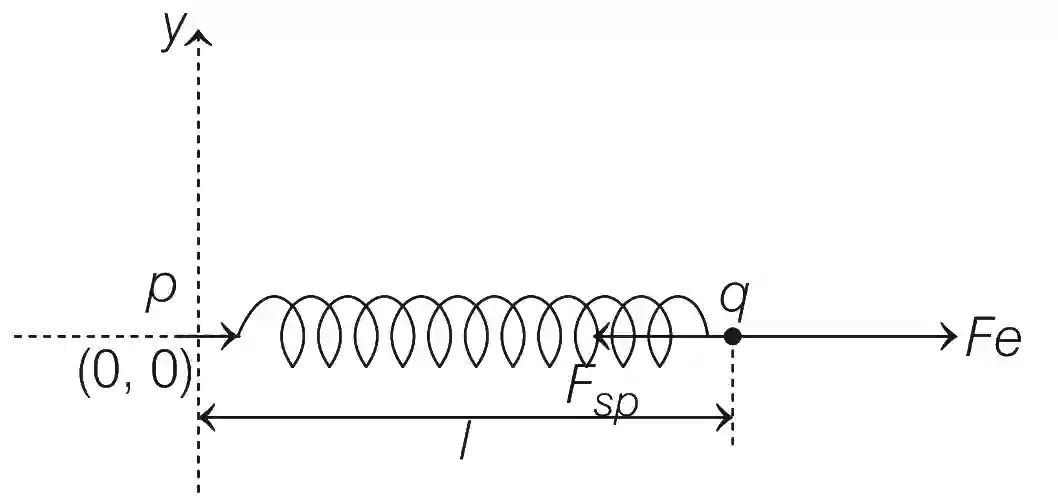
Electrostatic force = Spring force

At l, Fe=Fspkl=2αpql3Fe = {F_{sp}}kl = {{2\alpha pq} \over {{l^3}}} (Here, α=14πε0\alpha = {1 \over {4\pi {\varepsilon _0}}} )

JEE Advanced 2020 Paper 1 Offline Physics - Electrostatics Question 37 English Explanation

Now, the mass m is displaced by Δ\Delta l = x from the mean position.

Fnet=Fsp−Fe=k(l+x)−q(2αp)(l+x)3{F_{net}} = {F_{sp}} - Fe = k(l + x) - {{q(2\alpha p)} \over {{{(l + x)}^3}}}

=k(x+1)−q(2αp)l3(l+x/l)3= k(x + 1) - {{q(2\alpha p)} \over {{l^3}{{(l + x/l)}^3}}}

=kx+kl−q(2αpl3)(1−3xl)= kx + kl - q\left( {{{2\alpha p} \over {{l^3}}}} \right)\left( {1 - {{3x} \over l}} \right)

=kx+kl−q(2αpl3)+2αpl3.3xl= kx + kl - q\left( {{{2\alpha p} \over {{l^3}}}} \right) + {{2\alpha p} \over {{l^3}}}.{{3x} \over l}

Substituting 2αpql3=kl{{2\alpha pq} \over {{l^3}}} = kl , we get

Fnet=kx+kl(3xl)=4kx{F_{net}} = kx + kl\left( {{{3x} \over l}} \right) = 4kx

This is restoring in nature.

Hence, keq=4k{k_{eq}} = 4k

or T=2πm4k=πmkT = 2\pi \sqrt {{m \over {4k}}} = \pi \sqrt {{m \over k}}

∴\therefore f=1πkmf = {1 \over \pi }\sqrt {{k \over m}}

So, δ=π=3.14\delta = \pi = 3.14

Related Learning Resources & Exam Preparation