Verified Solution • 2025–26 Session moderate

QJEEAdv20Ph07ce: JEE Advanced 2020 Physics - Class 12 JEEAdv20Ph07ce Solution: Shown in the figure is a semicircular metallic strip that has…

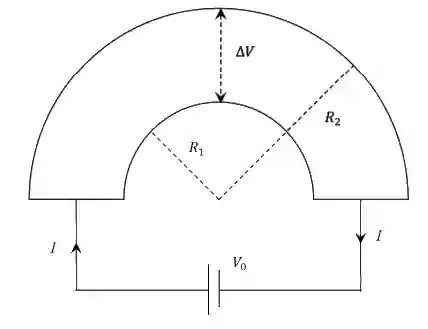
Shown in the figure is a semicircular metallic strip that has thickness t and resistivity ρ\rho . Its inner radius is R1 and outer radius is R2. If a voltage V0 is applied between its two ends, a current I flows in it. In addition, it is observed that a transverse voltage Δ\Delta V develops between its inner and outer surfaces due to purely kinetic effects of moving electrons (ignore any role of the magnetic field due to the current). Then (figure is schematic and not drawn to scale) JEE Advanced 2020 Paper 1 Offline Physics - Current Electricity Question 29 English
Multiple Choice Options

  • A I=V0tπρln⁡(R2R1)I = {{{V_0}t} \over {\pi \rho }}\ln \left( {{{{R_2}} \over {{R_1}}}} \right)
  • B the outer surface is at a higher voltage than the inner surface
  • C the outer surface is at a lower voltage than the inner surface
  • D Δ\Delta V ∝\propto I2

Step-by-Step Verified Solution

JEE Advanced 2020 Paper 1 Offline Physics - Current Electricity Question 29 English Explanation 1

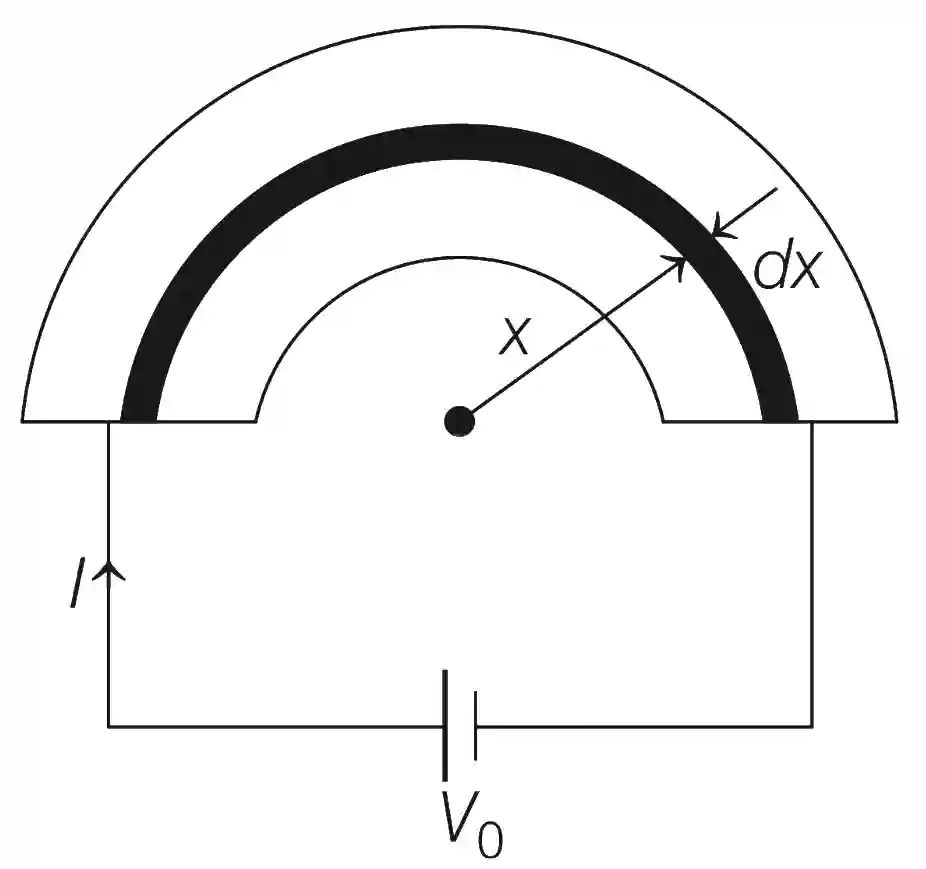
All the elements are in parallel.

∴\therefore ∫ldr=∫R1R2t dxρ πx\int {{l \over {dr}} = \int\limits_{{R_1}}^{{R_2}} {{{t\,dx} \over {\rho \,\pi x}}} }

lr=tπρln⁡(R2R1){l \over r} = {t \over {\pi \rho }}\ln \left( {{{{R_2}} \over {{R_1}}}} \right)

Resistance = πρtln⁡(R2R1){{\pi \rho } \over {t\ln \left( {{{{R_2}} \over {{R_1}}}} \right)}}

∴\therefore I=VResistan⁡ceI = {V \over {{\mathop{\rm Re}\nolimits} sis\tan ce}}

=Vtπρln⁡(R2R1)= {{{V_t}} \over {\pi \rho }}\ln \left( {{{{R_2}} \over {{R_1}}}} \right)

JEE Advanced 2020 Paper 1 Offline Physics - Current Electricity Question 29 English Explanation 2

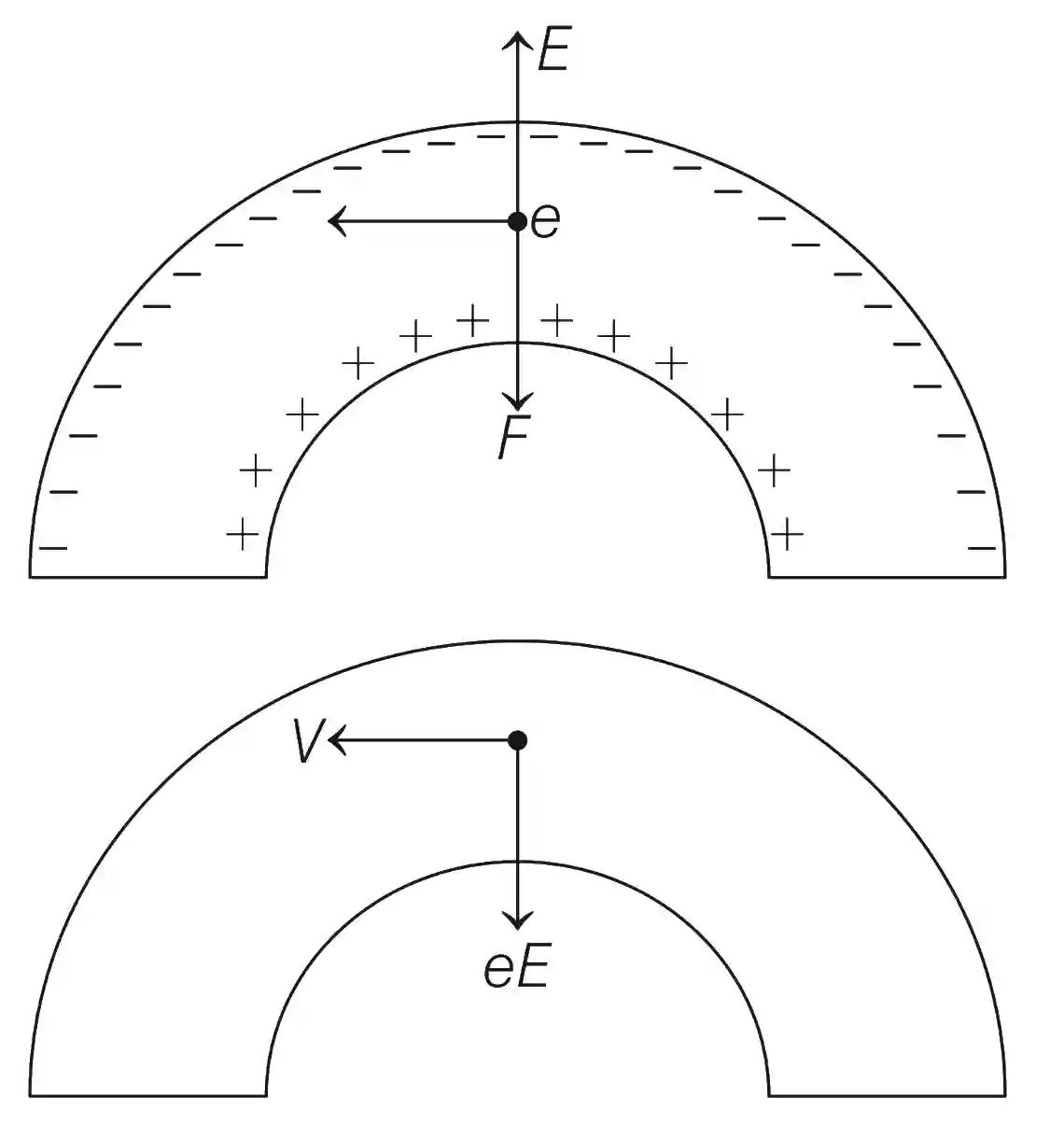
eE=mv2reE = {{m{v^2}} \over r}

I=neAVdI = neA{V_d}

V0tdrρπr=ne(drt)V{{{V_0}tdr} \over {\rho \pi r}} = ne(drt)V

⇒V=V0ρπner\Rightarrow V = \sqrt {{{{V_0}} \over {\rho \pi ner}}}

∴\therefore E=merV02t2ρ2π2n2e2r2E = {m \over {er}}{{V_0^2{t^2}} \over {{\rho ^2}{\pi ^2}{n^2}{e^2}{r^2}}}

⇒E=mV02e3r2ρ2π2n2\Rightarrow E = {{mV_0^2} \over {{e^3}{r^2}{\rho ^2}{\pi ^2}{n^2}}}

dV=−Edr⇒dV=−Kr3drdV = - Edr \Rightarrow dV = - {K \over {{r^3}}}dr

V=K∫R1R2r−3drV = K\int\limits_{{R^1}}^{{R_2}} {{r^{ - 3}}dr}

ΔV=mV02e3ρ2π2n2(1r12−1r22)\Delta V = {{mV_0^2} \over {{e^3}{\rho ^2}{\pi ^2}{n^2}}}\left( {{1 \over {r_1^2}} - {1 \over {r_2^2}}} \right)

ΔV∝V02\Delta V \propto V_0^2

⇒\Rightarrow Δ\Delta V ∝\propto I2 ( As I∝V0I \propto {V_0} )

Related Learning Resources & Exam Preparation