Verified Solution • 2025–26 Session moderate

QJEEAdv19Ph3ad0: JEE Advanced 2019 Physics - Class 12 JEEAdv19Ph3ad0 Solution: A thin convex lens is made of two materials with refractive…

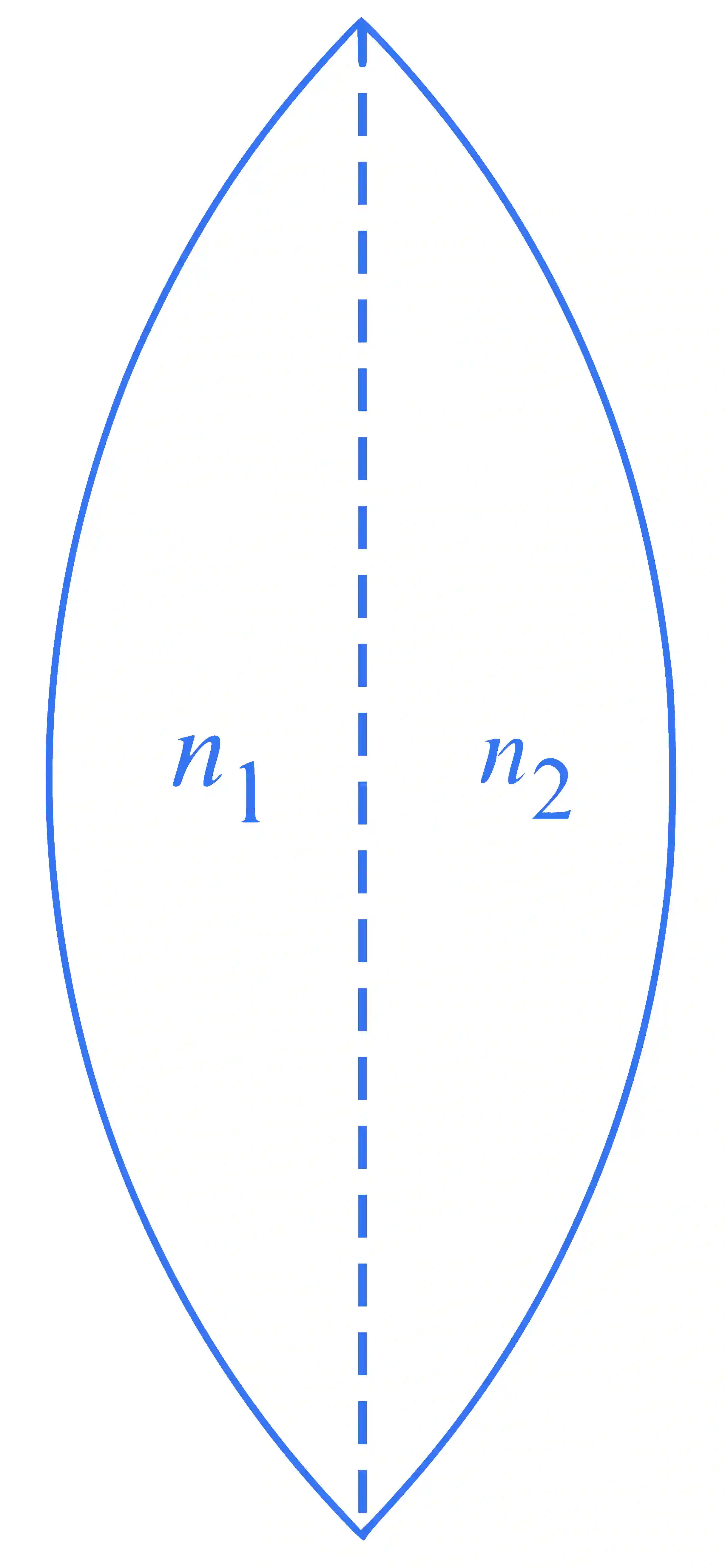
A thin convex lens is made of two materials with refractive indices n1 and n2, as shown in the figure. The radius of curvature of the left and right spherical surfaces are equal. f is the focal length of the lens when n1 = n2 = n. The focal length is f + Δ\Delta f when n1 = n and n2 = n + Δ\Delta n.

Assuming Δ\Delta n << (n - 1) and 1 < n < 2, the correct statement(s) is/are

JEE Advanced 2019 Paper 1 Offline Physics - Geometrical Optics Question 47 English

Multiple Choice Options

  • A If Δnn<0{{\Delta n} \over n} < 0 then Δff{{\Delta f} \over f} > 0
  • B For n = 1.5, Δ\Delta n = 10-3 and f = 20 cm, the value of ∣Δf∣\left| {\Delta f} \right| will be 0.02 cm (round off to 2nd decimal place).
  • C ∣Δff∣<∣Δnn∣\left| {{{\Delta f} \over f}} \right| < \left| {{{\Delta n} \over n}} \right|
  • D The relation between Δff{{{\Delta f} \over f}} and Δnn{{{\Delta n} \over n}} remains unchanged if both the convex surfaces are replaced by concave surfaces of the same radius of curvature.

Step-by-Step Verified Solution

Given, thin convex lens made of two materials.

Radius of curvature of left spherical surface == radius of curvature of right spherical surface

When n1=n2=nn_1=n_2=n , focal length =f=f

When n1=nn_1=n and n2=n+Δnn_2=n+\Delta n , focal length =f+Δf=f+\Delta f

Here, Δn≪(n−1)\Delta n \ll(n-1) and 1&lt; n &lt; 2

Now, when n1=n2=nn_1=n_2=n , from lens maker's formula

1famp;=(n−1)(1R1−1R2)=(n−1)(1R−1(−R))⇒1famp;=(n−1)(2R)........(1)\begin{aligned}\frac{1}{f} &amp; =(n-1)\left(\frac{1}{R_1}-\frac{1}{R_2}\right)=(n-1)\left(\frac{1}{R}-\frac{1}{(-R)}\right) \\\\\Rightarrow \frac{1}{f} &amp; =(n-1)\left(\frac{2}{R}\right) ........(1)\end{aligned}

When n1=nn_1=n and n2=n+Δnn_2=n+\Delta n

1f+Δf=(n−1)1R1−(n+Δn−1)1+R2\frac{1}{f+\Delta f}=(n-1) \frac{1}{R_1}-(n+\Delta n-1) \frac{1}{+R_2}

amp;=(n−1)1R−(n+Δn−1)1(−R)amp;⇒1f+Δf=1R(n−1+n+Δn−1)=1R(2n+Δn−2)amp;⇒1f+Δf=1R(2n+Δn−2)........(2)\begin{aligned}&amp; \quad=(n-1) \frac{1}{R}-(n+\Delta n-1) \frac{1}{(-R)} \\\\&amp; \Rightarrow \frac{1}{f+\Delta f}=\frac{1}{R}(n-1+n+\Delta n-1)=\frac{1}{R}(2 n+\Delta n-2) \\\\&amp; \Rightarrow \frac{1}{f+\Delta f}=\frac{1}{R}(2 n+\Delta n-2) ........(2)\end{aligned}

Subtracting Eq. (2) from Eq. (1), we get

amp;1f−1f+Δf=(n−1)(2R)−1R(2n+Δn−2)amp;=1R(2n−2−2n−Δn+2)=−ΔnRamp;⇒1f−1f+Δf=−ΔnR⇒(f+Δf)−ff(f+Δf)=−ΔnRamp;⇒Δff(f+Δf)=−ΔnR∼Δff=−ΔnRamp;⇒Δff=−ΔnR×f\begin{aligned}&amp; \frac{1}{f}-\frac{1}{f+\Delta f}=(n-1)\left(\frac{2}{R}\right)-\frac{1}{R}(2 n+\Delta n-2) \\\\&amp; =\frac{1}{R}(2 n-2-2 n-\Delta n+2)=-\frac{\Delta n}{R} \\\\&amp; \Rightarrow \frac{1}{f}-\frac{1}{f+\Delta f}=-\frac{\Delta n}{R} \Rightarrow \frac{(f+\Delta f)-f}{f(f+\Delta f)}=-\frac{\Delta n}{R} \\\\&amp; \Rightarrow \frac{\Delta f}{f(f+\Delta f)}=-\frac{\Delta n}{R} \sim \frac{\Delta f}{f}=-\frac{\Delta n}{R} \\\\&amp; \Rightarrow \frac{\Delta f}{f}=-\frac{\Delta n}{R} \times f\end{aligned}

Using Eq. (1), we get f=R2(n−1)f=\frac{R}{2(n-1)}

amp;⇒Δff=−ΔnR×R2(n−1)⇒Δff=−Δn2(n−1)amp;⇒∣Δff∣=12∣Δnn−1∣amp;⇒∣Δff∣gt;∣Δnn∣\begin{aligned}&amp; \Rightarrow \frac{\Delta f}{f}=-\frac{\Delta n}{R} \times \frac{R}{2(n-1)} \Rightarrow \frac{\Delta f}{f}=-\frac{\Delta n}{2(n-1)} \\\\&amp; \Rightarrow\left|\frac{\Delta f}{f}\right|=\frac{1}{2}\left|\frac{\Delta n}{n-1}\right| \\\\&amp; \Rightarrow\left|\frac{\Delta f}{f}\right|&gt;\left|\frac{\Delta n}{n}\right|\end{aligned}

Hence, option (C) is incorrect.

Now, for n=1.5,Δn=10−3n=1.5, \Delta n=10^{-3} and f=20 cmf=20 \mathrm{~cm} . Using relation Δff(f+Δf)=−ΔnR\frac{\Delta f}{f(f+\Delta f)}=-\frac{\Delta n}{R} and Eq. (1), we get

amp;Δff(f+Δf)=−Δn2(n−1)f⇒Δff+Δf=−Δn2n−2amp;⇒Δf(2n−2)=−Δn(f+Δf)amp;⇒Δf(2n−2)=−Δnf−ΔnΔfamp;⇒Δf(2n−2+Δn)=−Δnfamp;⇒Δf=−Δn×f2n−2+Δnamp;⇒∣Δf∣=Δn+f2n−2+Δn\begin{aligned}&amp; \frac{\Delta f}{f(f+\Delta f)}=-\frac{\Delta n}{2(n-1) f} \Rightarrow \frac{\Delta f}{f+\Delta f}=-\frac{\Delta n}{2 n-2} \\\\&amp; \Rightarrow \Delta f(2 n-2)=-\Delta n(f+\Delta f) \\\\&amp; \Rightarrow \Delta f(2 n-2)=-\Delta n f-\Delta n \Delta f \\\\&amp; \Rightarrow \Delta f(2 n-2+\Delta n)=-\Delta n f \\\\&amp; \Rightarrow \Delta f=\frac{-\Delta n \times f}{2 n-2+\Delta n} \\\\&amp; \Rightarrow|\Delta f|=\frac{\Delta n+f}{2 n-2+\Delta n}\end{aligned}

Substituting all values, we get

∣Δf∣=10−3×202×1.5−2+10−3=0.02 cm|\Delta f|=\frac{10^{-3} \times 20}{2 \times 1.5-2+10^{-3}}=0.02 \mathrm{~cm}

Hence, option (B) is correct.

Since Δff=−Δn2(n−1)\frac{\Delta f}{f}=-\frac{\Delta n}{2(n-1)} , so if \frac{\Delta n}{n}&lt;0 then \frac{\Delta f}{f}&gt;0 .

Hence, option (A)(\mathrm{A}) is correct.

Since the relation between Δff\frac{\Delta f}{f} and Δnn\frac{\Delta n}{n} is independent of radius of curvature so the relation remains unchanged only the sign of focal length changes.

Hence, option (D) is correct.

Related Learning Resources & Exam Preparation