Verified Solution • 2025–26 Session moderate

QJEEAdv19Ph14ef: JEE Advanced 2019 Physics - Class 12 JEEAdv19Ph14ef Solution: In a radioactive sample, nuclei either decay into stable nuclei …

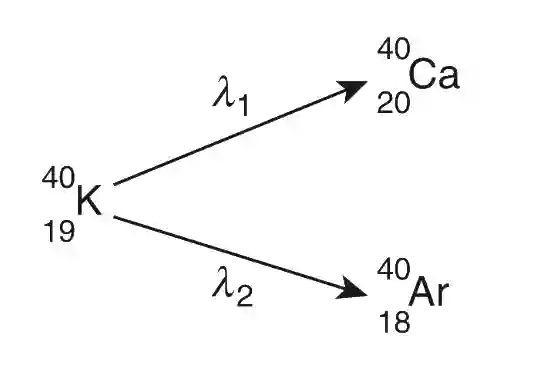
In a radioactive sample, 1940K{}_{19}^{40}K nuclei either decay into stable 2040Ca{}_{20}^{40}Ca nuclei with decay constant 4.5 ×\times 10-10 per year or into stable 1840Ar{}_{18}^{40}Ar nuclei with decay constant 0.5 ×\times 10-10 per year. Given that in this sample all the stable 2040Ca{}_{20}^{40}Ca and 1840Ar{}_{18}^{40}Ar nuclei are produced by the 1940K{}_{19}^{40}K nuclei only. In time t ×\times 109 years, if the ratio of the sum of stable 2040Ca{}_{20}^{40}Ca and 1840Ar{}_{18}^{40}Ar nuclei to the radioactive 1940K{}_{19}^{40}K nuclei is 99, the value of t will be

[Given : In 10 = 2.3]

Multiple Choice Options

  • A 9.2
  • B 1.15
  • C 4.6
  • D 2.3

Step-by-Step Verified Solution

JEE Advanced 2019 Paper 1 Offline Physics - Atoms and Nuclei Question 44 English Explanation

at t = 0 dissipated energy,

dNdt=−(λ1+λ2)×N{{dN} \over {dt}} = - ({\lambda _1} + {\lambda _2}) \times N

⇒\Rightarrow dNN=−(λ1+λ2)dt{{dN} \over N} = - ({\lambda _1} + {\lambda _2})dt

Integration on both sides, we get

log⁡e(NN0)=−(λ1+λ2)t{\log _e}\left( {{N \over {{N_0}}}} \right) = - ({\lambda _1} + {\lambda _2})t

2.3×log⁡10(N0N0/100)=(5×10−10)t2.3 \times {\log _{10}}\left( {{{{N_0}} \over {{N_0}/100}}} \right) = (5 \times {10^{ - 10}})t

2.303×25×10−10=t{{2.303 \times 2} \over {5 \times {{10}^{ - 10}}}} = t

2.303×0.4×1010=t2.303 \times 0.4 \times {10^{10}} = t

⇒t=9.2×10⁹Yr\Rightarrow t = 9.2 \times {10^9}Yr

Related Learning Resources & Exam Preparation