Verified Solution • 2025–26 Session moderate

QJEEAdv19Ph0a09: JEE Advanced 2019 Physics - Class 12 JEEAdv19Ph0a09 Solution: A conducting wire of parabolic shape, initially y = x 2 , is…

A conducting wire of parabolic shape, initially y = x2, is moving with velocity v=v0i^v = {v_0}\widehat i in a non-uniform magnetic field B=B0(1+(yL)β)k^B = {B_0}\left( {1 + {{\left( {{y \over L}} \right)}^\beta }} \right)\widehat k , as shown in figure. If V0, B0, L and β\beta are positive constants and Δ\Delta ϕ\phi is the potential difference developed between the ends of the wire, then the correct statement(s) is/are
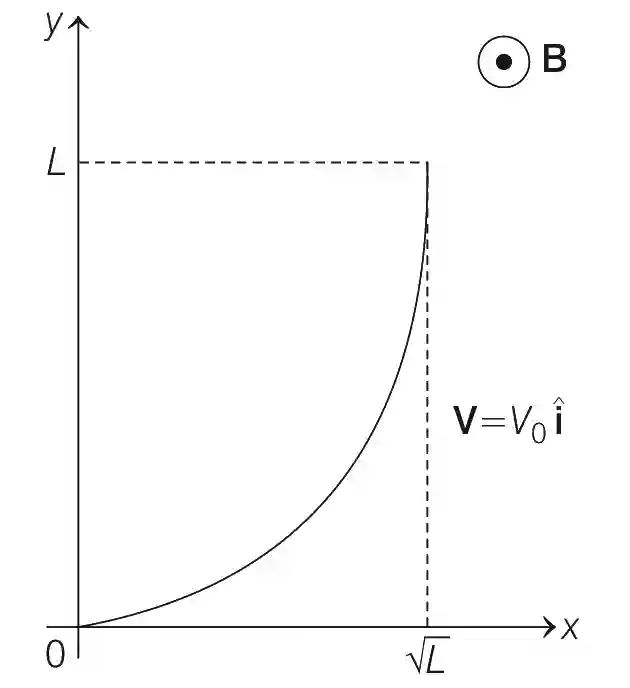
JEE Advanced 2019 Paper 1 Offline Physics - Electromagnetic Induction Question 14 English

Multiple Choice Options

  • A ∣Δϕ∣=43B0V0L\left| {\Delta \phi } \right| = {4 \over 3}{B_0}{V_0}L for β\beta = 2
  • B ∣Δϕ∣\left| {\Delta \phi } \right| remains the same if the parabolic wire is replaced by a straight wire, y =x initially, of length 2L\sqrt 2 L
  • C ∣Δϕ∣\left| {\Delta \phi } \right| = 12B0V0L{1 \over 2}{B_0}{V_0}L for β\beta = 0
  • D ∣Δϕ∣\left| {\Delta \phi } \right| is proportional to the length of the wire projected on the y-axis.

Step-by-Step Verified Solution
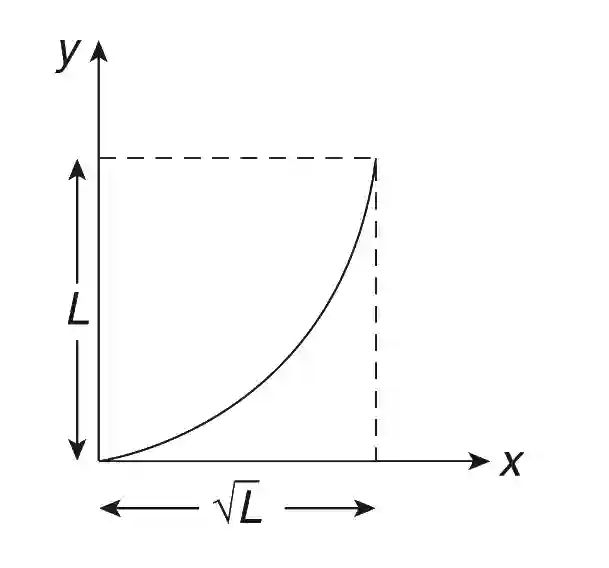
JEE Advanced 2019 Paper 1 Offline Physics - Electromagnetic Induction Question 14 English Explanation

Motional emf across the length dy is,

dε=BV0 dy=B0[1+(yL)β]V0dyd\varepsilon = B{V_0}\,dy = {B_0}\left[ {1 + {{\left( {{y \over L}} \right)}^\beta }} \right]{V_0}dy

∴\therefore ε=∫0LB0(1+(yL)β)V0dy\varepsilon = \int\limits_0^L {{B_0}} \left( {1 + {{\left( {{y \over L}} \right)}^\beta }} \right){V_0}dy

=B0V0[1+1β+1]= {B_0}{V_0}\left[ {1 + {1 \over {\beta + 1}}} \right]

emf in loop is proportional to L for given value of β\beta ,

β=0, ε=2B0V0L\beta = 0,\,\varepsilon = 2{B_0}{V_0}L

β=2, ε=B0V0L[1+13]=43B0V0L\beta = 2,\,\varepsilon = {B_0}{V_0}L\left[ {1 + {1 \over 3}} \right] = {4 \over 3}{B_0}{V_0}L

The length of projection of the wire Y = X of length 2L\sqrt 2 L on the y-axis is thus, the answer remain unchanged.

Therefore, correct options are (a), (b) and (d)

Related Learning Resources & Exam Preparation