QJEEAdv19Ph030e: JEE Advanced 2019 Physics - Class 11 JEEAdv19Ph030e Solution: A block of mass 2M is attached to a massless spring with…
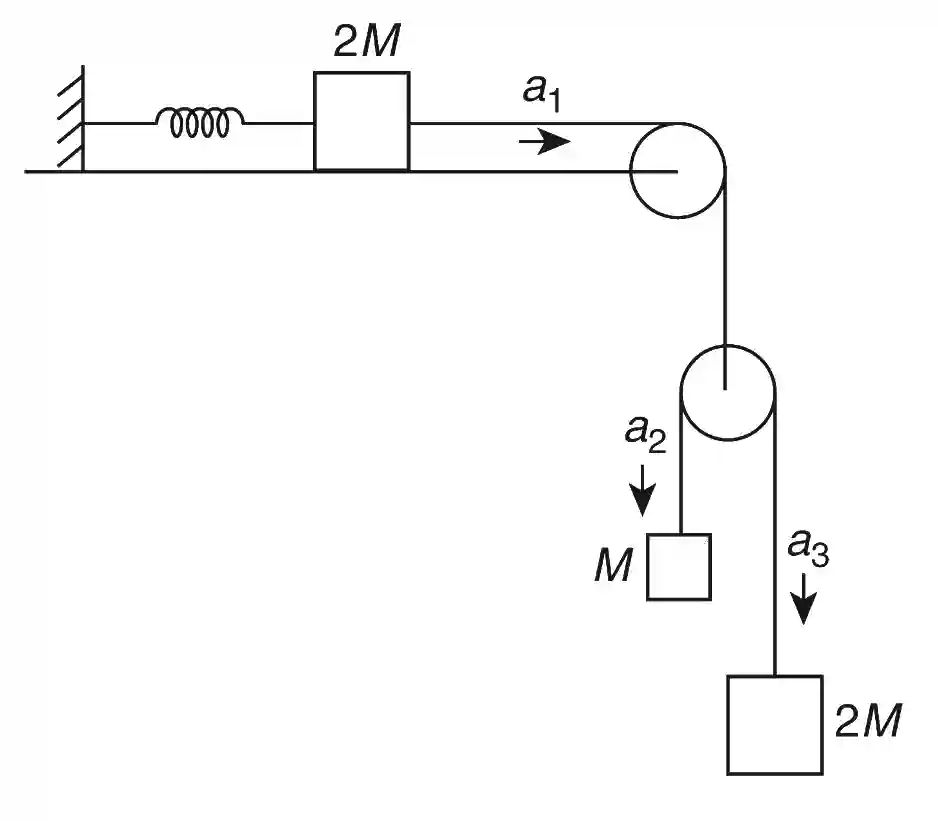
A block of mass 2M is attached to a massless spring with spring-constant k.This block is connected to two other blocks of masses M and 2M using two massless pulleys and strings. The accelerations of the blocks are a1, a2 and a3 as shown in the figure. The system is released from rest with the spring in its unstretched state. The maximum extension of the spring is x0. Which of the following option(s) is/are correct? [g is the acceleration due to gravity. Neglect friction]
Multiple Choice Options
Aa2−a1=a1−a3
BAt an extension of 4x0 of the spring, the magnitude of acceleration of the block connected to the spring is 103g .
Cx0=k4Mg
DWhen spring achieves an extension of 2x0 for the first time, the speed of the block connected to the spring is 3g5kM
Step-by-Step Verified Solution
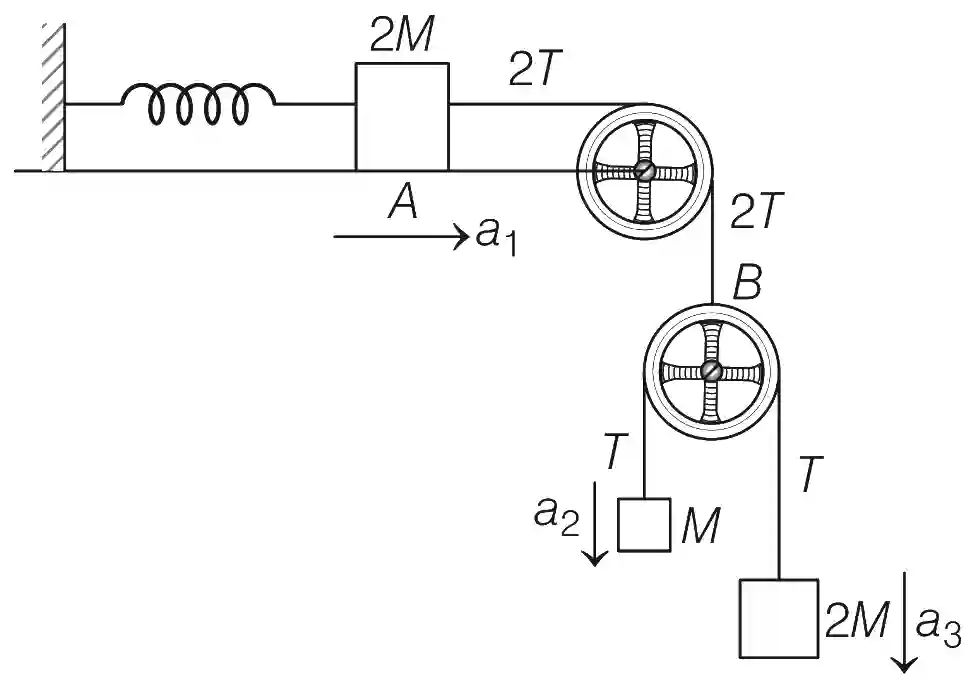
In the frame of pulley B,
the hanging masses have accelerations :
M→(a2−a1)
2M→(a3−a1) : downward.
∴(a2−a1) = (−a3−a1) [constant]
Assuming that the extension of the spring is x
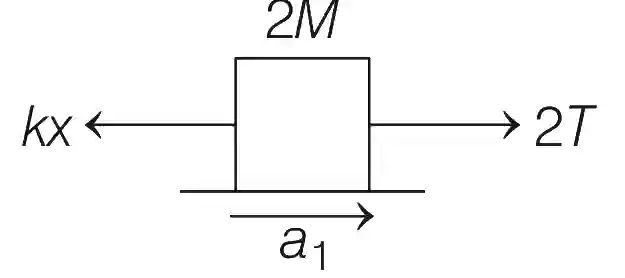
We consider the FBD of A :
2M.dt2d2x=2T−kx
where, a1≡dt2d2x ....(i)
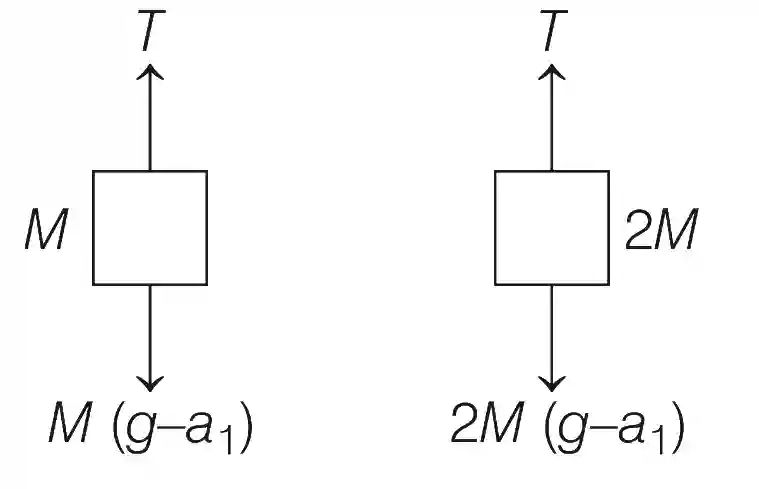
and the FBD of the rest of the system in the frame of pulley B :
Upward acceleration of block M w.r.t. the pulley B = Downward acceleration of block 2M w.r.t. the pulley.
MT−M(g−a1)=2M2M(g−a1)−T
⇒T=34M(g−a1) .....(ii)
Substituting in Eq. (i), we get
2M.a1=38M(g−a1)−kx
or 314Ma1=38Mg−kx ....(iii)
This is equation of SHM
Maximum extension = 2 × amplitude
i.e., x0=2×3k8Mg
Amplitude = 2x0=3k3Mg and ω=14M3k
At 4x0, acceleration is easily found from Eq. (iii),