Verified Solution • 2025–26 Session moderate

QJEEAdv19Ma12a1: JEE Advanced 2019 Mathematics - Class 11 JEEAdv19Ma12a1 Solution: In a non-right-angled triangle PQR, let p, q, r denote the…

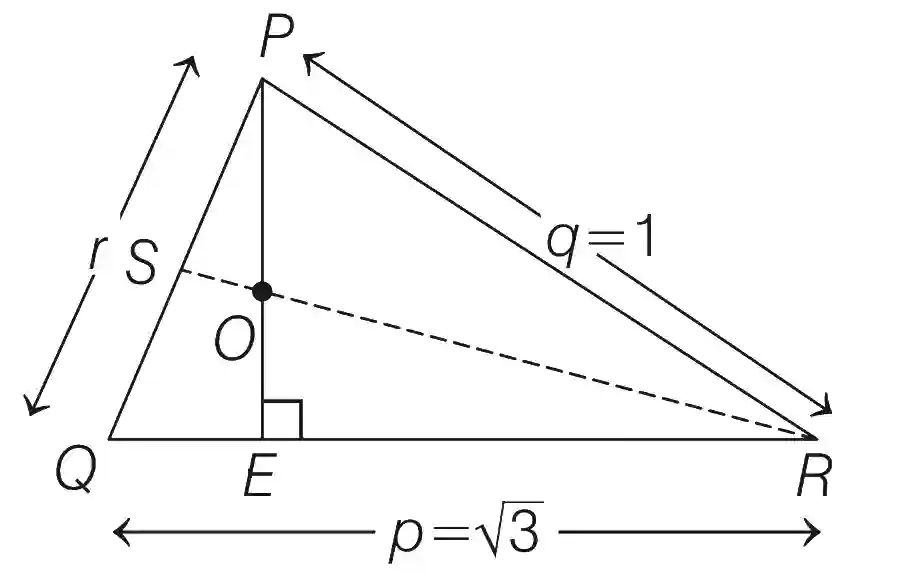
In a non-right-angled triangle Δ\Delta PQR, let p, q, r denote the lengths of the sides opposite to the angles At P, Q, R respectively. The median from R meets the side PQ at S, the perpendicular from P meets the side QR at E, and RS and PE intersect at O. If p = 3{\sqrt 3 } , q = 1, and the radius of the circumcircle of the Δ\Delta PQR equals 1, then which of the following options is/are correct?

Multiple Choice Options

  • A Length of OE = 16{1 \over 6}
  • B Length of RS = 72{{\sqrt 7 } \over 2}
  • C Area of Δ\Delta SOE = 312{{\sqrt 3 } \over {12}}
  • D Radius of incircle of Δ\Delta PQR = 32{{\sqrt 3 } \over {2}} ( 2−3{2 - \sqrt 3 } )

Step-by-Step Verified Solution

Let a non-right angled Δ\Delta PQR.

Now, by sine rule

JEE Advanced 2019 Paper 1 Offline Mathematics - Properties of Triangle Question 6 English Explanation

Psin⁡P=qsin⁡Q=rsin⁡R=2×{P \over {\sin P}} = {q \over {\sin Q}} = {r \over {\sin R}} = 2 \times circumradius

⇒3sin⁡P=1sin⁡Q=rsin⁡R=2×1\Rightarrow {{\sqrt 3 } \over {\sin P}} = {1 \over {\sin Q}} = {r \over {\sin R}} = 2 \times 1

[circumradius = 1 unit]

⇒\Rightarrow sin⁡P{\sin P} = 32{{\sqrt 3 } \over 2} and sinQ = 12{1 \over 2}

⇒P=120∘\Rightarrow P = 120^\circ and ⇒Q=30∘\Rightarrow Q = 30^\circ

( ∵\because Δ\Delta PQR is non-right angled triangle)

So, R = 30 ∘^\circ

⇒\Rightarrow r = 1, so Δ\Delta PQR is an isosceles triangle. And, since RS and PE are the median of Δ\Delta PQR, so 'O' is centroid of the Δ\Delta PQR.

Now,

Option (a),

From Apollonius theorem,

2(PE2+QE2)=PQ2+PR22(P{E^2} + Q{E^2}) = P{Q^2} + P{R^2}

⇒2(PE2+34)=1+1\Rightarrow 2\left( {P{E^2} + {3 \over 4}} \right) = 1 + 1

⇒PE2=1−34⇒PE2=14\Rightarrow P{E^2} = 1 - {3 \over 4} \Rightarrow P{E^2} = {1 \over 4}

⇒PE=12\Rightarrow PE = {1 \over 2} units

and OE=13PE=16OE = {1 \over 3}PE = {1 \over 6} units

[ ∵\because O divides PE is 2 : 1]

Option (b),

Again from Apollonius theorem,

2 (PS2 + RS2) = PR2 + QR2

⇒2(14+RS2)=1+3\Rightarrow 2\left( {{1 \over 4} + R{S^2}} \right) = 1 + 3

⇒RS2=2−14⇒RS2=74\Rightarrow R{S^2} = 2 - {1 \over 4} \Rightarrow R{S^2} = {7 \over 4}

⇒RS=72\Rightarrow RS = {{\sqrt 7 } \over 2} units

Option (c),

Area of Δ\Delta SOE = 12(OE) (ST){1 \over 2}(OE)\,(ST)

= 12×16[(PS)sin60∘]{1 \over 2} \times {1 \over 6}[(PS)sin60^\circ ]

= 112×12×32{1 \over {12}} \times {1 \over 2} \times {{\sqrt 3 } \over 2}

= 348{{\sqrt 3 } \over {48}} square units

Option (d),

∵\because Inradius of

ΔPQR=Δs=12pqsin⁡R12(p+q+r)=12(2)(1)1212(3+1+1)\Delta PQR = {\Delta \over s} = {{{1 \over 2}pq\sin R} \over {{1 \over 2}(p + q + r)}} = {{{1 \over 2}(\sqrt 2 )(1){1 \over 2}} \over {{1 \over 2}(\sqrt 3 + 1 + 1)}}

=32(2−3)= {{\sqrt 3 } \over 2}(2 - \sqrt 3 ) units

Hence, options (a), (b) and (d) are correct.

Related Learning Resources & Exam Preparation