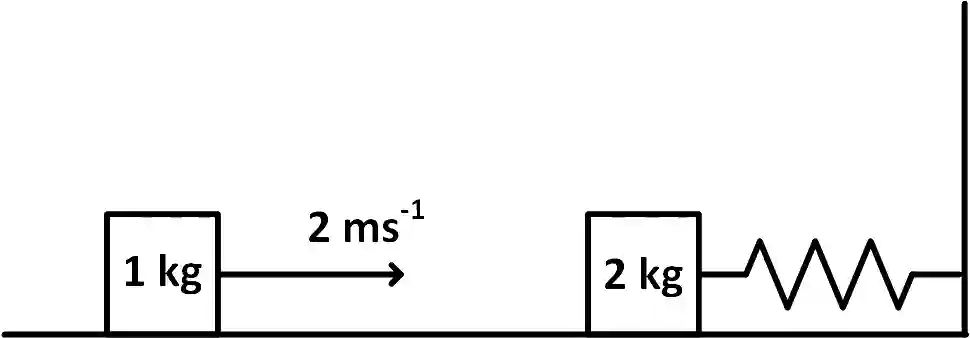
QJEEAdv18Ph9fbc: JEE Advanced 2018 Physics - Class 11 JEEAdv18Ph9fbc Solution: A spring-block system is resting on a frictionless floor as…
Step-by-Step Verified Solution
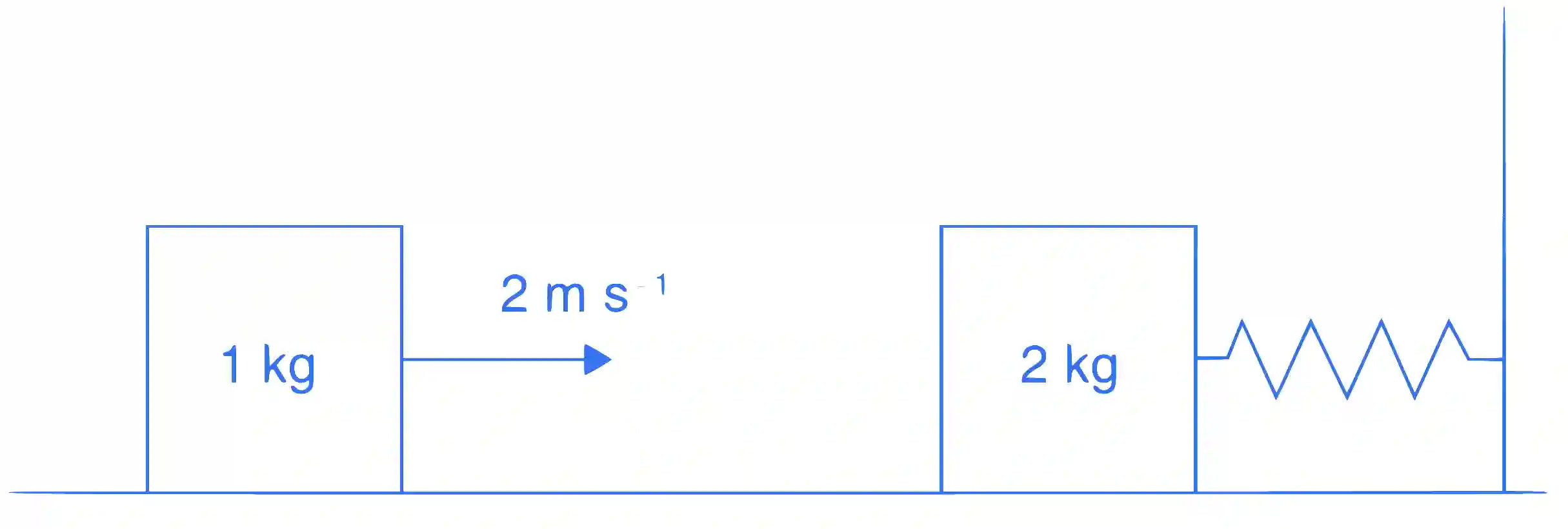
After collision the 2.0 kg block will perform simple harmonic oscillation with time period
Given m = 2.0 kg and k = 2.0 N m 1, we have
T = 2
Thus, the block returns to its original position in time
= s
That is, t = 3.14 s
Now, if v1 and v2 are velocities of 1.0 kg block and 2.0 kg block, respectively, before collision; v'1 and v'2 are velocities of 1.0 kg block and 2.0 block, respectively, after collision. So, by conservation of momentum
m1v1 + m2v2 = m1v'1 + m2v'2
Here, m1 = 1.0 kg, v1 is initial speed of 1.0 kg block = 2.0 m s 1, m2 = 2.0 kg, v2 is initial speed of 2.0 kg block = 0.0 m s 1, v'1 is final speed of 1.0 kg block after collision and v'2 is final speed of 2.0 kg block after collision. Then, 1.0 kg 2.0 m/s + 2.0 kg 0 m/s = 1.0 v'1 + 2.0 v'2
v'1 + 2v'2 = 2 ..... (1)
Also, using definition of coefficient of restitution
v'2 v'1 = (v1 v2)
Since collision is elastic, So = 1
v'2 v'1 = v1 v2
v'2 v'1 = 2 0
v'2 v'1 = 2 ...... (2)
From Eqs. (1) and (2), we get
m s 1 and m s 1
Therefore, distance between the blocks is given as
m