QJEEAdv18Ph8ba8: JEE Advanced 2018 Physics - Class 12 JEEAdv18Ph8ba8 Solution: Two infinitely long straight wires lie in the -plane along the…
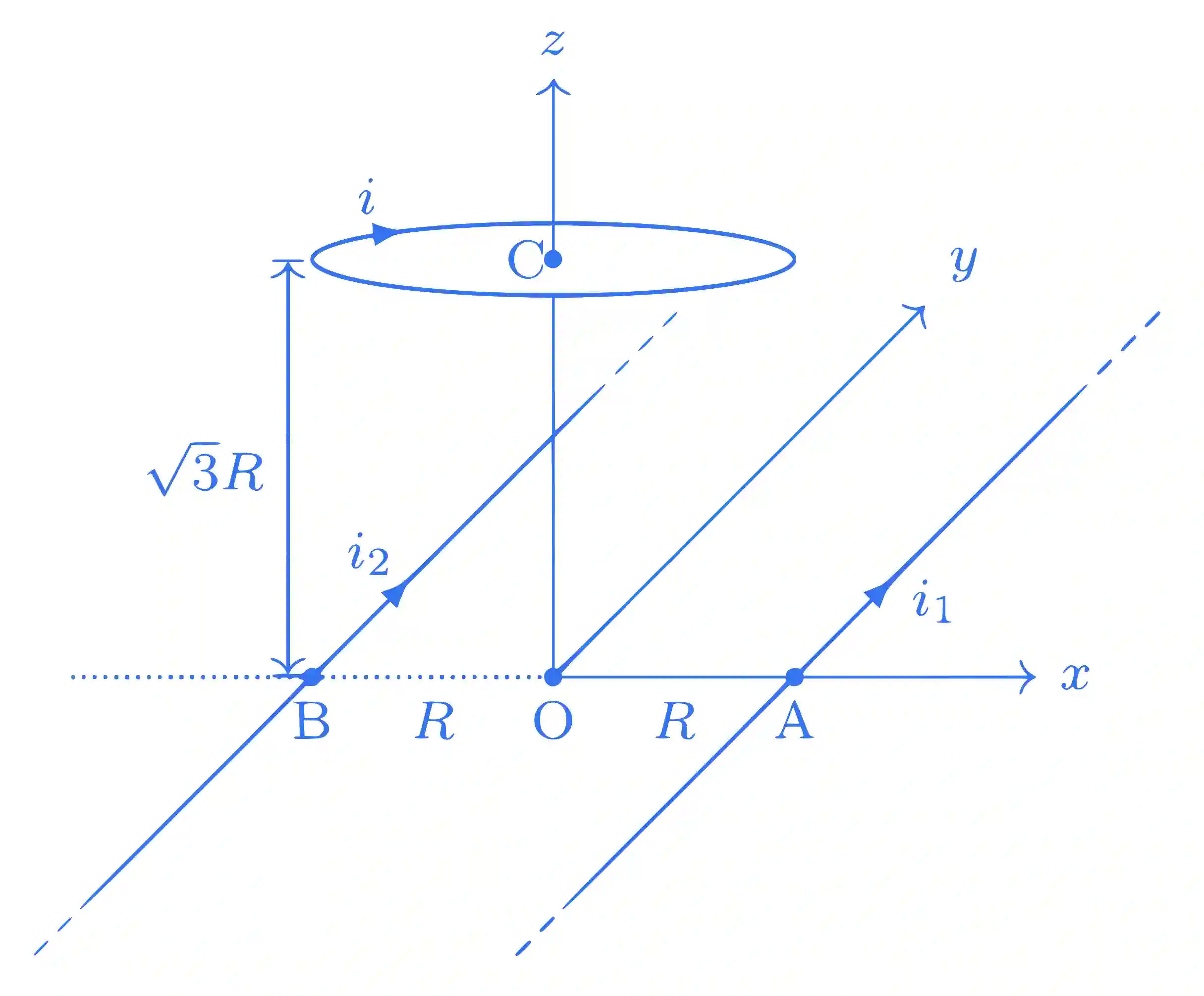
Two infinitely long straight wires lie in the xy-plane along the lines x=±R. The wire located at x=+R carries a constant current I1 and the wire located at x=−R carries a constant current I2. A circular loop of radius R is suspended with its center at (0,0,3R) and in a plane parallel to the xy-plane. This loop carries a constant current I in the clockwise direction as seen from above the loop. The current in the wire is taken to be positive if it is in the +j direction. which of the following statements regarding the magnetic field B is (are) true?
Multiple Choice Options
AIf I1=I2, then B cannot be equal to zero at the origin (0,0,0)
BIf I1>0 and I2<0, then B can be equal to zero at the origin (0,0,0)
CIf I1<0 and I2>0, then B can be equal to zero at the origin (0,0,0)
DIf I1=I2, then the z -component of the magnetic field at the center of the loop is (−2Rμ0I)
Step-by-Step Verified Solution
The magnetic field at the origin O (0, 0, 0) due to the infinitely long straight wire located at x = +R is
B1(O)=2πRμ0i1k
and due to the infinitely long straight wire located at x = −R is
B2(O)=2πRμ0i2(−k).
The magnetic field at O due to the circular loop is
B3(O)=2(R2+(3R)2)3/2μ0iR2(−k)=16Rμ0i(−k).
The resultant magnetic field at the origin (0, 0, 0) is
B3(O)=B1(O)+B2(O)+B3(O)
=16πRμ0(8(i1−i2)−πi)k.
Thus, if i1 = i2 then B1(O)=−B2(O) and B1(O)=B3(O)=0.
If i1 > 0 and i2 < 0 then both B1(O) and B2(O) are along k but B3(O) is along −k. Thus, resultant field B(O) can be zero.
If i1 < 0 and i2 > 0 then B1(O), B2(O) and B3(O) are all along −k. Thus, resultant field B(O) cannot be zero. We encourage you to relate these results with the feasible solutions of 8(i1− i2) −πi = 0 for i > 0.
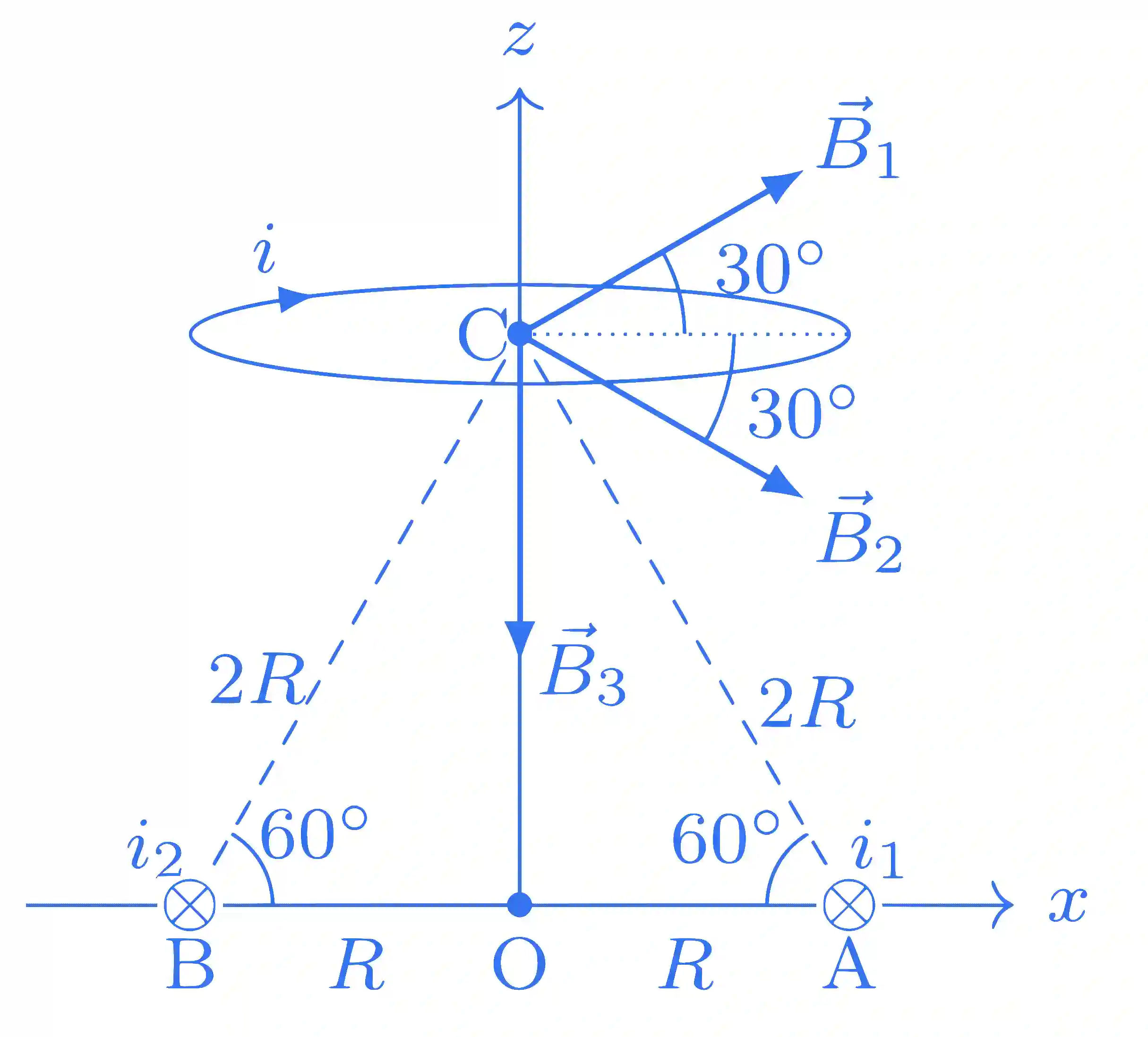
Now, let us find the magnetic field at the centre of the loop i.e., point C in the figure.
The magnetic field B1 at the point C due to the infinitely long straight wire located x = +R is perpendicular to the line AC (see figure). It lies in the x-z plane and makes an angle 30∘ with the x axis. Resolve B1 along the x and z directions to get
B1(C)=2π(2R)μ0i1(cos30∘i+sin30∘k).
Similarly, the magnetic field at C due to the infinitely long straight wire located at x = −R is
B2(C)=2π(2R)μ0i2(cos30∘i−sin30∘k).
The magnetic field at C due to the circular loop is
If i1 = i2 then magnitudes of B1(C) and B2(C) are equal and their z-components are equal in magnitude but opposite in direction. Thus, z-component of the magnetic field at C is due to the circular loop only and its value is (−2Rμ0i).