Verified Solution • 2025–26 Session moderate

QJEEAdv18Ph78cb: JEE Advanced 2018 Physics - Class 12 JEEAdv18Ph78cb Solution: In the -plane, the region has a uniform magnetic field and the…
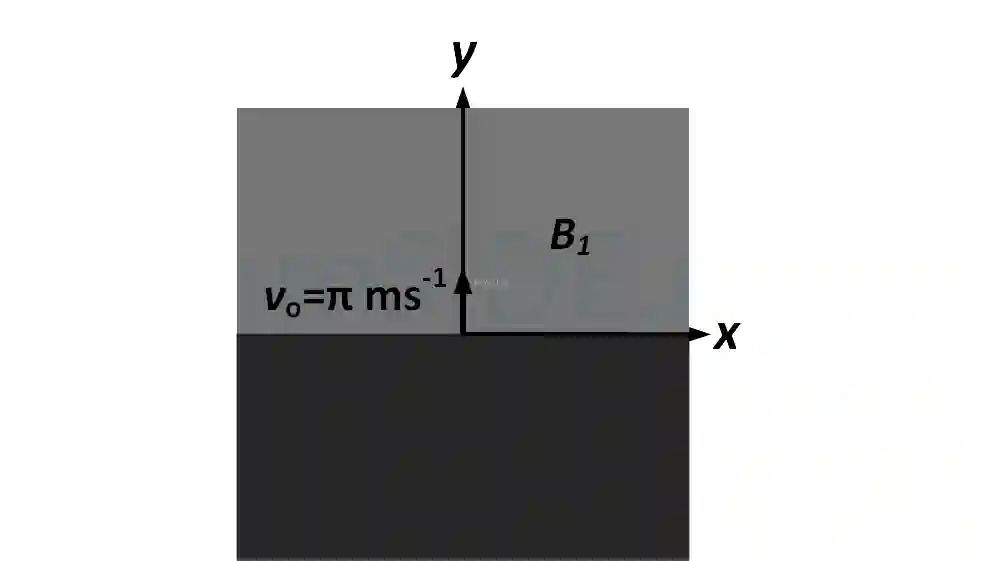
In the xyxy -plane, the region y > 0 has a uniform magnetic field B1k^{B_1}\widehat k and the region y < 0 has another uniform magnetic field B2k^.{B_2}\widehat k. A positively charged particle is projected from the origin along the positive yy -axis with speed v0=π ms−1{v_0} = \pi \,m{s^{ - 1}} at t=0,t=0, as shown in the figure. Neglect gravity in this problem. Let t=Tt=T be the time when the particle crosses the xx -axis from below for the first time. If B2=4B1,{B_2} = 4{B_1}, the average speed of the particle, in ms−1,m{s^{ - 1}}, along the xx -axis in the time interval TT is ___________.

JEE Advanced 2018 Paper 1 Offline Physics - Magnetism Question 45 English

Step-by-Step Verified Solution

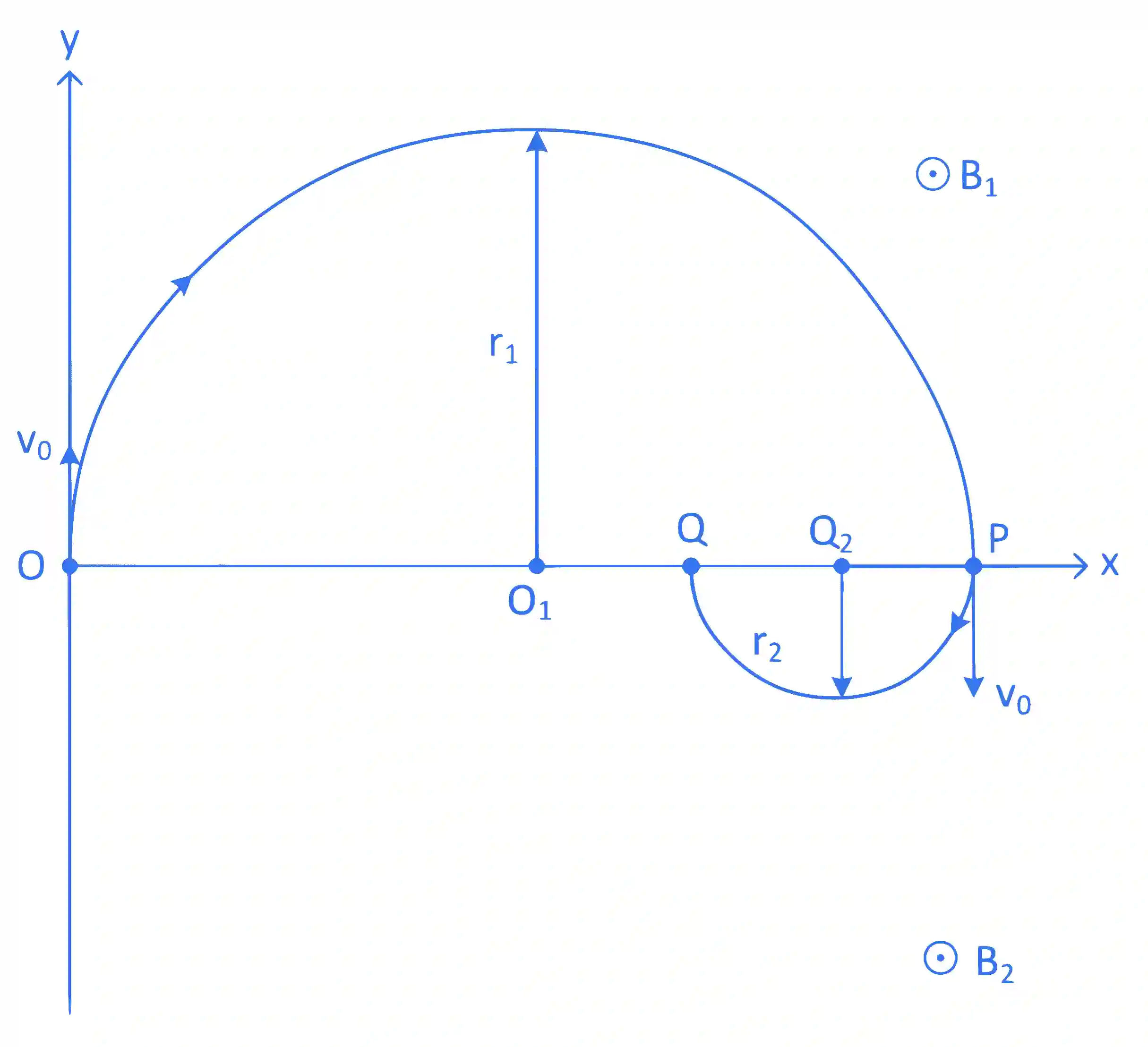
The charged particle enters the magnetic field region at O. Its velocity is perpendicular to the field direction. The magnetic force on the particle, qv0B1, provides centripetal acceleration to move on a circular path from O to P. The radius of the circular path is given by

r1=mv0/(qB1){r_1} = m{v_0}/(q{B_1}) .

JEE Advanced 2018 Paper 1 Offline Physics - Magnetism Question 45 English Explanation

The time taken by the particle to travel from O to P is

T1=πr1/v0=πm/(qB1){T_1} = \pi {r_1}/{v_0} = \pi m/(q{B_1})

At P, the particle enters the magnetic field B2 with its velocity perpendicular to the field direction. The magnetic force qv0B2 provides the centripetal acceleration to move in a circular path from P to Q. The radius of the circular path is

r2=mv0/(qB2){r_2} = m{v_0}/(q{B_2}) .

The time taken by the particle to travel from P to Q is

T2=πr2/v0=πm/(qB2){T_2} = \pi {r_2}/{v_0} = \pi m/(q{B_2}) .

AT Q, the particle crosses x-axis from below for the first time. Thus, T = T1 + T2. The average speed of the particle along the x-axis in the time interval T is given by

v=∫0TvxdtT=∫0T1vx1dt+∫T1T1+T2vx2dtT1+T2v = {{\int_0^T {{v_x}dt} } \over T} = {{\int_0^{{T_1}} {{v_{x1}}dt + \int_{{T_1}}^{{T_1} + {T_2}} {{v_{x2}}dt} } } \over {{T_1} + {T_2}}}

=2r1+2r2T1+T2=2mv0q(1B1+1B2)πmq(1B1+1B2)= {{2{r_1} + 2{r_2}} \over {{T_1} + {T_2}}} = {{{{2m{v_0}} \over q}\left( {{1 \over {{B_1}}} + {1 \over {{B_2}}}} \right)} \over {{{\pi m} \over q}\left( {{1 \over {{B_1}}} + {1 \over {{B_2}}}} \right)}}

=2v0π=2(π)π=2= {{2{v_0}} \over \pi } = {{2(\pi )} \over \pi } = 2 m/s

Related Learning Resources & Exam Preparation