QJEEAdv18Ph5d8b: JEE Advanced 2018 Physics - Class 12 JEEAdv18Ph5d8b Solution: An infinitely long thin non-conducting wire is parallel to the…
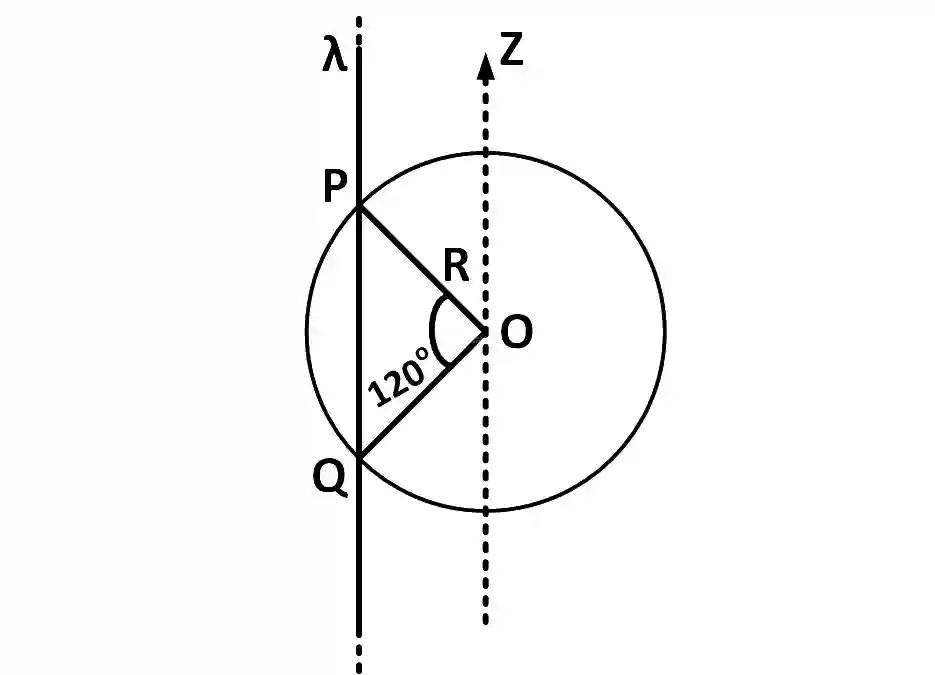
Multiple Choice Options
- A The electric flux through the shell is
- B The -component of the electric field is zero at all the points on the surface of the shell
- C The electric flux through the shell is
- D The electric field is normal to the surface of the shell at all points
Step-by-Step Verified Solution
Let Gaussian surface be same as the non-conducting spherical shell. The charge enclosed by this Gaussian surface is the charge on the line segment PQ i.e.,
,
where we used law of cosines in triangle OPQ to get . The electric flux through the shell (Gaussian surface) is given by Gauss's law
.
The electric field at a point due to the infinitely long line charge is radial i.e., perpendicular to the line PQ. The non-conducting spherical shell does not affect or alter the electric field. Thus, electric field at a point lying on the surface of the shell is perpendicular to the z-axis i.e., its z component is zero. The figure shows electric field on the surface of the shell for a positive line charge. Note that the magnitude of electric field is inversely proportional to the distance of the point from the line charge.