Verified Solution • 2025–26 Session moderate

QJEEAdv18Ph30b9: JEE Advanced 2018 Physics - Class 11 JEEAdv18Ph30b9 Solution: A planet of mass has two natural satellites with masses and The …

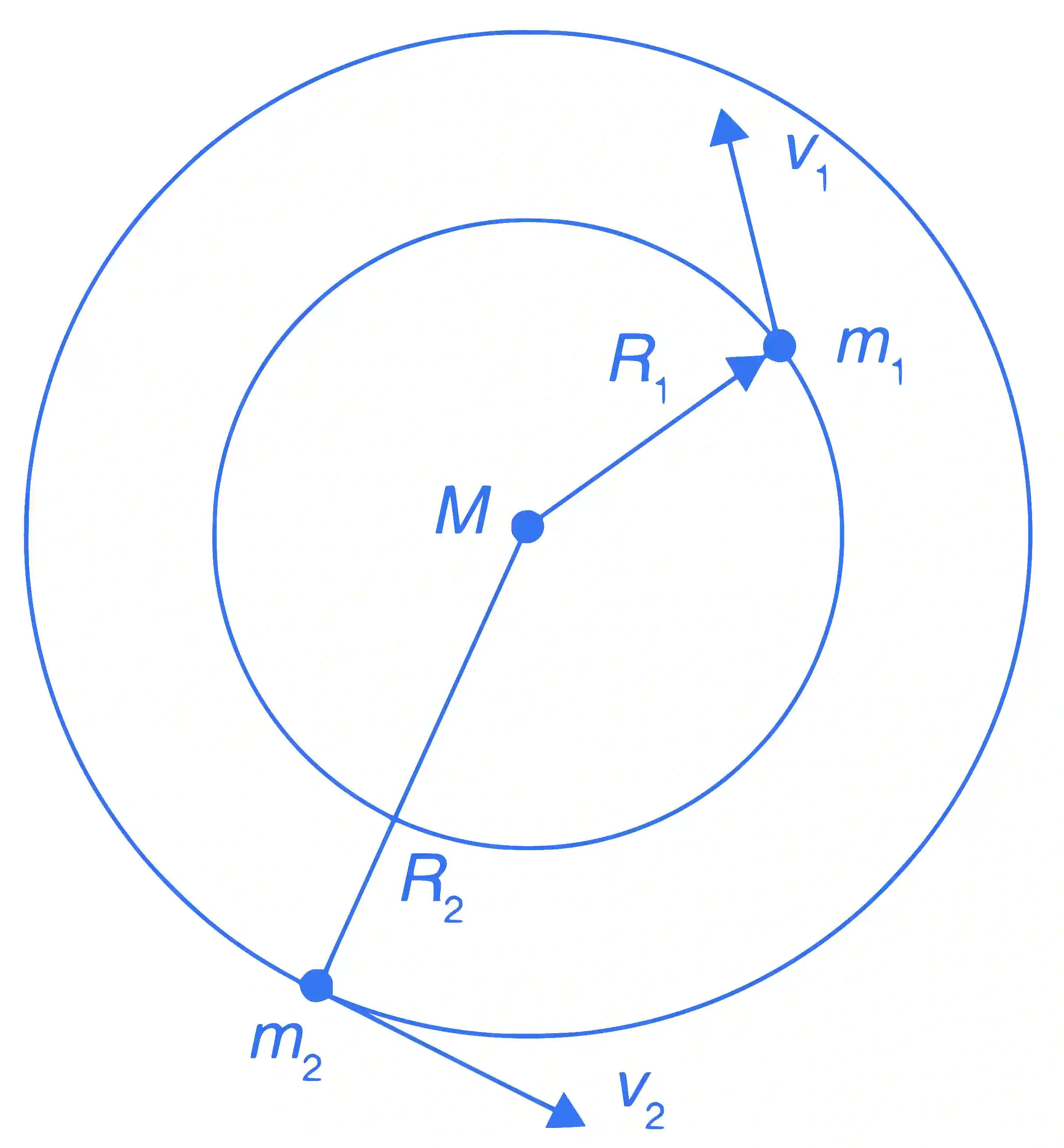
A planet of mass M,M, has two natural satellites with masses m1{m_1} and m2.{m_2}. The radii of their circular orbits are R1{R_1} and R2{R_2} respectively, Ignore the gravitational force between the satellites. Define v1,L1,K1{v_1},{L_1},{K_1} and T1{T_1} to be , respectively, the orbital speed, angular momentum, kinetic energy and time period of revolution of satellite 11 ; and v2,L2,K2,{v_2},{L_2},{K_2}, and T2{T_2} to be the corresponding quantities of satellite 2.2. Given m1/m2=2{m_1}/{m_2} = 2 and R1/R2=1/4,{R_1}/{R_2} = 1/4, match the ratios in List- I{\rm I} to the numbers in List- II.{\rm II}.

LIST - I LIST - II
P. v1/v2 1. 1/8
Q. L1/L2 2. 1
R. K1/K2 3. 2
S. T1/T2 4. 8

Multiple Choice Options

  • A P→4;Q→2;R→1;S→3P \to 4;Q \to 2;R \to 1;S \to 3
  • B P→3;Q→2;R→4;S→1P \to 3;Q \to 2;R \to 4;S \to 1
  • C P→2;Q→3;R→1;S→4P \to 2;Q \to 3;R \to 1;S \to 4
  • D P→2;Q→3;R→4;S→1P \to 2;Q \to 3;R \to 4;S \to 1

Step-by-Step Verified Solution

Given : m1m2=2{{{m_1}} \over {{m_2}}} = 2 and R1R2=14{{{R_1}} \over {{R_2}}} = {1 \over 4}

JEE Advanced 2018 Paper 2 Offline Physics - Gravitation Question 12 English Explanation

Now,

GMmR2=mv2R{{GMm} \over {{R^2}}} = {{m{v^2}} \over R}

⇒GMR=v2⇒v=GMR\Rightarrow {{GM} \over R} = {v^2} \Rightarrow v = \sqrt {{{GM} \over R}}

⇒v1v2=GMR1GMR2⇒v1v2=R2R1\Rightarrow {{{v_1}} \over {{v_2}}} = {{\sqrt {{{GM} \over {{R_1}}}} } \over {\sqrt {{{GM} \over {{R_2}}}} }} \Rightarrow {{{v_1}} \over {{v_2}}} = \sqrt {{{{R_2}} \over {{R_1}}}}

⇒v1v2=41⇒v1v2=2\Rightarrow {{{v_1}} \over {{v_2}}} = \sqrt {{4 \over 1}} \Rightarrow {{{v_1}} \over {{v_2}}} = 2

Thus, the correct mapping is P →\to 3.

Now, L = mvR

⇒L1L2=m1v1R1m2v2R2=m1m2×v1v2×R1R2\Rightarrow {{{L_1}} \over {{L_2}}} = {{{m_1}{v_1}{R_1}} \over {{m_2}{v_2}{R_2}}} = {{{m_1}} \over {{m_2}}} \times {{{v_1}} \over {{v_2}}} \times {{{R_1}} \over {{R_2}}}

⇒L1L2=2×2×14=1\Rightarrow {{{L_1}} \over {{L_2}}} = 2 \times 2 \times {1 \over 4} = 1

Thus, the correct mapping is Q →\to 2.

Now,

K=12mv2K = {1 \over 2}m{v^2}

⇒K1K2=12m1v1212m2v22=m1m2×(v1v2)2\Rightarrow {{{K_1}} \over {{K_2}}} = {{{1 \over 2}{m_1}v_1^2} \over {{1 \over 2}{m_2}v_2^2}} = {{{m_1}} \over {{m_2}}} \times {\left( {{{{v_1}} \over {{v_2}}}} \right)^2}

⇒K1K2=2×(2)2=8\Rightarrow {{{K_1}} \over {{K_2}}} = 2 \times {(2)^2} = 8

Thus, the correct mapping is R →\to R.

Now,

T=2πRvT = {{2\pi R} \over v}

⇒T1T2=2πR1v12πR2v2⇒T1T2=R1R2×v2v1\Rightarrow {{{T_1}} \over {{T_2}}} = {{{{2\pi {R_1}} \over {{v_1}}}} \over {{{2\pi {R_2}} \over {{v_2}}}}} \Rightarrow {{{T_1}} \over {{T_2}}} = {{{R_1}} \over {{R_2}}} \times {{{v_2}} \over {{v_1}}}

⇒T1T2=14×12⇒T1T2=18\Rightarrow {{{T_1}} \over {{T_2}}} = {1 \over 4} \times {1 \over 2} \Rightarrow {{{T_1}} \over {{T_2}}} = {1 \over 8}

Thus, the correct mapping is S →\to 1.

Therefore, option (B) is correct.

Related Learning Resources & Exam Preparation