Verified Solution • 2025–26 Session
moderate
QJEEAdv18Ma88cc: JEE Advanced 2018 Mathematics - Class 11 JEEAdv18Ma88cc Solution: For a non-zero complex number z, let arg(z) denote the…
For a non-zero complex number z, let arg(z) denote the principal argument with < arg(z) . Then, which of the following statement(s) is (are) FALSE?
Multiple Choice Options
- A arg( 1 i) = , where i =
- B The function f : R ( , ), defined by f(t) = arg ( 1 + it) for all t R, is continuous at all points of R, where i = .
- C For any two non-zero complex numbers z1 and z2, arg arg (z1) + arg(z2) is an integer multiple of 2 .
- D For any three given distinct complex numbers z1, z2 and z3, the locus of the point z satisfying the condition arg , lies on a straight line.
Step-by-Step Verified Solution
(a) Let z= 1 i and arg(z) =
Now,
Since, x < 0, y < 0
(b) We have, f(t) = arg( 1 + it)
This function is discontinuous at t = 0.
(c) We have,
= arg(z1) arg(z2) + 2n arg(z1) + arg(z2) = 2n
So, given expression is multiple of 2 .
(d) We have,
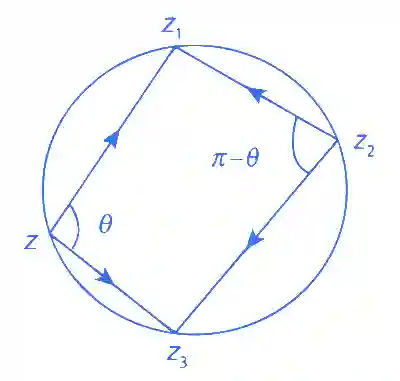
Now,
and
Therefore,
That is,
This implies that for any three given distinct complex numbers z1 , z2 and z3 , the locus of the point z satisfying the condition
, lies on a circle.
(a), (b), (d) are false statement.
Hence, option (a), (b), (d) are correct answer.
Now,
Since, x < 0, y < 0
(b) We have, f(t) = arg( 1 + it)
This function is discontinuous at t = 0.
(c) We have,
= arg(z1) arg(z2) + 2n arg(z1) + arg(z2) = 2n
So, given expression is multiple of 2 .
(d) We have,
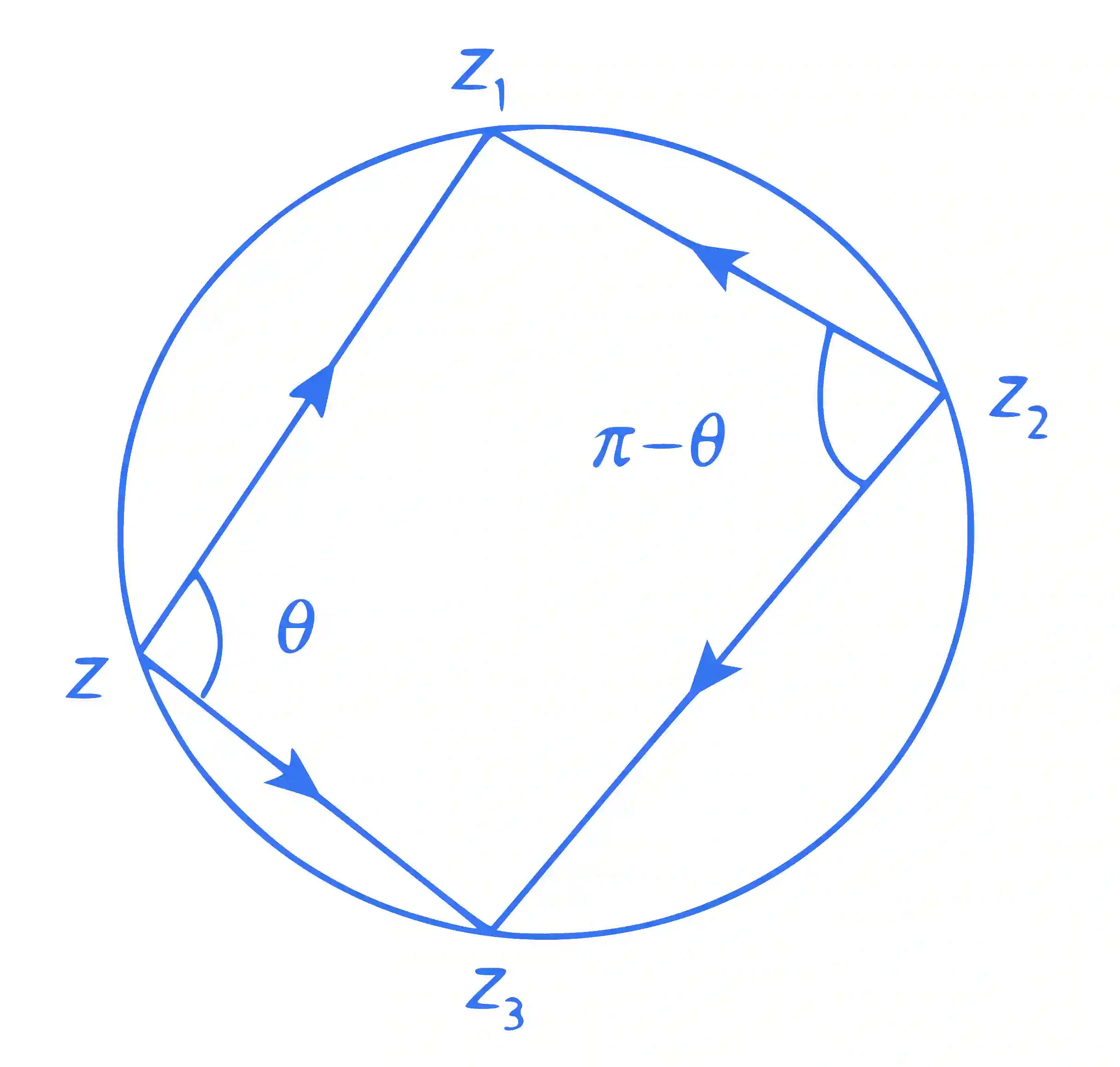
Now,
and
Therefore,
That is,
This implies that for any three given distinct complex numbers z1 , z2 and z3 , the locus of the point z satisfying the condition
, lies on a circle.
(a), (b), (d) are false statement.
Hence, option (a), (b), (d) are correct answer.